Guide · The Great Race
The Great Race: why the Chinese zodiac starts with the Rat
Updated 22 November 2026
In short
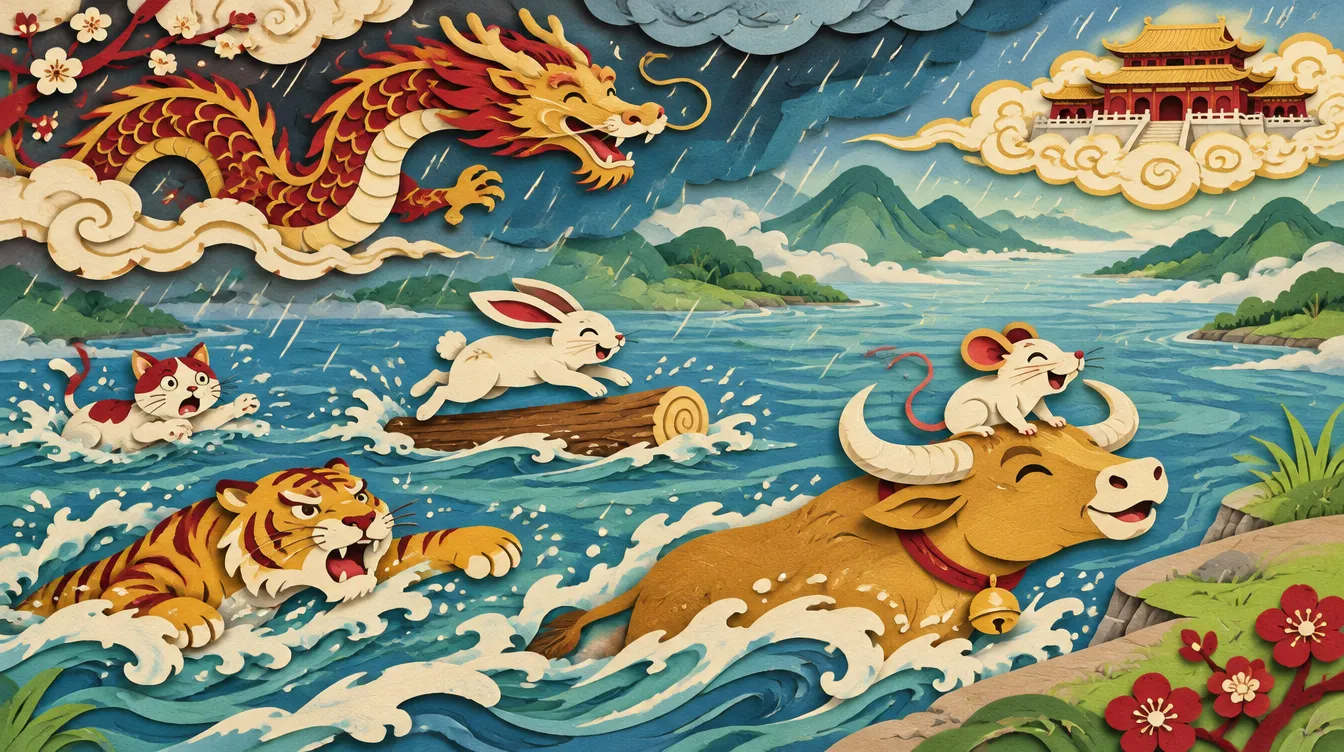
In the best-known telling, the Jade Emperor (玉皇大帝) held a race across a wide river and named the years after the first twelve animals to reach him. The clever Rat rode across on the Ox’s back and leapt ahead at the finish, which is why the Rat comes first and the Ox second. The Cat, pushed into the water or left asleep, never made the list. It is a much-loved folk tale, but the order itself is far older: it follows the twelve earthly branches, which were linked with animals by the Qin dynasty.
How does the story of the Great Race go?
The Jade Emperor, ruler of heaven in Chinese folk religion, wanted a way to measure time. He announced that the first twelve animals to cross the great river and reach his palace would each have a year named after them, in the order they arrived. On the morning of the race, the animals gathered on the bank.
The Rat and the Cat were poor swimmers, so they asked the Ox, strong and good-natured, to carry them. Halfway across, the Rat pushed the Cat into the river. As the Ox climbed onto the far bank, the Rat jumped off its head and scampered to the Jade Emperor first. The Ox, who had done all the work, came second.
The finishing order, and the story behind each place
Tellings differ in the details, but the order never changes, because it was fixed long before the story was told. A common version explains each place like this:
- Rat, 1st: rode the Ox and jumped ahead at the end.
- Ox, 2nd: the strongest swimmer, beaten by a passenger.
- Tiger, 3rd: powerful but swept downstream by the current, and arrived tired.
- Rabbit, 4th: hopped across on stepping stones and finished on a floating log.
- Dragon, 5th: could have flown across first, but stopped to make rain for people on the land, and gave the Rabbit’s log a helpful push.
- Snake, 6th: hid coiled around the Horse’s hoof, then darted out and startled it at the line.
- Horse, 7th: lost its place to the Snake by a moment.
- Goat, Monkey and Rooster, 8th to 10th: worked together on a raft, the Rooster spotting it and the Monkey and Goat clearing the weeds, and the Jade Emperor ranked them in that order.
- Dog, 11th: a fine swimmer who stopped to play and bathe in the river.
- Pig, 12th: stopped to eat, fell asleep, and only just made it.
Your year animal is one of four
Your BaZi chart has an animal for your year, month, day and hour. The free chart shows all four, with the hour worked out by true solar time.
See my four animalsWhy is there no Cat in the Chinese zodiac?
In the version above, the Rat pushes the Cat into the river, and cats have chased rats ever since. In another, the Cat asks the Rat to wake it on race day, and the Rat slips off alone. In a third, the Rat simply forgets to pass on the invitation. All three end the same way: the Cat misses out and never forgives the Rat.
A common historical explanation is plainer: the twelve animals were settled before domestic cats were widespread in China, so there was never a place for one. Scholars do not all agree on the dates, so treat this as a likely reason rather than a settled fact.
Vietnam does have a Cat. Its zodiac puts the Cat (mèo) in place of the Rabbit, and the water buffalo in place of the Ox, so 2023 was celebrated there as the Year of the Cat. The usual explanation is the sound of the branch name: 卯, the Rabbit’s branch, is read “mão” in Sino-Vietnamese, close to “mèo”. Others point to the cat’s value to rice farmers. No one knows for certain when the change happened.
Other versions of the legend
- A Buddhist telling: the Buddha invited all the animals to visit him (some say to a farewell before he left the world), and only twelve came, so he named a year after each in the order they arrived.
- A banquet instead of a race: the Jade Emperor holds a feast, and the twelve guests take their seats in order.
- A singing Rat: the Rat earns its ride by promising to sing to the Ox on the way across.
- Japan keeps the same twelve, with one change: the twelfth animal is the wild boar rather than the domestic pig.
What history actually records
The twelve earthly branches, 子 to 亥, are much older than the animals. They appear in Shang-dynasty inscriptions more than 3,000 years ago as a way of counting days. The earliest known pairing of branches with animals comes from bamboo slips found in 1975 in Tomb 11 at Shuihudi (睡虎地), Yunmeng county, Hubei, buried around 217 BCE. A section of the tomb’s 日书 (day book, a manual for choosing days) called 盗者, “The Thief”, matches each branch with an animal to describe what a thief looks like, depending on the day of a theft.
That list is close to ours but not identical: most transcriptions read the 午 and 未 animals as a deer and a horse, for example. Another Qin day book, found in 1986 at Fangmatan (放马滩) near Tianshui in Gansu, has its own variations. By the Eastern Han, in the first century CE, Wang Chong’s 论衡 (Lunheng) names the twelve animals in the pairing we use today. Some scholars note that the Qin lists served for days and omens rather than birth years, so the zodiac as a personal sign came later still.
How the order fits the branches and the hours
The race explains the order with a story, but the order is simply the sequence of the twelve branches: 子 Rat, 丑 Ox, 寅 Tiger, 卯 Rabbit, 辰 Dragon, 巳 Snake, 午 Horse, 未 Goat, 申 Monkey, 酉 Rooster, 戌 Dog, 亥 Pig. The same branches name the twelve double hours of the day, starting with the 子 hour from 23:00 to 01:00 by the sun, so each animal also rules a time of day.
Folk explanations then matched each animal to its hours. The Rat is busiest around midnight, the Rooster goes to roost at dusk in the 酉 hour from 17:00, the Dog keeps watch in the 戌 hour after dark, and the Pig sleeps most soundly in the 亥 hour before midnight. A popular explanation for the Rat’s first place counts toes: a rat has four toes on its front feet, an even, yin number, and five on its back feet, an odd, yang number, so it straddles the midnight hour when yin turns to yang. These are later explanations fitted to an existing order, which makes them no less fun.
In BaZi the hours are worked out by the sun at your birthplace, so the clock can mislead you. Our heavenly stems and earthly branches guide has the full table of branches, hours and directions, and the free chart works out your hour animal for you.
Questions
Why is the Rat first in the Chinese zodiac?
In legend, it rode across the river on the Ox and jumped ahead at the finish. Historically, the Rat belongs to 子, the first of the twelve earthly branches.
Who organised the Great Race?
Most versions say the Jade Emperor. A Buddhist version has the Buddha calling the animals together instead.
Is there a Year of the Cat?
In Vietnam, yes: the Cat takes the Rabbit’s place, so Rabbit years such as 2023 are Cat years there. The Chinese zodiac has no Cat.
How old is the Chinese zodiac?
Branch-and-animal lists appear on Qin bamboo slips buried around 217 BCE, and the modern set is recorded in the Eastern Han Lunheng in the first century CE.
Does the race order mean the Rat is the best sign?
No. The order is the sequence of the branches. No sign ranks above another; each has its own strengths.
For reflection and entertainment.