Guide · Twelve life stages
The twelve life stages (十二长生): from birth to rest
Updated 22 November 2026
In short
The twelve life stages (十二长生) describe a stem’s strength on each of the twelve branches as a life cycle: birth, bathing, capping, taking office, peak, decline, ailing, stillness, storage, cutting off, conception and nurturing. Our engine follows the common convention that yang stems move forward through the branches and yin stems move backward (阳顺阴逆), with 戊 and 己 following 丙 and 丁. The names are metaphors for rising and falling energy; 病 and 死 never mean illness or death.
What are the twelve life stages?
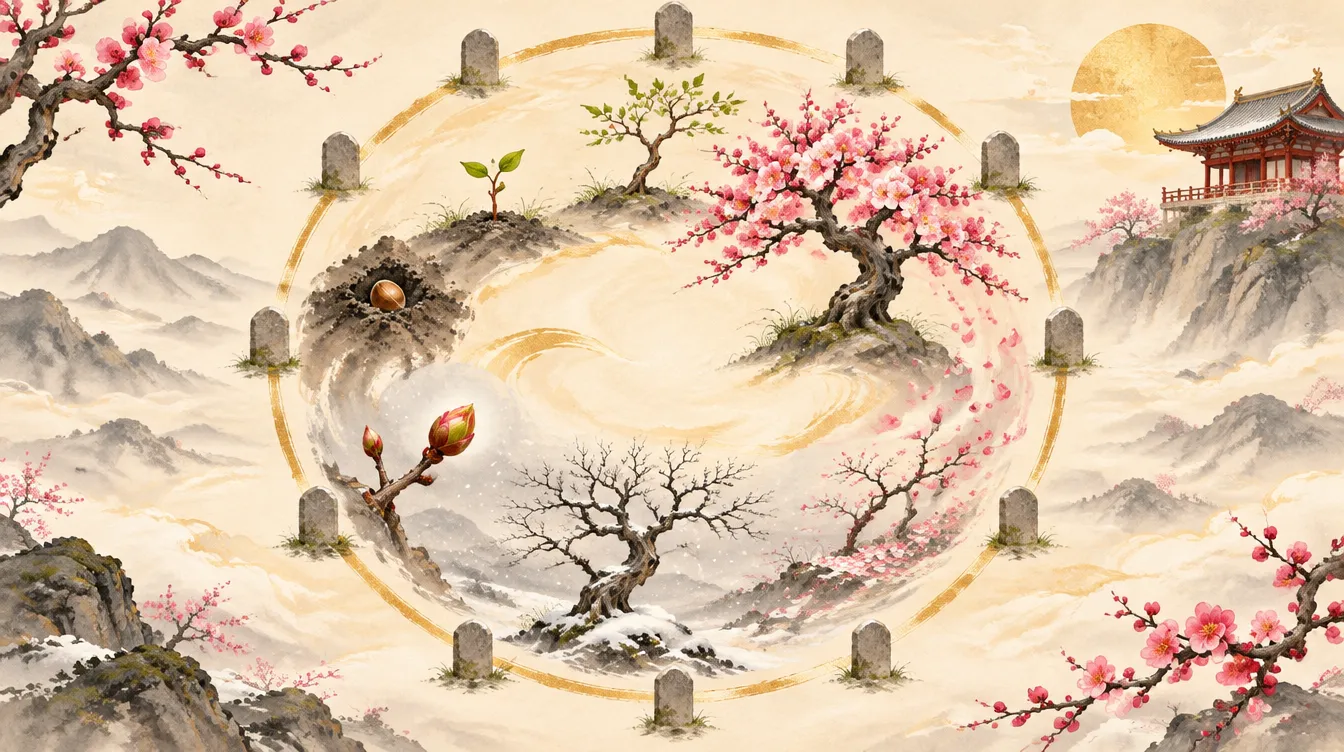
Each heavenly stem grows stronger in some months and quieter in others. Classical writers pictured that rise and fall as the life of a person, passing through twelve stages, one for each earthly branch. A stem is “born” on one branch, comes of age a few branches later, peaks, eases off and rests, and then a new cycle begins. The whole list is called 十二长生 after its first stage, or 十二运 (the twelve phases).
In a chart, the stage that matters most is your Day Master’s stage on each of your four branches. It gives a quick sense of where you feel at home: a branch where your Day Master stands at 临官 or 帝旺 is ground where its energy runs freely, while a branch at 绝 or 胎 is one where it is gathering itself.
The twelve stages and what their names mean
| Stage | Literal meaning | How it is read |
|---|---|---|
| 长生 | birth, long life | a fresh start with room to grow |
| 沐浴 | bathing | young and open, still finding its shape |
| 冠带 | putting on cap and belt | coming of age, learning to present itself |
| 临官 | taking office | capable and self-supporting; the same branch as 禄 |
| 帝旺 | imperial peak | full strength, sometimes too much of it |
| 衰 | easing | experienced, past the peak, steadier |
| 病 | ailing | slowing down; energy turns inward |
| 死 | stillness | quiet and settled, little outward push |
| 墓 | tomb, storehouse | stored away, kept in reserve |
| 绝 | cut off | the lowest point, a clean break before renewal |
| 胎 | conception | a new cycle forming quietly |
| 养 | nurturing | being cared for, preparing to be born again |
Find your Day Master first
Your free BaZi chart shows your Day Master and four branches, so you can find each stage in the tables above. It also shows the 禄神 and 羊刃 stars when they appear.
See my free chartYang forward, yin backward: the convention we use
Our engine’s life-stage rule starts each stem at a fixed birth branch: 甲 at 亥, 丙 and 戊 at 寅, 庚 at 巳, 壬 at 申, 乙 at 午, 丁 and 己 at 酉, 辛 at 子 and 癸 at 卯. Yang stems then count forward through the branches and yin stems count backward. 戊 and 己 Earth borrow the stages of 丙 and 丁 Fire, a rule called 火土同宫 (Fire and Earth share a palace). This matches the 地势 values of the lunar-typescript calendar library, and our tests check the two against each other on hundreds of dates.
Other schools exist, and you will meet them in books and apps. Some give yin stems the same stages as their yang partner, so 乙 is born at 亥 like 甲 (阴阳同生同死). Some place Earth with Water instead of Fire, so 戊 is born at 申 (水土同宫). If another calculator shows a different stage for a yin or Earth Day Master, this is usually why.
For yang stems the cycle links neatly to the three-branch trines. 甲 is born at 亥, peaks at 卯 and is stored at 未, and 亥卯未 is the Wood trine. The same holds for 丙 with 寅午戌, 庚 with 巳酉丑 and 壬 with 申子辰. Two stages also have other names: 临官 is the stem’s 禄 (salary), and for a yang stem 帝旺 is its 羊刃 (blade), two of the symbolic stars our free chart can show.
Where each Day Master stands on every branch
Find your Day Master’s column, then read down to see which branch gives each stage. Both tables come straight from the engine’s rule.
Yang Day Masters (counting forward)
| Stage | 甲 Wood | 丙 Fire · 戊 Earth | 庚 Metal | 壬 Water |
|---|---|---|---|---|
| 长生 | 亥 | 寅 | 巳 | 申 |
| 沐浴 | 子 | 卯 | 午 | 酉 |
| 冠带 | 丑 | 辰 | 未 | 戌 |
| 临官 | 寅 | 巳 | 申 | 亥 |
| 帝旺 | 卯 | 午 | 酉 | 子 |
| 衰 | 辰 | 未 | 戌 | 丑 |
| 病 | 巳 | 申 | 亥 | 寅 |
| 死 | 午 | 酉 | 子 | 卯 |
| 墓 | 未 | 戌 | 丑 | 辰 |
| 绝 | 申 | 亥 | 寅 | 巳 |
| 胎 | 酉 | 子 | 卯 | 午 |
| 养 | 戌 | 丑 | 辰 | 未 |
Yin Day Masters (counting backward)
| Stage | 乙 Wood | 丁 Fire · 己 Earth | 辛 Metal | 癸 Water |
|---|---|---|---|---|
| 长生 | 午 | 酉 | 子 | 卯 |
| 沐浴 | 巳 | 申 | 亥 | 寅 |
| 冠带 | 辰 | 未 | 戌 | 丑 |
| 临官 | 卯 | 午 | 酉 | 子 |
| 帝旺 | 寅 | 巳 | 申 | 亥 |
| 衰 | 丑 | 辰 | 未 | 戌 |
| 病 | 子 | 卯 | 午 | 酉 |
| 死 | 亥 | 寅 | 巳 | 申 |
| 墓 | 戌 | 丑 | 辰 | 未 |
| 绝 | 酉 | 子 | 卯 | 午 |
| 胎 | 申 | 亥 | 寅 | 巳 |
| 养 | 未 | 戌 | 丑 | 辰 |
A worked example: a Fire Day Master at its peak
Take a sample birth: a man born at 13:40 on 18 May 1983 in Johor Bahru. True solar time is 12:38, and the pillars are 癸亥 (year), 丁巳 (month), 丙午 (day) and 甲午 (hour). The Day Master is 丙, Yang Fire, and the engine gives these stages on his four branches: 绝 on the year branch 亥, 临官 on the month branch 巳, and 帝旺 on both the day and hour branches 午.
Three of his four branches put the Day Master at taking office or at its peak, and the symbolic stars agree: the engine finds the 禄神 star on his month pillar and 羊刃 on his day and hour pillars. His strength score is 61 out of 100, strong. A reader would describe him as someone whose energy runs high in work, at home and in his own projects, and who does best with a clear outlet for it, which matches the engine’s favourable elements of Earth, Metal and Water.
The year branch is the other side. 亥 puts his Fire at 绝, its lowest point, and 亥 also clashes with his 巳 month branch. Tradition might read that as roots or family background that feel different from the life he built himself. It describes a contrast and says nothing about difficulty ahead.
Where 2027’s 未 falls for each Day Master
| Day Master | Stage on 未 |
|---|---|
| 甲 Yang Wood | 墓 storage |
| 乙 Yin Wood | 养 nurturing |
| 丙 Yang Fire | 衰 easing |
| 丁 Yin Fire | 冠带 capping |
| 戊 Yang Earth | 衰 easing |
| 己 Yin Earth | 冠带 capping |
| 庚 Yang Metal | 冠带 capping |
| 辛 Yin Metal | 衰 easing |
| 壬 Yang Water | 养 nurturing |
| 癸 Yin Water | 墓 storage |
A year’s branch can be read the same way. For 丁, 己 and 庚 Day Masters, 2027 sits at 冠带, a stage of stepping forward and being seen. For 丙, 戊 and 辛 it is 衰, a year that rewards experience over speed. For 甲 and 癸 it is 墓, storage, which suits consolidating and saving rather than spreading out, and for 乙 and 壬 it is 养, a year of preparation. Treat this as one small layer: the ten gods and branch relations of the year say far more, as our guide to reading your own year shows.
Questions
Does 死 (death) in my chart mean something bad?
No. It is a metaphor for stillness: your Day Master is quiet on that branch. It says nothing about health or lifespan.
Why does another app show a different stage for my yin Day Master?
Some schools let yin stems share the yang stem’s stages. We follow yang forward, yin backward (阳顺阴逆), as the lunar-typescript library does.
Which stage is the best?
None by itself. 帝旺 is the strongest, but a Day Master that is already strong may be better balanced by quieter stages. It depends on the whole chart.
Do the stages affect my strength score?
Not in our engine. The score uses the season, the hidden stems and the visible stems. The stages are recorded for readings as extra colour.
For reflection and entertainment.