Guide · Wedding customs
Chinese wedding customs: guo da li, the tea ceremony and the door games
Updated 22 November 2026
In short
A traditional Chinese wedding in Singapore or Malaysia unfolds over several weeks. Two to four weeks before, the groom’s side delivers betrothal gifts (过大礼), and the bride’s family returns part of them. Days before, the bridal bed is set (安床). The night before, each partner’s hair is combed by a person of good fortune (上头). On the day, the groom wins entry through the bridesmaids’ door games, and the couple serve tea to elders, the groom’s family first. Traditionally the bride then returns to visit her family (回门). Lists differ between Hokkien, Teochew, Cantonese and Hakka families, so ask your elders early.
What are the steps of a traditional Chinese wedding?
- 过大礼 (guo da li), the betrothal gifts: usually two to four weeks before the wedding, on a day chosen from the almanac.
- 安床 (an chuang), setting the bridal bed: about three days to a week before.
- 上头 (shang tou), the hair combing: the night before, at each family’s home.
- Fetching the bride and the door games: the wedding morning.
- The tea ceremony: at the groom’s home, then at the bride’s, or together at the venue.
- The banquet, with three rounds of “yam seng”, then 回门, the return visit to the bride’s family.
Few couples now do every step in full, and that is fine. The National Heritage Board, which lists Chinese weddings as part of Singapore’s intangible cultural heritage, notes how much the rituals vary between dialect groups. Choosing the dates is a separate job, covered in our 2027 wedding dates guide.
What goes into guo da li, the betrothal gifts?
The groom, usually with a female relative, brings baskets of gifts to the bride’s home. Every item stands for something: oranges for luck, dragon-and-phoenix candles for the couple, coconuts for a family line that carries on, black moss (发菜, fa cai) for prosperity. The bride’s family keeps some and sends a share back, the 回礼, often about half, with gifts of its own. Typical Singapore and Malaysian lists look like this:
| Item | Hokkien and Teochew | Cantonese and Hakka |
|---|---|---|
| Betrothal money (聘金) in a red packet | Yes | Yes |
| Pork for the bride’s mother | Canned pig trotters, or roast pork | Roast pork or a roast suckling pig |
| Wedding cakes, oranges, wine or liquor for the bride’s father | Yes | Yes |
| Sweets | Peanut and sesame candies (Teochew), rice candies (Hokkien) | Not usually |
| Dried seafood | Not usually | Yes, such as dried scallops, sea cucumber and mushrooms |
| Other symbolic items | Charcoal, sesame seeds, tea leaves, bananas (Teochew) | Suan pan zi, the abacus-bead yam dumplings (Hakka) |
| Gold jewellery | 四点金, four pieces of gold | 四点金, and dragon-and-phoenix bangles (Cantonese) |
How well do your two charts fit?
Enter both birth dates for a free compatibility check that looks at your Day Masters, day branches and the elements you each need.
Check compatibilityWhat are 安床 and 上头?
Setting the bridal bed (安床)
A few days before the wedding the new bed is made up with fresh red linen, and a tray of dried fruit and nuts is laid on it. The items are puns: 红枣 red dates (枣 zǎo, for 早, early), 花生 peanuts (生, to give birth), 桂圆 longans (桂, for 贵, honoured) and 莲子 lotus seeds (for 连子, children in succession), together 早生贵子, “may you soon have a fine child”. On the wedding day a young child, ideally a boy born in a Dragon year, is invited to roll or jump on the bed for the same blessing.
The hair combing (上头)
On the eve of the wedding, bride and groom each sit at home facing lit candles while a person of good fortune, often called a 好命人 or 全福人, someone whose parents, spouse and children are all living, combs their hair four times. Each stroke comes with a line of blessing. The first three are widely shared:
- 一梳梳到尾: the first combing, all the way to the end, for a marriage that lasts.
- 二梳白发齐眉: the second, for growing old together until your hair is white.
- 三梳儿孙满地: the third, for children and grandchildren all around.
The fourth line varies by family and dialect, so let your elders choose it. Afterwards the family often shares sweet glutinous rice balls (汤圆), for a sweet and complete union.
How do the door games (gatecrash) work?
On the wedding morning the groom and his groomsmen (兄弟) arrive to fetch the bride, and her bridesmaids (姐妹) bar the door. They set challenges, which may include sour, bitter, spicy and sweet things to taste, love questions, a dance, and a red packet, the 开门利是, to open the door. Teochew families traditionally want the bride to leave home before sunrise, so their gatecrash can start very early. As she leaves, the bride is sheltered under a red umbrella, and in the car she may toss a fan out of the window to leave anything negative behind.
- Agree a time limit with the bridesmaids, so the tea ceremony and its good hour are not missed.
- Keep the games kind. Nothing dangerous, nothing that embarrasses a guest, and nothing that spoils clothes needed later.
- Let the groomsmen carry spare red packets. The amount is a family and friends’ matter; there is no fixed rate.
Who is served first at the tea ceremony?
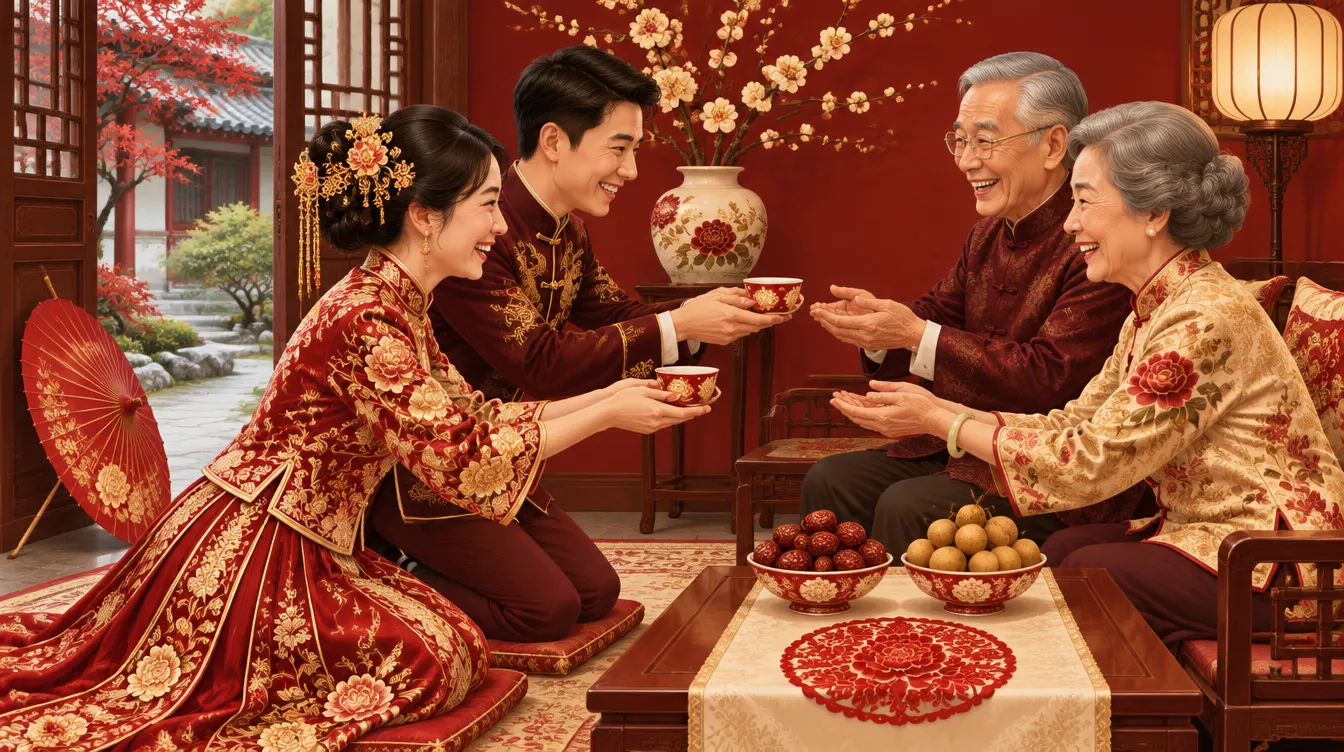
The tea ceremony is how the couple are formally welcomed into each other’s families. It is held at the groom’s home first, usually in the morning after the bride is fetched, and at the bride’s home later. Some couples combine both at the venue, still serving the groom’s family first. Elders are served by seniority, the father’s side before the mother’s:
- Grandparents, then parents (some families prefer parents first, so ask).
- Uncles and aunts, then elder siblings and elder cousins.
- Then the order flips: younger siblings, cousins, nieces and nephews serve tea to the couple, and receive a red packet in return.
Hold the cup with both hands, use each relative’s proper family title, and say “please drink tea” (请喝茶) in the language or dialect they speak most. Elders usually reply with a red packet or a piece of jewellery, and sometimes put it on the bride there and then. In Cantonese the bride’s part is fondly called 新抱茶, the new daughter-in-law’s tea.
What is 回门, the return visit?
Traditionally the bride went back to her parents’ home on the third day after the wedding, 三朝回门, with her husband and gifts. He paid respects at her family altar and her family hosted a meal, a sign that the marriage had joined two families and that she was still a daughter of her own. Today many Singapore and Malaysian couples fold it into the wedding day itself, going to the bride’s home for the second tea ceremony after the groom’s. Families who keep the third-day visit often bring a roast pig or cakes, which the bride’s family shares with relatives.
Questions
How long before the wedding is guo da li?
Usually two to four weeks before, on an auspicious day chosen from the almanac.
Who should comb the bride’s hair?
A person of good fortune: traditionally a married woman whose parents, husband and children are all living. Often it is the bride’s mother or a respected aunt.
Do Hokkien and Cantonese weddings differ?
Mainly in the details: Cantonese gifts include roast pork and dried seafood, Hokkien ones pig trotters and rice candies, and Teochew brides traditionally leave home before sunrise.
Do we have to follow every custom?
No. Most couples keep the steps that matter to their families, often the tea ceremony and the door games, and simplify the rest.
Can the tea ceremony be held at the hotel?
Yes, if both families agree. Serve the groom’s family first and keep the order of seniority.
For reflection and entertainment.