Guide · Red packets 2027
Red packet (ang pow) etiquette for 2027: who gives, how much, and how
Updated 22 November 2026
In short
At Chinese New Year, married people give red packets (红包; ang pow in Hokkien, lai see 利是 in Cantonese) to children and unmarried relatives, many working adults give one to their parents, and many employers give one to staff. Amounts are usually even, avoid the number 4, and depend on how close you are; there is no official rate. Singapore’s central bank and Bank Negara Malaysia both encourage “fit” used notes or e-ang pows instead of new notes. Give and receive with both hands, say a greeting, and open packets later in private. New Year’s Day 2027 is Saturday 6 February.
Who gives red packets to whom?
The core rule is about marriage, not age. Once you marry, you become a giver; until then, you receive, even as a working adult in your thirties. That is why a single cousin may still collect red packets from a younger married cousin. The direction is from the settled household to those who have not yet started one, and from older to younger.
- Married couples and elders give to children, nephews and nieces, and unmarried younger relatives.
- Working children often give to their parents and grandparents, married or not, as a gesture of thanks (孝敬).
- Employers often give staff a red packet on the first working day (开工利是). In Singapore that is Tuesday 9 February 2027 for most office workers.
- Many households also give a small packet to people who help them through the year, such as a domestic helper, a cleaner or the security guard.
Couples differ on one detail. In some families a married couple gives a single packet together; in others, especially some Cantonese families, each spouse gives one. If you married into a different dialect group, ask your partner what their side expects before the first visit.
How much should you put in a red packet?
There is no official rate in Singapore or Malaysia, and we have not found a survey-based figure we could stand behind for 2027, so we don’t quote one. The “rate cards” that circulate online each year are opinions. What families actually do follows a few steady principles:
- Closer means more. Parents and grandparents usually receive the most, then your own children, then nephews and nieces, then friends’ children and acquaintances.
- Be consistent within a group. Give every child of the same generation in the family the same amount, so nobody compares packets and feels left out.
- Agree a family plan with your partner and siblings, especially if you visit the same relatives.
- Set a total budget first, then divide it, and prepare a few spare packets for children you did not expect to meet.
Lucky and unlucky numbers
Amounts are usually even, because good things come in pairs (好事成双). Avoid 4, since 四 sì sounds like 死, death, and many people also avoid amounts that contain a 4, such as 14 or 40. Popular choices are 6 (六六大顺, everything going smoothly), 8 (八 sounds close to 发, prosper) and 10 (十全十美, complete and perfect). Some families put in two notes rather than one for the same reason as even amounts. Our guide to lucky and unlucky numbers goes further.
Begin 2027 with a Guanyin stick
Draw a free Guanyin fortune stick (观音灵签) with a quiet question in mind, and read what its verse says about the year ahead.
Draw a stickNew notes, fit notes and the bank queue
Crisp new notes are traditional because the new year should start fresh, but both central banks now ask people to think again. The Monetary Authority of Singapore (MAS) “strongly encourages” the public to use fit notes, which are used notes in good condition, similar to those from an ATM, or e-hong baos. In its January 2026 release MAS said over 16 million fit notes were exchanged at banks in 2025, about 40% more than the year before, and that in a 2025 survey two in three people were open to receiving them.
For Lunar New Year 2026, online pre-booking at DBS, OCBC and UOB opened on 27 January, about three weeks before the holiday, and collection began on 3 February; slots for new notes filled up within hours. Expect a similar pattern before 6 February 2027, but check the MAS and bank announcements in January rather than relying on last year’s dates. MAS also warns that banks will not send SMS messages with clickable links, so treat any “note booking” link in a text message as a scam.
In Malaysia, Bank Negara has run its Go Green campaign with the Association of Banks in Malaysia since 2013, encouraging fit banknotes and digital gifting. It notes that many new notes issued for festivals come back to the banks unused, wasting resources. New-note availability varies by bank and branch, so check your bank before you queue.
Is it polite to send an e-ang pow?
Yes, and it is increasingly normal. In Singapore, DBS, OCBC and UOB offer e-hong baos through their apps using PayNow, with festive designs and greetings. In Malaysia every major bank supports transfers through DuitNow, and apps such as Maybank MAE and the Touch ’n Go eWallet have dedicated ang pow features. E-ang pows suit relatives overseas, colleagues and anyone you will not see in person during the 15 days. A few habits keep them warm rather than transactional:
- Add a personal message or a short voice note, not just the amount.
- Keep paper packets for elders who prefer them, and for small children who enjoy opening them.
- Send only from your bank’s official app, and never open an “ang pow” link that arrives by message.
How to give and receive a red packet politely
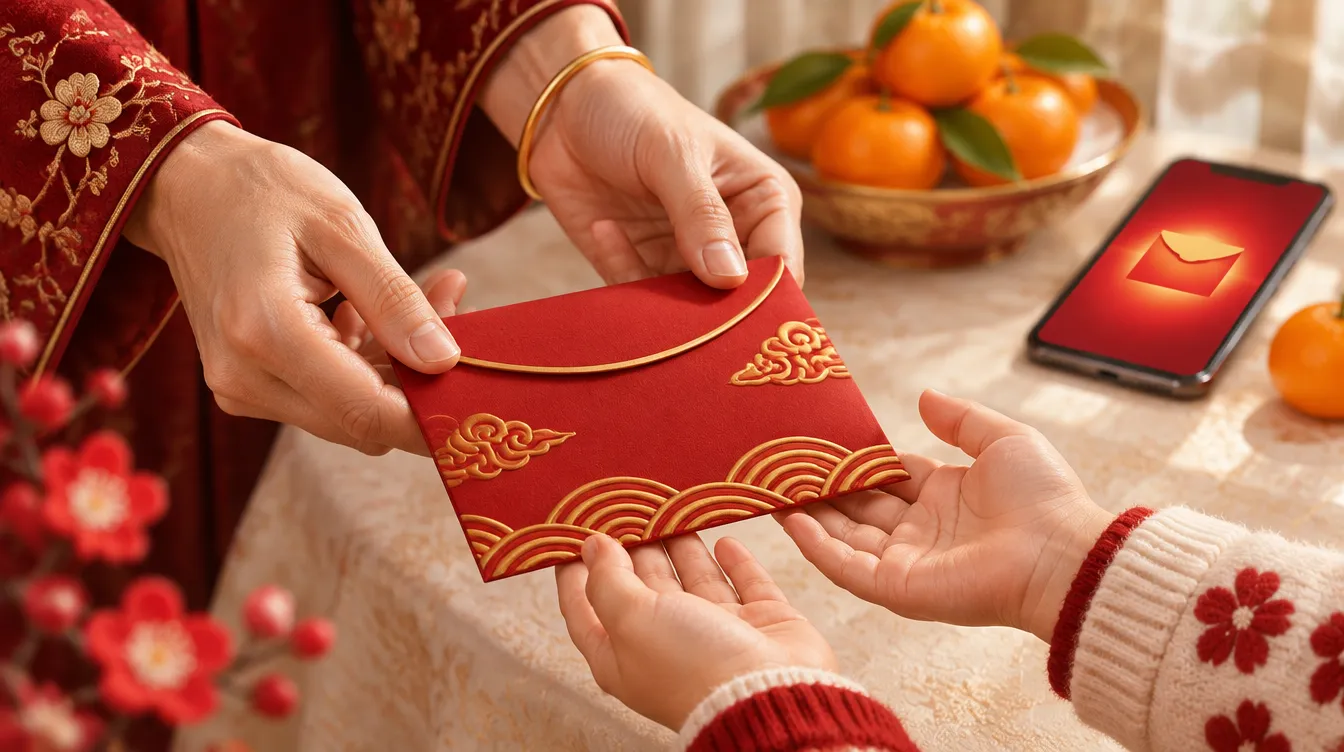
- Give and receive with both hands, and look at the person as you do.
- Say a greeting as you hand it over: 新年快乐 (happy New Year) and 恭喜发财 to anyone, 身体健康 (good health) to elders, 学业进步 (progress in your studies) to students.
- When you receive one, thank the giver and return a greeting.
- Open it later, in private, never in front of the giver.
- Put the notes in flat and facing the same way, and write your name lightly on the back if your family likes to keep track.
- Use red or gold packets. White envelopes are for condolence money, so keep them away from New Year.
- Red packets are given during visits across the 15 days, up to 元宵 on Saturday 20 February 2027.
Questions
Do single working adults give red packets?
Traditionally no: unmarried people receive. Many single working adults do give to their parents and grandparents, though, as thanks.
Is there an official ang pow rate for 2027?
No. Neither Singapore nor Malaysia has one. Choose an even amount you can sustain, more for closer family, and keep it consistent within each group.
Why avoid the number 4?
四 (four) sounds like 死 (death) in Mandarin and many dialects, so many people avoid it and amounts containing it.
Are used notes rude in a red packet?
Clean fit notes are widely accepted now, and both MAS and Bank Negara encourage them. Avoid torn or very worn notes.
Should I open a red packet in front of the giver?
No. Thank them, say a greeting and put it away. Open it later in private.
For reflection and entertainment.