Guide · Reunion dinner
Reunion dinner (团圆饭): the lucky dishes and what each one means
Updated 22 November 2026
In short
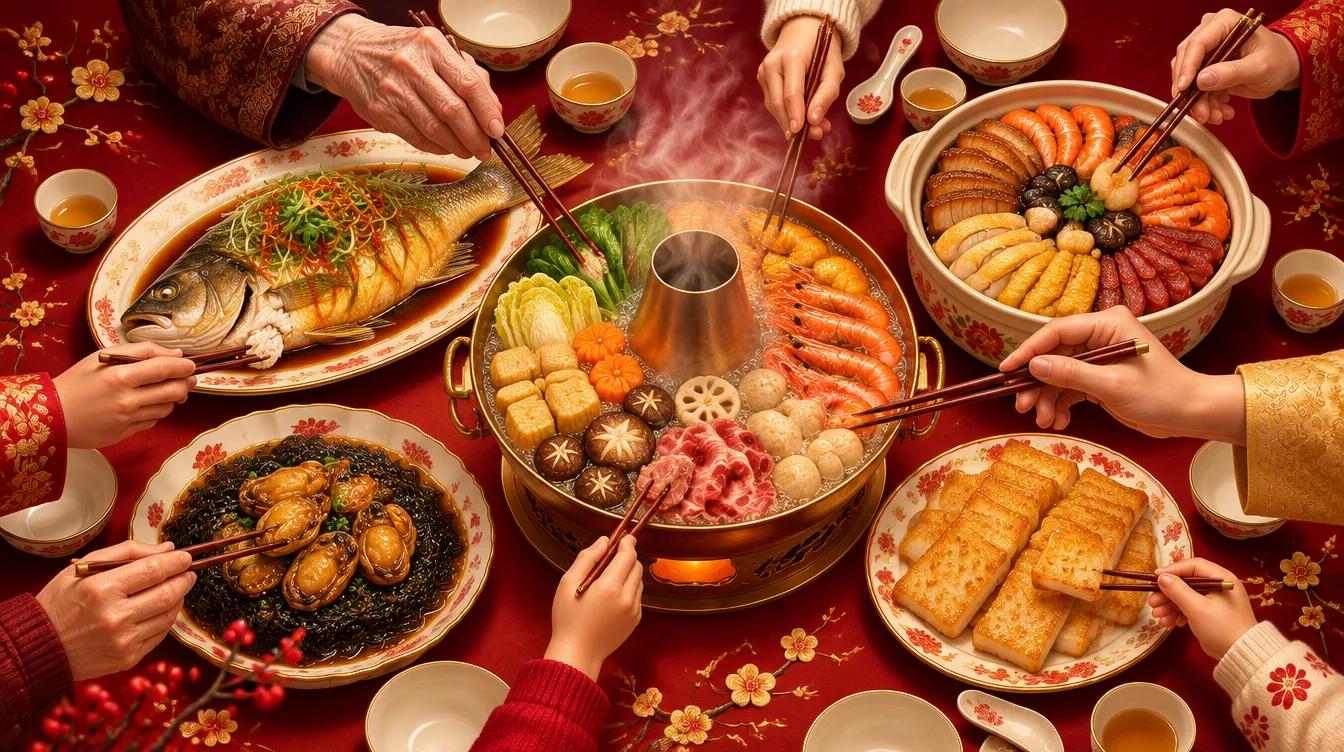
The reunion dinner (团圆饭, also 年夜饭) is the most important meal of Chinese New Year. In 2027 it falls on Friday 5 February, the 29th of the twelfth lunar month, because the month is short and there is no 30th. Most dishes carry a wish through wordplay: fish (鱼, yú) sounds like surplus (余, yú), black moss (发菜) like getting rich (发财), and rice cake (年糕) like rising higher each year (年高). In Singapore and Malaysia many families gather round a steamboat, and each dialect group adds its own dishes. The table below lists the common dishes and their meanings.
When is the reunion dinner in 2027?
The reunion dinner is eaten on New Year’s Eve, 除夕. We converted the dates with a Chinese calendar library: in 2027 the twelfth lunar month has 29 days, so the eve is the 29th, Friday 5 February, and New Year’s Day is Saturday 6 February. People still call it “the thirtieth night” out of habit, but the date to plan around is the Friday.
A Friday eve is a working day for many people in Singapore and Malaysia, so families who travel home, or across the Causeway, tend to leave early or take the day off. Restaurant set menus for the eve are usually booked weeks ahead. Many households also make offerings to their ancestors (祭祖) in the afternoon, then sit down together once everyone has arrived. Hokkien and Taiwanese families call the meal 围炉, “gathering round the stove”, a name that fits the steamboat at the centre of so many tables today.
The lucky dishes and their meanings
| Dish | Wordplay or symbol | The wish |
|---|---|---|
| Whole fish (鱼) | 鱼 yú sounds like 余 yú, surplus | 年年有余: more than enough, year after year |
| Black moss (发菜) with dried oysters (蚝豉) | Cantonese fat choy sounds like 发财; ho si like 好事 or 好市 | Prosperity and good things, or good business |
| Nian gao (年糕) | 糕 gāo sounds like 高 gāo, high | Rising higher each year; its round shape stands for togetherness |
| Dumplings (饺子) | Shaped like 元宝, old silver ingots | Wealth; favoured by families of northern Chinese origin |
| Poon choi (盆菜) | Many layers in one basin | 盆满钵满, a full basin: abundance shared by everyone |
| Long-life greens (长年菜) | Long leaves cooked and eaten without cutting | Long life for the family |
| Whole chicken (鸡) | 鸡 jī sounds close to 吉 jí, good fortune; served whole | Good luck, and a family that is complete |
| Prawns (虾) | Cantonese ha sounds like laughter, “ha ha” | A happy, laughing year |
| Lettuce (生菜) | 生菜 shēngcài sounds like 生财 shēngcái | Making money |
| Long noodles (面) | Length stands for a long life | Longevity |
Most of these puns work in Mandarin, and a few only in Cantonese, which is why the same dish can carry slightly different wishes from one family to the next. Black moss is a good example. Its Cantonese name, fat choy, is the same sound as the greeting 恭喜发财, and it is often braised with dried oysters, whose name, ho si, sounds like “good things”. Real 发菜 is scarce today, and China has restricted its harvest since 2000 because gathering it damaged grassland, so much of what is sold is a substitute.
Poon choi comes from the walled villages of Hong Kong’s New Territories, where villagers served layered food in wooden basins at clan feasts. A popular legend links it to a Song dynasty emperor fleeing south, though historians date the custom later. Hong Kong listed it as intangible cultural heritage in 2017. In Singapore and Malaysia it has become a common reunion dinner choice through restaurants and supermarkets, especially for Cantonese families. Long-life greens are best known in Taiwan and among Hokkien speakers: long-leaf mustard greens (芥菜), or in southern Taiwan spinach, eaten whole without biting through.
How well do your family’s charts fit?
Enter two birthdays and see how the charts fit, free: parents and children, siblings, or the in-laws you are meeting this New Year. Worked out with true solar time.
Compare two chartsWhy the fish is never finished
The fish is the one dish nearly every family serves, and it comes with its own habits. It is usually steamed and served whole, head and tail on, for a year that is good from start to finish. Many families leave some of it uneaten, so that a “surplus” is literally carried into the new year. Some, especially those with roots in fishing communities, avoid turning the fish over to reach the meat underneath, because flipping a fish recalls a capsizing boat; they lift the bone away instead. Teochew families in Singapore often steam rabbitfish, which they call “prosperity fish”.
Singapore and Malaysia favourites
In Singapore and Malaysia the most familiar reunion table is a bubbling steamboat. Everyone cooks from the same pot, which suits a gathering of three generations, and the round pot itself is read as a sign of unity. Around it, each dialect group adds dishes from home. The Singapore Chinese Cultural Centre gives some examples:
- Hakka families: caiban (菜粄), vegetable dumplings in a glutinous rice skin.
- Hainanese families: yiba (薏粑), sweet glutinous rice cakes.
- Teochew families: steamed rabbitfish, the “prosperity fish”.
- Cantonese families: black moss with dried oysters, roast meats and, increasingly, poon choi.
Yusheng often appears too, especially at restaurant dinners, though its traditional day is 人日, the seventh day of the new year; our lo hei guide explains the toss. If your family mixes dialect groups, or includes vegetarian members, the easiest approach is to keep a few symbolic dishes, such as a fish, some greens and nian gao for dessert, and let the rest be what everyone enjoys.
Table manners for the reunion dinner
- Seat and serve the eldest first, and wait for them to start before you eat.
- In many Singapore and Malaysia families, children call each elder to eat by name before picking up their chopsticks.
- Pour tea for the elders and for guests before yourself.
- Rest chopsticks across your bowl or on a rest, never upright in rice, which looks like incense at an offering for the departed.
- Keep the talk warm. The eve is not the night to raise old arguments or press relatives about marriage, babies or salaries.
- If a bowl breaks, say 岁岁平安 and carry on; our dos and don’ts guide explains why.
- Put phones away for the meal, and video-call relatives who cannot be there.
Questions
What date is the reunion dinner in 2027?
Friday 5 February 2027, the 29th of the twelfth lunar month. There is no 30th this year, so the 29th is the eve.
Why is fish served at the reunion dinner?
鱼 (fish) sounds like 余 (surplus), so a whole fish wishes the family more than enough in the year ahead. Many families leave some uneaten on purpose.
What does 发菜 mean?
Black moss. In Cantonese, fat choy sounds like 发财, “get rich”, so it is a wish for prosperity, often cooked with dried oysters for “good things”.
Is steamboat a traditional reunion dinner?
In Singapore and Malaysia it has become one of the most common. Everyone shares one round pot, which suits the meaning of reunion.
Do I have to cook every lucky dish?
No. Pick a few that matter to your family, such as fish and nian gao. Being together is the point of the meal.
For reflection and entertainment.