Guide · Lo hei
Lo hei (捞鱼生): the yusheng toss, step by step, with the lucky phrases
Updated 22 November 2026
In short
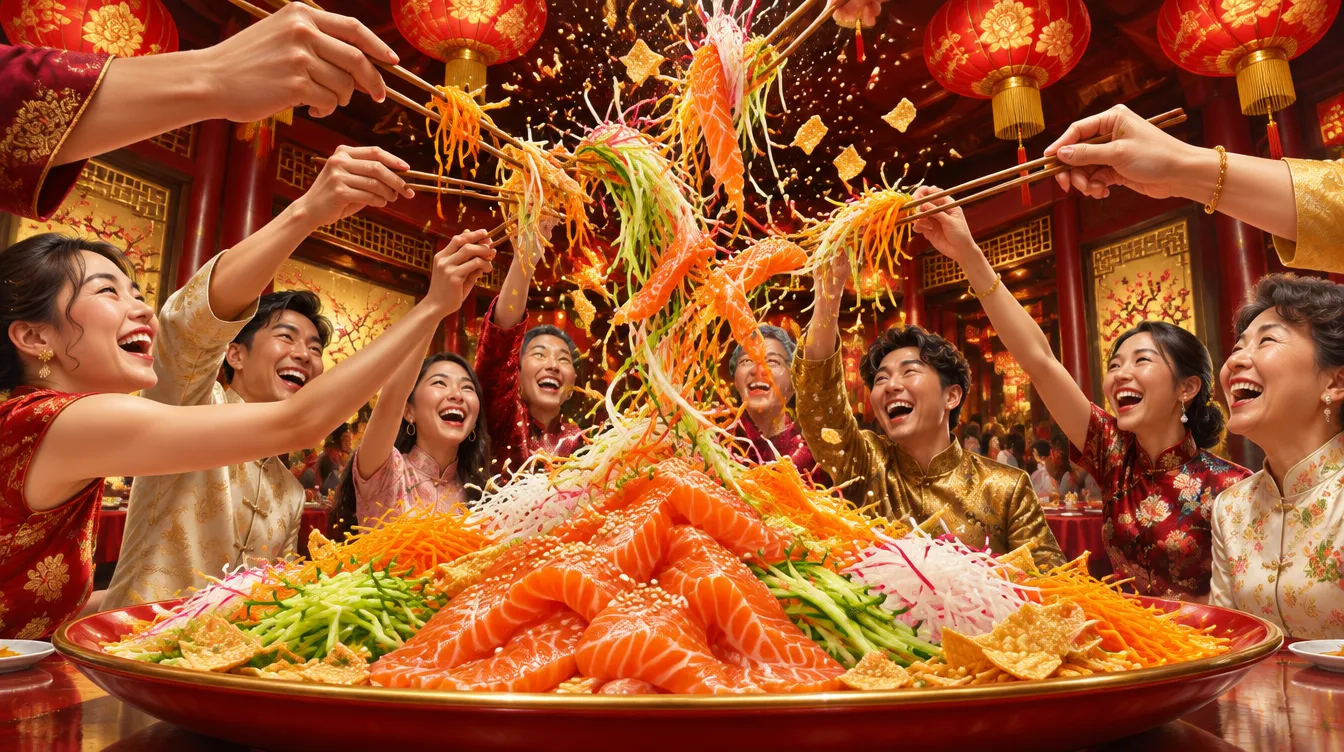
Lo hei (捞起, Cantonese for “toss up”) is the Singapore and Malaysia custom of tossing yusheng (鱼生), a raw fish salad, high with chopsticks while calling out wishes for the year. Each ingredient is added with its own phrase, from 年年有余 for the fish to 遍地黄金 for the golden crackers. The modern colourful version took shape in Singapore restaurants in the 1960s, while Malaysia traces a version to Seremban in the 1940s. The traditional day is 人日, the seventh day of the new year, which in 2027 is Friday 12 February, though today people toss throughout the season.
What is lo hei, and what does yusheng mean?
Yusheng is a salad of thinly sliced raw fish, shredded vegetables, crackers, nuts and a sweet plum sauce. The name carries a pun: 鱼生 yú shēng sounds like 余升, “rising abundance”. Lo hei is the toss itself. 捞 means to scoop or lift, and 起 means up, so 捞起 is both an instruction and a wish: lift your fortunes high. The Cantonese sound, lou hei, is the one you will hear shouted around tables in Singapore and Malaysia, whatever dialect the family speaks.
Where did lo hei come from?
Raw fish itself is very old in Chinese cooking. Singapore’s national heritage portal, Roots, notes that it goes back to the Zhou dynasty, and that by the end of the Qing it was eaten mainly in Guangdong and the Chaoshan region. Cantonese and Teochew migrants brought simple versions to Singapore and Malaysia in the 19th century: raw fish with cucumber, radish and coriander, dressed with vinegar, oil and sugar. Cantonese families traditionally ate it at home on 人日, and by the 1930s restaurants in Singapore were already serving it.
The colourful version most people know today is credited in Singapore to four Cantonese chefs, Tham Yui Kai, Lau Yoke Pui, Sin Leong and Hooi Kok Wai, later nicknamed the “Four Heavenly Kings” of the local restaurant scene. Roots records that their seven-colour yusheng (七彩鱼生) debuted on the second day of Lunar New Year in 1964. Lai Wah Restaurant, which Tham and Lau co-founded, is linked with the custom of a server adding each ingredient while saying its lucky phrase, which is how lo hei became the ritual it is now.
Malaysia has its own account. In Seremban, Loke Ching Fatt is credited with a multi-ingredient yee sang in the 1940s, known as 十感鱼生, and Malaysian media report that it was listed as a national heritage item in 2009. The two claims were long a friendly rivalry. In 2020 a descendant of the family behind the Seremban restaurant, Lu Zhen Ji (陆祯记), said the origin was hard to prove and not worth insisting on, and most people now simply enjoy it as a shared Singapore and Malaysia custom.
Make one more wish for 2027
After the toss, light a free wishing lantern with your hope for the Fire Goat year and see the wishes others have sent up.
Light a lanternLo hei step by step: each ingredient and its phrase
The order and phrases below are the most widely used. Restaurants vary them a little, and some add or drop ingredients, so follow whoever is leading at your table.
| Step and ingredient | Phrase | Pinyin | Meaning |
|---|---|---|---|
| Greeting as the plate arrives | 恭喜发财,万事如意 | gōng xǐ fā cái, wàn shì rú yì | Prosperity, and may all go as you wish |
| 1. Raw fish slices | 年年有余 | nián nián yǒu yú | Abundance year after year |
| 2. Pomelo or a squeeze of lime | 大吉大利 | dà jí dà lì | Great luck and smooth progress |
| 3. Pepper and cinnamon or five-spice powder | 招财进宝 | zhāo cái jìn bǎo | Attracting wealth and treasure |
| 4. Oil, poured in a circle | 一本万利,财源广进 | yì běn wàn lì, cái yuán guǎng jìn | Great returns, and money from many sources |
| 5. Shredded carrot | 鸿运当头 | hóng yùn dāng tóu | Good luck ahead; 红 (red) sounds like 鸿 (great) |
| 6. Shredded green radish | 青春常驻 | qīng chūn cháng zhù | Staying young |
| 7. Shredded white radish | 风生水起,步步高升 | fēng shēng shuǐ qǐ, bù bù gāo shēng | Quick progress, and rising step by step at work |
| 8. Crushed peanuts | 金银满屋 | jīn yín mǎn wū | A home full of gold and silver |
| 9. Sesame seeds | 生意兴隆 | shēng yì xīng lóng | Thriving business |
| 10. Plum sauce, drizzled generously | 甜甜蜜蜜 | tián tián mì mì | A sweet life and sweet relationships |
| 11. Golden fried crackers | 遍地黄金 | biàn dì huáng jīn | Gold everywhere underfoot |
| 12. Everyone tosses together | 捞起! | lāo qǐ (Cantonese: lou hei) | Toss it up: the higher, the better the year |
Once every ingredient is on the plate, everyone stands, picks up their chopsticks and tosses on the leader’s signal, lifting the salad as high as they can while shouting 捞起 and any wishes of their own: a new job, good exam results, a smooth move, health for the grandparents. Personal wishes are welcome; the set phrases are a starting point, not a script.
When do people lo hei in 2027?
The traditional day is 人日, the seventh day of the first lunar month, said in legend to be the day humans were created and so everyone’s birthday. We converted the date with a Chinese calendar library: in 2027 it falls on Friday 12 February. In practice, Singapore and Malaysia families and offices lo hei whenever they gather during the season, from New Year’s Day on Saturday 6 February to 元宵 on Saturday 20 February. Many companies hold a lo hei lunch on their first working day back, and many restaurants start serving yusheng before New Year for early gatherings with friends and colleagues.
How to lo hei politely
- Let one person lead. At a restaurant the server usually adds the ingredients and says the phrases; at home it is often the host or the eldest at the table.
- Wait until every ingredient is in before anyone starts tossing.
- Toss high but keep it on the plate: lift and drop, rather than flinging. A little mess is part of the fun; a cracker on someone’s shirt is not.
- Bring everyone in, including children and non-Chinese colleagues. Explain a phrase or two so they can shout along.
- Eat it afterwards. Yusheng is a dish, not just a ritual, so share it out rather than leaving the plate untouched.
- Mind allergies. Peanuts and sesame are standard, so ask guests first and set some aside before they go in, or ask the restaurant to leave them out.
Questions
What does lo hei mean?
It is Cantonese for “toss up” (捞起). Tossing the yusheng high stands for lifting your fortunes in the new year.
When is 人日 in 2027?
Friday 12 February 2027, the seventh day of the first lunar month. Most people lo hei at any gathering during the New Year season.
Was yusheng invented in Singapore or Malaysia?
Both have claims. Singapore credits four chefs with the seven-colour version in 1964; Malaysia credits a Seremban restaurateur in the 1940s. Raw fish dishes themselves came from southern China.
Do I have to say the phrases in Chinese?
No. Shout along in any language. The leader usually says the phrases, and everyone joins in with 捞起 and their own wishes.
Is a higher toss really luckier?
That is the tradition, and it is half the fun. Keep the food on the plate, though; nobody’s year improves with plum sauce on the ceiling.
For reflection and entertainment.