Guide · New Year greetings
Chinese New Year greetings in Mandarin, Cantonese and Hokkien
Updated 22 November 2026
In short
The three greetings that work almost everywhere are 新年快乐 (Happy New Year), 恭喜发财 (wishing you prosperity) and 身体健康 (good health). Gong Xi Fa Cai is the Mandarin way to say 恭喜发财; Gong Hei Fat Choy is Cantonese and Kiong Hee Huat Chai is Hokkien. For elders, add a wish for health or vigour; for colleagues, a wish for promotion; for children, progress at school. In the 2027 Goat year, 三阳开泰 and 喜气洋洋 play on the sound of 羊. Below is a table you can use at the door, with romanisations for all three languages.
Which language should you greet in?
Most Chinese families in Singapore and Malaysia trace their roots to a handful of dialect groups: Hokkien, Teochew, Cantonese, Hakka and Hainanese. Younger relatives usually speak Mandarin or English, but many grandparents grew up speaking their dialect at home, and a greeting in it lands warmly even if your tones are rough. In Malaysia, Cantonese is widely heard in Kuala Lumpur and Ipoh, and Penang has its own Hokkien. If you are not sure, Mandarin is understood almost everywhere.
A note on spelling. Mandarin below uses Hanyu Pinyin with tone marks. Cantonese uses Jyutping, where the number after each syllable is its tone (Cantonese has six); the familiar spellings, such as Gong Hei Fat Choy, are given where they exist. Hokkien has no single spelling that everyone uses, so we give common Singapore and Malaysia spellings. You will see others, such as Kong Hee Huat Chye in Penang, and they are just as correct.
Chinese New Year greetings in three languages
| Greeting | Mandarin | Cantonese | Hokkien | Meaning and who to say it to |
|---|---|---|---|---|
| 新年快乐 | xīn nián kuài lè | san1 nin4 faai3 lok6 | Sin Ni Khuai Lok | Happy New Year. Anyone. |
| 恭喜发财 | gōng xǐ fā cái | gung1 hei2 faat3 coi4 (Gong Hei Fat Choy) | Kiong Hee Huat Chai | Congratulations, may you prosper. The standard greeting at the door. |
| 新正如意,新年发财 | xīn zhēng rú yì, xīn nián fā cái | Rarely used | Sin Chia Ju Ee, Sin Ni Huat Chai | May the first month go as you wish and the new year bring wealth. A classic Hokkien and Teochew greeting. |
| 身体健康 | shēn tǐ jiàn kāng | san1 tai2 gin6 hong1 | Sin Teh Kian Khong | Good health. Elders, and anyone. |
| 龙马精神 | lóng mǎ jīng shén | lung4 maa5 zing1 san4 | Liong Ma Cheng Sin | The vigour of a dragon-horse. Elders. |
| 万事如意 | wàn shì rú yì | maan6 si6 jyu4 ji3 | Ban Su Ju Ee | May everything go as you wish. Anyone. |
| 心想事成 | xīn xiǎng shì chéng | sam1 soeng2 si6 sing4 | Sim Siong Su Seng | May your wishes come true. Friends and peers. |
| 步步高升 | bù bù gāo shēng | bou6 bou6 gou1 sing1 | Po Po Ko Seng | Rise step by step. Colleagues and working adults. |
| 生意兴隆 | shēng yì xīng lóng | saang1 ji3 hing1 lung4 | Seng Li Hin Liong | A thriving business. Shop owners and business people. |
| 学业进步 | xué yè jìn bù | hok6 jip6 zeon3 bou6 | Hak Giap Chin Po | Progress in your studies. Children and students. |
| 大吉大利 | dà jí dà lì | daai6 gat1 daai6 lei6 | Tua Kiat Tua Li | Great luck and great profit. Anyone; often said with oranges. |
| 发啊! | fā (发) | Mainly a Hokkien cheer | Huat ah! | Prosper! A cheer, shouted while tossing yusheng. |
Send your wish into the new year
Write a New Year wish, in any language, on a free wish lantern and light it for the year ahead.
Light a lanternWho says what to whom?
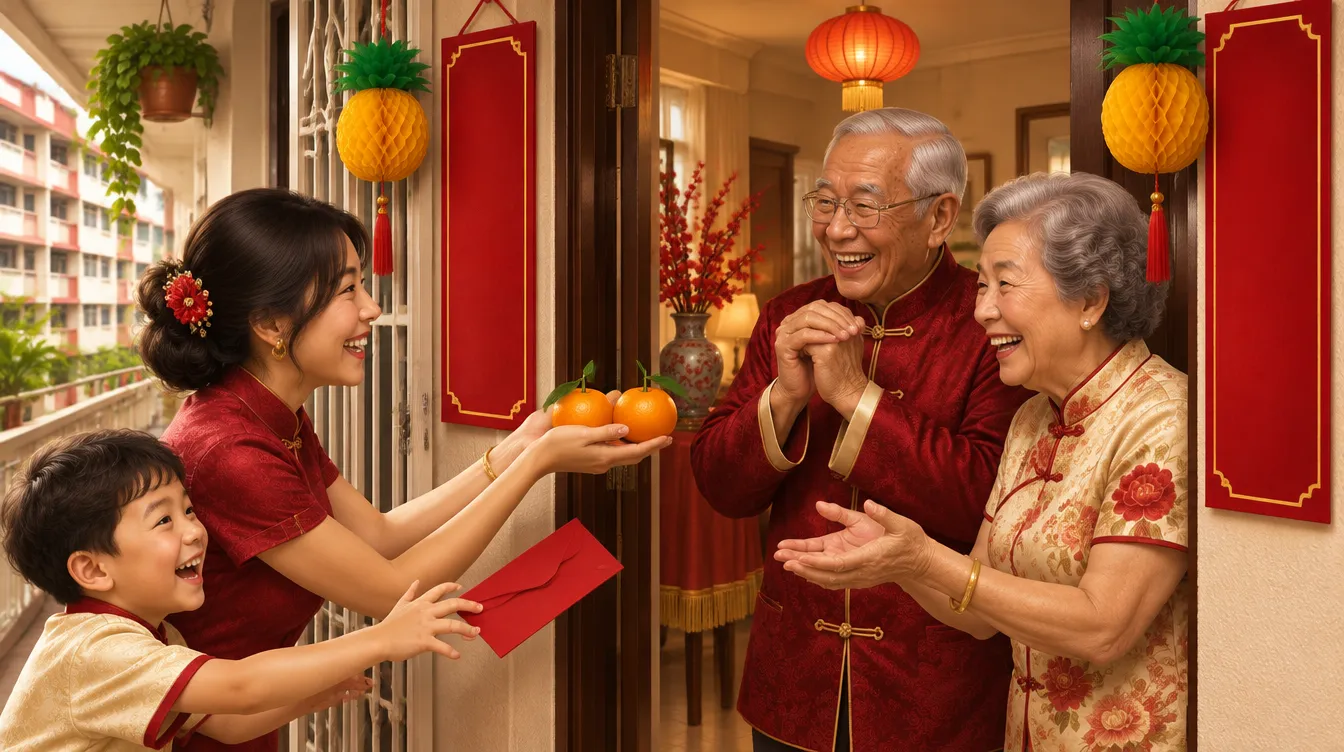
The younger person greets first. Walking into a relative’s home, children and younger adults greet the grandparents, then the aunts and uncles, usually by their family title rather than their name. Pairing two four-character phrases sounds especially polished, such as 身体健康,万事如意 for a grandparent. Elders reply with their own wishes, and married relatives hand red packets to children and unmarried younger relatives. Red packet amounts and etiquette have a guide of their own.
- How to reply: the easiest answer to 恭喜发财 is to say it back. In Mandarin many people add 同喜同喜 (tóng xǐ, “the same joy to you”); in Cantonese, 大家咁话 (daai6 gaa1 gam2 waa6, “same to everyone”).
- At work: 步步高升 and 心想事成 suit colleagues; 生意兴隆 suits clients who run a business. Many Malay and Indian friends in Malaysia and Singapore greet Chinese colleagues with “Gong Xi Fa Cai”, and a smile and the same greeting back is the warm reply.
- Children’s rhyme: kids often add 红包拿来 (“now hand over the red packet”) in Mandarin, or 利是逗来 (lai6 si6 dau6 loi4) in Cantonese. It is charming from a child and a little cheeky from an adult.
- Messages: for a card or a text, a four-character phrase plus 新年快乐 is enough. Writing it in characters is thoughtful even if you speak to that person in English.
Greetings for the 2027 Year of the Goat
Each zodiac year brings its own puns, and the Goat (羊, yáng) is one of the richest, because yang also means the bright, active force of yin and yang (阳), and sounds like 洋, as in the word for overflowing joy. The ancient dictionary 说文解字 even glosses 羊 as 祥, auspicious. 2027 is the 丁未 Fire Goat year, beginning on 6 February 2027.
| Greeting | Mandarin | Meaning and the wordplay |
|---|---|---|
| 三阳开泰 / 三羊开泰 | sān yáng kāi tài | From the I Ching: the 泰 hexagram has three yang lines at the bottom and stands for the first month, when spring returns. Written with 羊 in Goat years. |
| 喜气洋洋 | xǐ qì yáng yáng | Brimming with joy; 洋洋 sounds like “goat goat”. |
| 羊年大吉 | yáng nián dà jí | Great luck in the Goat year. Simple and safe for anyone. |
| 吉祥如意 | jí xiáng rú yì | Good fortune and everything as you wish; 祥 was once written with 羊. |
| 羊羊得意 | yáng yáng dé yì | A playful twist on 洋洋得意. Best kept for friends (see below). |
三阳开泰 is the most elegant of these and suits elders, bosses and cards. The hexagram behind it is 泰 (Tai, peace), number 11 of the 64; in the old calendar its three unbroken yang lines rising from below marked the first month of spring, which is why the phrase was a New Year wish long before anyone swapped in the goat.
Greetings and topics to avoid
- 洋洋得意 on its own: in everyday Chinese it means smug or self-satisfied. Written as 羊羊得意 it is a joke among friends, but to a boss or an elder it can sound like a jab. Choose 喜气洋洋 instead.
- Cheerful congratulations to a family in mourning: traditionally a household in its first year of mourning does not celebrate or go visiting. A quiet “新年好” or simply asking how they are is kinder than 恭喜.
- Words linked with death, illness or loss, and the number four, even as a joke. The reasons are covered in our guide to New Year taboos.
- The famous relative questions: when are you getting married, how much do you earn, have you put on weight. They are part of New Year humour in Singapore and Malaysia, but a wish for the year is a much better opener.
- 早生贵子 (may you have a son soon) to couples you do not know well. Some find it sweet; others find it personal.
Questions
Is it Gong Xi Fa Cai or Gong Hei Fat Choy?
Both. They are the same phrase, 恭喜发财: Gong Xi Fa Cai is Mandarin and Gong Hei Fat Choy is Cantonese. In Hokkien it is Kiong Hee Huat Chai.
How do you reply to 恭喜发财?
Say it back, or add 同喜同喜 in Mandarin or 大家咁话 in Cantonese, both meaning “the same to you”.
What should I say to my grandparents at Chinese New Year?
身体健康 (good health) and 龙马精神 (vigour) are the classics. Pair one with 万事如意 for a complete, polished greeting.
What is a good greeting for the Year of the Goat?
三阳开泰 (also written 三羊开泰) is the classic Goat-year wish: spring returns and good times open up. 喜气洋洋 is a cheerful everyday alternative.
What does “Huat ah” mean?
It is Hokkien for “prosper!”, from 发. In Singapore and Malaysia people shout it while tossing yusheng together.
For reflection and entertainment.