Guide · I Ching
The 64 hexagrams of the I Ching: a plain-English guide
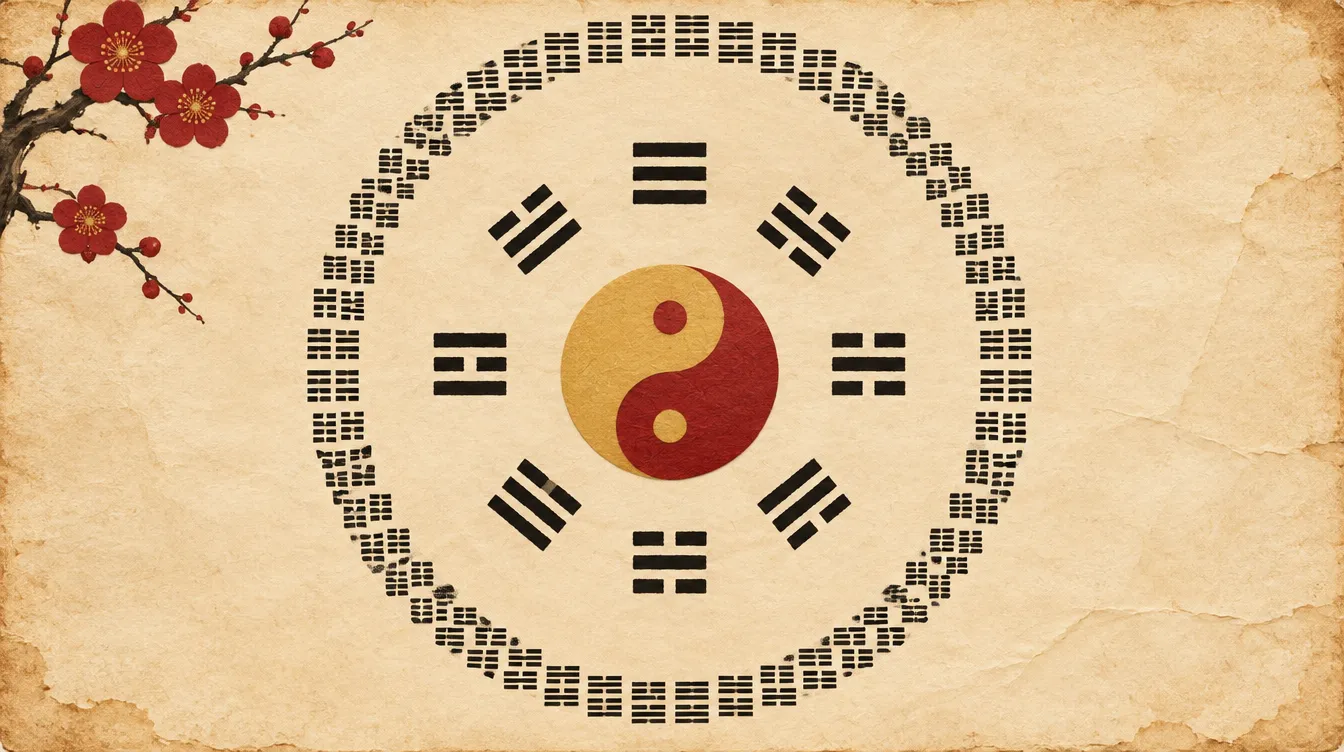
Updated 22 November 2026
In short
The I Ching (易经, the Book of Changes) has 64 hexagrams. Each is a stack of six solid (yang) or broken (yin) lines, and each is made of two trigrams of three lines: one below, one above. There are eight trigrams, Heaven, Lake, Fire, Thunder, Wind, Water, Mountain and Earth, so 8 × 8 gives 64. The traditional order, credited to King Wen of Zhou, runs them in pairs from 乾 (The Creative) to 未济 (Before Completion). The table below lists all 64 with the names and gists our I Ching tool uses.
What are the 64 hexagrams?
A hexagram (卦) is a figure of six lines, read from the bottom up. Each line is either yang, drawn solid, or yin, drawn broken. With two choices for each of six lines there are exactly 64 possible figures, and the I Ching gives every one a name and a set of texts: a judgment (卦辞) on the situation as a whole, an image (象辞) that pictures its two trigrams, and a short text for each of the six lines.
The classical texts in our I Ching tool come from Chinese Wikisource’s edition of the 周易, cross-checked line by line against a second edition on Project Gutenberg. The English names and the short gists in the table below are our own plain-language interpretations, written for people asking about everyday life. Translations of the names vary between books, so you may see other English names elsewhere.
The eight trigrams (八卦)
Every hexagram is built from two of these eight trigrams. The family roles come from the 说卦传, one of the classic commentaries on the I Ching, which calls 乾 the father, 坤 the mother and the other six their sons and daughters. The directions are those of the later heaven (后天) arrangement, traditionally linked with King Wen, which the same commentary sets out and which feng shui compasses still use.
| Trigram | Lines (bottom to top) | Nature | Family role | Direction (later heaven) |
|---|---|---|---|---|
| ☰ 乾 qián | Solid, solid, solid | Heaven 天 | Father | North-west |
| ☱ 兑 duì | Solid, solid, broken | Lake 泽 | Youngest daughter | West |
| ☲ 离 lí | Solid, broken, solid | Fire 火 | Middle daughter | South |
| ☳ 震 zhèn | Solid, broken, broken | Thunder 雷 | Eldest son | East |
| ☴ 巽 xùn | Broken, solid, solid | Wind 风 | Eldest daughter | South-east |
| ☵ 坎 kǎn | Broken, solid, broken | Water 水 | Middle son | North |
| ☶ 艮 gèn | Broken, broken, solid | Mountain 山 | Youngest son | North-east |
| ☷ 坤 kūn | Broken, broken, broken | Earth 地 | Mother | South-west |
There is a logic to the family roles. 乾 and 坤 are pure yang and pure yin. In the other six, the one line that differs from the rest decides the role: a single yang line makes a son and a single yin line a daughter, and its position, bottom, middle or top, makes the child eldest, middle or youngest. So 震, with its one yang line at the bottom, is the eldest son, and 兑, with its one yin line at the top, is the youngest daughter.
Which hexagram answers your question?
Toss three coins six times and read your hexagram, its classical texts and any changing lines, in English and 中文.
Ask the I ChingHow two trigrams make a hexagram
Put one trigram below and another above and you have a hexagram. The lower trigram is traditionally the inner side of a matter, the upper the outer side. A hexagram’s full Chinese name reads from the top down: 水雷屯 is Water (坎) over Thunder (震), hexagram 3, Difficult Beginnings. When a trigram is doubled, the name says so with 为, as in 乾为天, Heaven doubled, and 坎为水, Water doubled. There are eight such doubled hexagrams, one for each trigram.
Swapping the two trigrams can turn the meaning round. 地天泰, Earth above Heaven, is hexagram 11, Peace: heaven’s energy rises and earth’s descends, so the two meet. 天地否, Heaven above Earth, is hexagram 12, Standstill: each stays where it is and they drift apart. The same two trigrams, in a different order, describe opposite seasons.
The King Wen order: why the hexagrams come in pairs
The order used in the received text of the 周易, and in our tool’s numbering, is traditionally credited to King Wen of Zhou. It is split into an upper part of 30 hexagrams (1 to 30) and a lower part of 34 (31 to 64). It begins with 乾 and 坤, Heaven and Earth, and ends with 既济, After Completion, followed by 未济, Before Completion, so the book closes on an open door rather than a full stop.
The hexagrams run in 32 pairs, 1 and 2, 3 and 4, and so on. In 28 of the pairs the second hexagram is the first turned upside down: hexagram 3, 屯, flipped top to bottom gives hexagram 4, 蒙. Eight hexagrams look the same upside down, so they are paired a different way, by turning every line into its opposite: 1 and 2 (乾, 坤), 27 and 28 (颐, 大过), 29 and 30 (坎, 离), and 61 and 62 (中孚, 小过). We checked this against the line patterns in our hexagram data, and every pair follows one of the two rules.
All 64 hexagrams at a glance
The number is the King Wen order. The gist is the opening line of the interpretation our I Ching tool shows when you cast that hexagram; the tool goes on to give the classical judgment and image, notes for career, love, wealth, health and family, and a small next step.
| No. | Hexagram | English name | Gist |
|---|---|---|---|
| 1 | 乾为天 qián | The Creative | This is a time of strong, steady energy. |
| 2 | 坤为地 kūn | The Receptive | This is a time to support, follow and nurture rather than to lead. |
| 3 | 水雷屯 zhūn | Difficult Beginnings | Something new is starting, and the start feels messy. |
| 4 | 山水蒙 méng | Youthful Learning | You may not yet see the whole picture, and that is fine. |
| 5 | 水天需 xū | Waiting | What you want is coming, but not yet. |
| 6 | 天水讼 sòng | Conflict | There is disagreement, and both sides may feel they are right. |
| 7 | 地水师 shī | The Army | This is a time for order, discipline and teamwork. |
| 8 | 水地比 bǐ | Holding Together | This is a time to come together with people you trust. |
| 9 | 风天小畜 xiǎo xù | Small Taming | Things are building, but slowly, like clouds that have not yet brought rain. |
| 10 | 天泽履 lǚ | Treading Carefully | You are walking on a delicate path, perhaps near someone powerful or a sensitive situation. |
| 11 | 地天泰 tài | Peace | Heaven and earth are in harmony, and things flow smoothly. |
| 12 | 天地否 pǐ | Standstill | Things feel stuck, and communication may not flow well. |
| 13 | 天火同人 tóng rén | Fellowship | This is a time to unite with others around a shared purpose. |
| 14 | 火天大有 dà yǒu | Great Possession | You hold much right now, whether in skills, support or resources. |
| 15 | 地山谦 qiān | Modesty | Humility is your greatest strength now. |
| 16 | 雷地豫 yù | Enthusiasm | There is joy and fresh energy in the air. |
| 17 | 泽雷随 suí | Following | This is a time to adapt and move with the flow, not to force your own plan. |
| 18 | 山风蛊 gǔ | Repair | Something has been neglected and now needs care. |
| 19 | 地泽临 lín | Approach | Good things are drawing near, and your influence is growing. |
| 20 | 风地观 guān | Contemplation | Step back and observe before you act. |
| 21 | 火雷噬嗑 shì kè | Biting Through | Something stands between you and your goal, and it needs to be faced directly. |
| 22 | 山火贲 bì | Grace | Beauty and good presentation have real value, but they work best when they reflect something true. |
| 23 | 山地剥 bō | Splitting Apart | Things are wearing away, and this is not the moment to push ahead. |
| 24 | 地雷复 fù | Return | After a low point, the light comes back. |
| 25 | 天雷无妄 wú wàng | Innocence | Act simply and sincerely, without hidden motives or clever schemes. |
| 26 | 山天大畜 dà xù | Great Taming | You are gathering strength, knowledge and resources. |
| 27 | 山雷颐 yí | Nourishment | Pay attention to what you take in and what you give out. |
| 28 | 泽风大过 dà guò | Great Exceeding | The load is heavier than the structure can easily carry. |
| 29 | 坎为水 kǎn | The Abyss | You may be going through a hard stretch. |
| 30 | 离为火 lí | Radiance | Clarity and warmth are shining now, like a fire that gives light. |
| 31 | 泽山咸 xián | Influence | Hearts are moving toward each other. |
| 32 | 雷风恒 héng | Duration | Lasting success comes from steady effort over time. |
| 33 | 天山遯 dùn | Retreat | This is a time to step back, not to push forward. |
| 34 | 雷天大壮 dà zhuàng | Great Strength | Your strength is rising and things are moving your way. |
| 35 | 火地晋 jìn | Progress | Like the sun rising over the land, things are getting brighter. |
| 36 | 地火明夷 míng yí | Hidden Light | The light is dimmed for now, and it is wise not to shine too openly. |
| 37 | 风火家人 jiā rén | The Family | Good order begins at home and in the people closest to you. |
| 38 | 火泽睽 kuí | Opposition | People are looking in different directions, and views do not match. |
| 39 | 水山蹇 jiǎn | Obstruction | The road ahead is hard, like a steep path in the mountains. |
| 40 | 雷水解 jiě | Release | Like rain after thunder, tension is breaking and things are loosening. |
| 41 | 山泽损 sǔn | Decrease | Something must be reduced now, and that is not a loss. |
| 42 | 风雷益 yì | Increase | A season of growth and help is here. |
| 43 | 泽天夬 guài | Breakthrough | A decision is ready to be made, and something must be cleared away. |
| 44 | 天风姤 gòu | Encounter | Something new arrives without warning, a person, an idea or an offer. |
| 45 | 泽地萃 cuì | Gathering | People and resources are coming together. |
| 46 | 地风升 shēng | Rising | Like a young tree growing from the earth, you are rising step by step. |
| 47 | 泽水困 kùn | Exhaustion | You may feel tired, stuck, or unheard right now. |
| 48 | 水风井 jǐng | The Well | A well stays in one place yet feeds everyone who comes. |
| 49 | 泽火革 gé | Transformation | The time for real change has come, but it works best when the timing is ripe and people trust it. |
| 50 | 火风鼎 dǐng | The Cauldron | The cauldron cooks food that nourishes many people. |
| 51 | 震为雷 zhèn | Thunder | Thunder rolls and startles everyone, then the sky clears. |
| 52 | 艮为山 gèn | Mountain | The mountain stands still. |
| 53 | 风山渐 jiàn | Gradual Progress | A tree on the mountain grows slowly, but its roots go deep. |
| 54 | 雷泽归妹 guī mèi | The Marrying Maiden | This hexagram speaks of a position you do not fully control, or a role that is not yet clear. |
| 55 | 雷火丰 fēng | Abundance | Like the sun at noon, things are full and bright. |
| 56 | 火山旅 lǚ | The Traveller | The traveller is far from home, only passing through. |
| 57 | 巽为风 xùn | Wind | Wind is soft, yet it reaches everywhere. |
| 58 | 兑为泽 duì | Joy | Two lakes side by side refresh each other. |
| 59 | 风水涣 huàn | Dispersion | Wind moves over water and the ice melts away. |
| 60 | 水泽节 jié | Moderation | Bamboo stands tall because of its joints. |
| 61 | 风泽中孚 zhōng fú | Inner Truth | Sincerity from the heart can reach even those who are hard to move. |
| 62 | 雷山小过 xiǎo guò | Small Steps | A small bird should fly low, not high. |
| 63 | 水火既济 jì jì | After Completion | Water sits above fire, and everything is in its place. |
| 64 | 火水未济 wèi jì | Before Completion | The last hexagram is not an ending but a doorway. |
How to use this list
- Find a hexagram you cast by its trigrams: look up the lower and upper trigram, then the full name, which reads upper over lower.
- Read the gist as a starting point, not the whole answer. The judgment, the image and any changing lines are what speak to your own question.
- Do not judge a hexagram by its name. Names like Conflict, Splitting Apart or Exhaustion describe a situation and how to meet it calmly, not a fate.
- Look at the pairs. Reading a hexagram next to its partner in the King Wen order often makes both clearer, as with 泰 and 否, or 既济 and 未济.
Questions
Why are there 64 hexagrams?
Each of six lines is yin or yang, which gives 2 × 2 × 2 × 2 × 2 × 2 = 64 figures. Equally, eight trigrams below times eight above make 64.
Who created the King Wen order?
Tradition credits King Wen of Zhou. It is the order of the received text of the 周易 and the numbering most books use.
Is there a “bad” hexagram?
No. Every hexagram describes a season and how to act well in it. Even the harder ones, such as 坎 or 困, give practical advice.
Which line of a hexagram comes first?
The bottom line. Hexagrams are drawn and read from the bottom up, and the lower trigram is the first three lines.
For reflection and entertainment.