Guide · Fortune sticks
How to do kau cim (求签): a step-by-step guide to Guanyin fortune sticks
Updated 22 November 2026
In short
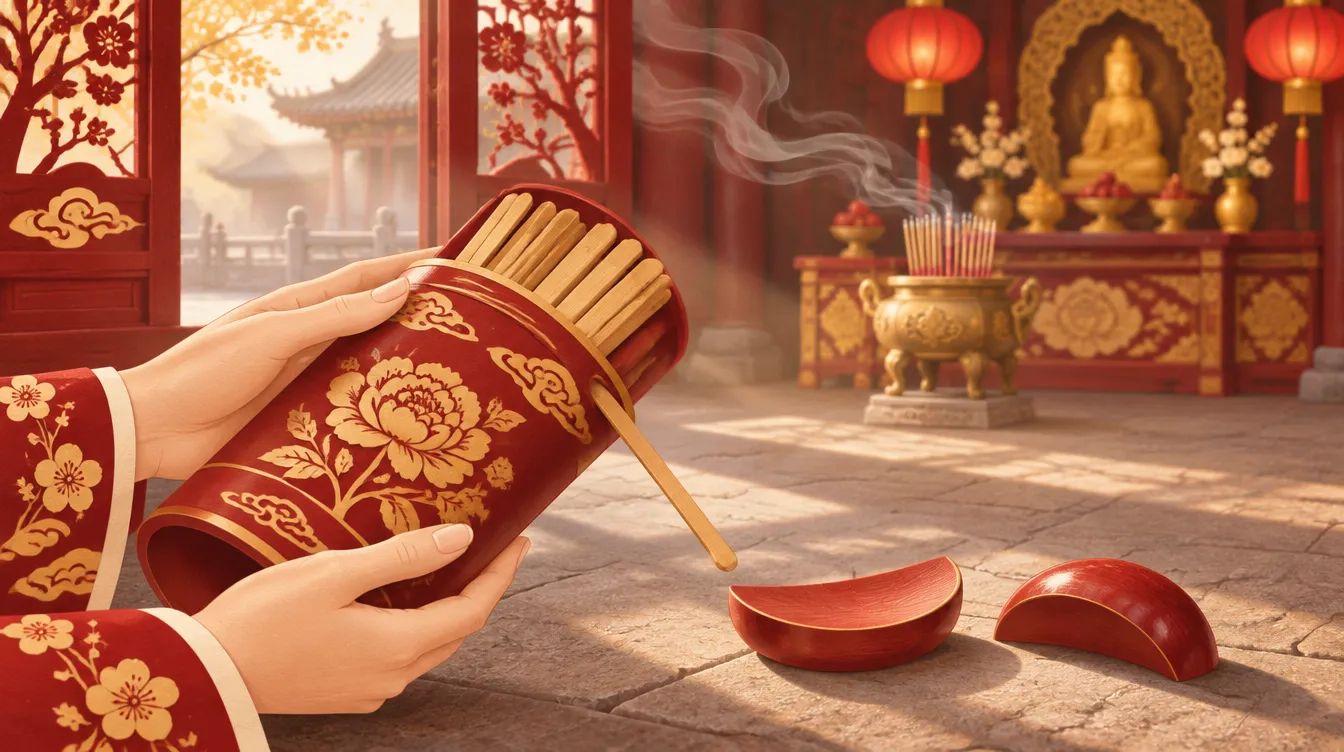
Kau cim (求签, qiú qiān in Mandarin) is the temple custom of asking a question and shaking a cylinder of numbered bamboo sticks until one falls out. The number points to a verse, which you then read for your question. In most temples you first pray and state your question, shake until a single stick drops, confirm it with two moon blocks (筊杯), then collect the matching slip and, if you like, ask someone to interpret it. Customs differ from temple to temple, so watch what others do and follow any notices. You can also draw one of the 100 Guanyin sticks online here.
How do you prepare a question for kau cim?
The question matters more than anything else you bring. A stick answers one matter at a time, so pick a single question and say it clearly. Vague wishes such as “Will my life be good?” are hard to read. A concrete question such as “Should I accept the job offer from this company this year?” gives the verse something to speak to.
- Choose one area: career, love, money, family, health, travel or a decision you are facing.
- Add a time frame where it helps. Many interpreters read a stick for the months ahead, often no further than about a year.
- Ask about your own choices and conduct (“How should I approach…?”) rather than about other people’s minds.
- Traditionally people also tell the deity their name, date of birth and where they live before asking. You can say this silently.
What are the steps of kau cim at a temple?
The order below is common in Guanyin temples in Singapore, Malaysia, Hong Kong and Taiwan. Each temple has its own small variations, and some have simplified the steps.
1. Pay respects
Where it is customary, light incense and pray at the main altar first, often holding the sticks of incense with both hands and bowing. Some temples sell or provide incense at the entrance; others ask that incense is offered only at the burners outside. Then state your question to the deity.
2. Shake the cylinder
Kneel or stand at the place set aside for drawing, hold the cylinder (签筒) in both hands, tilted slightly forward, and shake it gently while you keep your question in mind. Some people first pass the cylinder around the incense burner. Keep going until one stick slides out and falls. If several fall at once, they usually do not count: put them back and shake again.
3. Read the number
Pick up the stick and note its number. Keep the stick in your hand or take a photo, because you will need the number at the counter.
4. Confirm with the moon blocks
Hold the two crescent-shaped moon blocks (筊杯) together, ask whether this stick is the answer to your question, and let them fall. One flat face and one round face up is a “yes”: the stick is yours. Two flat faces usually mean the answer is unclear, so you ask again. Two round backs usually mean “no”: return the stick and shake again. Some temples accept one “yes”, while others ask for three in a row.
5. Get the slip and its interpretation
Take the number to the slip counter or the numbered drawers, where you will find a printed verse (签诗). Many slips give a rank, a four-line poem, a story from Chinese history or opera, and short notes on areas such as work, marriage or travel. You can read it yourself, ask a temple volunteer, or go to an interpreter (解签), who may charge a small fee. A good interpreter asks what your question was before saying anything.
Draw a Guanyin stick now
Light incense, hold your question in mind, shake the cylinder and confirm your stick with the moon blocks.
Draw a stickWhat etiquette should you follow?
- Dress modestly and speak quietly. A temple is a place of worship first.
- Wait your turn at the cylinder and don’t hover over someone who is drawing.
- Put the stick and the moon blocks back where you found them.
- Ask before taking photos of altars or of people praying.
- A donation is customary at many temples. Give what feels right; you are never obliged to pay for a ritual to “fix” a stick.
- Ask one question per draw, and don’t keep drawing for the same question until you get the answer you want.
How does kau cim work online here?
Our virtual temple follows the same order. You enter, light incense and bow with a tap, choose what your question is about (career, love, wealth, health or family) and, if you like, write it in your own words. Then you hold your question in mind and shake: tilt and shake your phone like a cylinder, or press and hold the button. When a stick falls, you cast the moon blocks. A “yes” confirms the stick. A laughing throw lets you throw again, up to three throws per stick. A “no”, or three throws without a “yes”, sends you back to shake for a new stick.
The stick and every throw are decided by secure random numbers on our server before any animation plays. The set is the traditional 100 Guanyin sticks (观音灵签): 23 are ranked 上 (upper), 59 中 (middle) and 18 下 (lower). Once confirmed, your scroll shows the rank, the classical verse, its story, a plain meaning and a short note on your question. Drawing is free with an account, up to five draws a day. If you drew a stick at a temple that uses the same Guanyin set, you can look up its number on our stick pages.
What should you do after reading your stick?
Read the verse once for its overall mood, then line by line for your question. Notice what it asks of you: patience, preparation, a conversation, a change of direction. Write down one practical step you can take this week. A stick describes the season you are in and gives advice for it. What you do next is still your decision, and for medical, legal or money matters the right professional comes first.
Questions
What does kau cim mean?
It is the Cantonese reading of 求签, “seeking a stick”: asking a question at a temple and drawing a numbered fortune stick that points to a verse.
What if two sticks fall out at once?
They usually don’t count. Put both back, settle your mind on the question and shake again until a single stick falls.
How many “yes” throws do I need?
It depends on the temple. Some accept one “yes”, others ask for three in a row. Look for a notice or ask the staff.
Can I do kau cim for someone else?
Many people ask on behalf of family members, stating that person’s name and question. Customs vary, so ask the temple if you are unsure.
Is an online stick the same as a temple stick?
The verses are the same traditional Guanyin set and the steps follow temple practice. It is a digital way to reflect on a question; we are not a real temple and not affiliated with one.
For reflection and entertainment.