Guide · Moon blocks
Moon blocks (筊杯) explained: how temples confirm your fortune stick
Updated 22 November 2026
In short
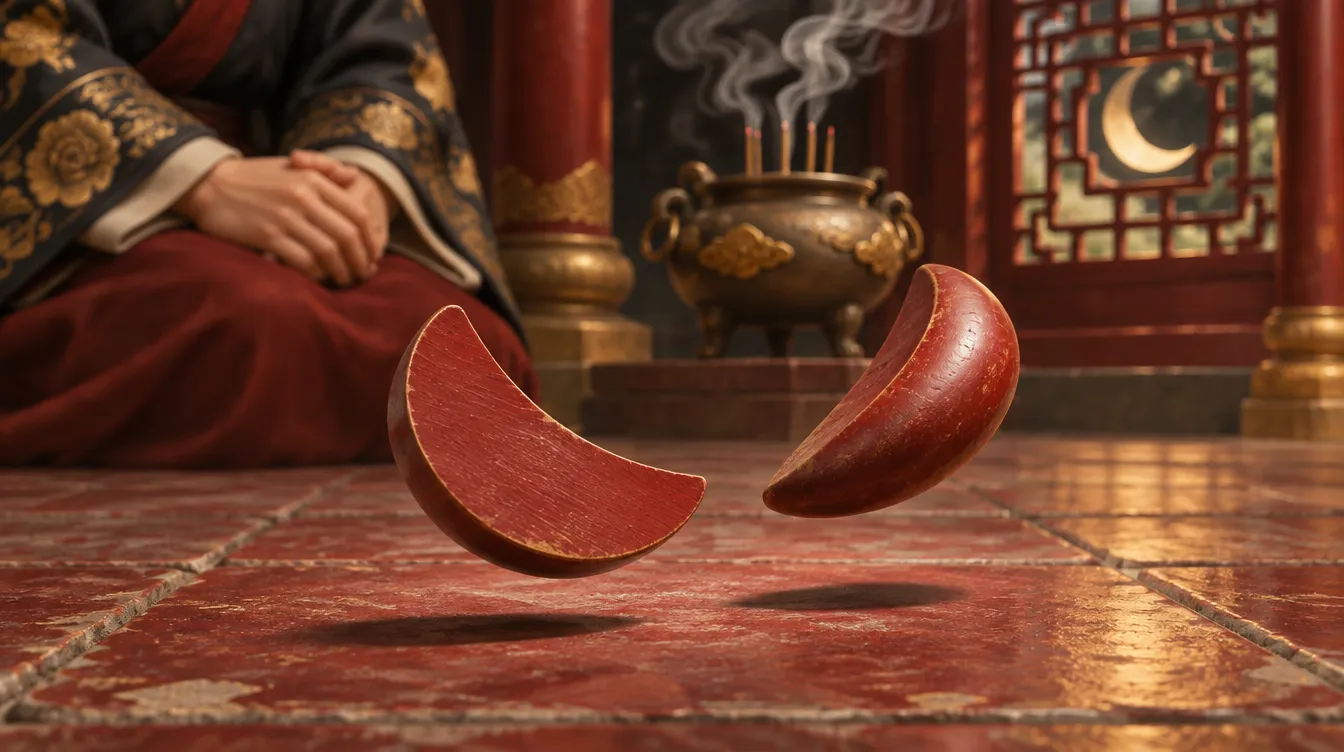
Moon blocks (筊杯, jiǎo bēi) are a pair of crescent-shaped blocks, each with one flat face and one rounded back. You hold them together, ask a yes-or-no question and let them fall. One flat and one round face up (圣杯) means yes. Two flat faces (笑杯, the “laughing” answer) means the answer is unclear. Two round backs (阴杯) means no. Temples use them to confirm that a fortune stick really answers your question; some accept one yes, others ask for three in a row. In Hokkien the act is 跋杯 and in Cantonese 问杯.
What are moon blocks?
Moon blocks are one of the oldest and simplest ways of asking a deity a question in Chinese temples. A pair is usually carved from wood or bamboo root into two half-moons that fit together. The flat face of each block is called the 阳 (yang) side and the rounded back the 阴 (yin) side. Because each block can land either way, a throw gives one of three combinations, and each combination has a traditional meaning.
Moon blocks can be used on their own, for any yes-or-no question, or as part of kau cim (求签), the drawing of fortune sticks. In kau cim they act as a check: after a stick falls from the cylinder, you ask whether this stick is the right one for your question, and the blocks reply.
What do the three moon block outcomes mean?
| Name | How the blocks land | Traditional meaning |
|---|---|---|
| 圣杯 / 圣筊 (shèng bēi) | One flat face up, one round back up | Yes. The deity agrees; the stick is confirmed. |
| 笑杯 / 笑筊 (xiào bēi) | Both flat faces up | Laughing. The answer is unclear, or the question needs rethinking. Ask again. |
| 阴杯 / 阴筊 (yīn bēi) | Both round backs up | No. Not this stick, or not this way. |
The laughing answer is often explained as the deity smiling at the question: perhaps it was unclear, perhaps the answer is obvious, perhaps it is not yet time. Most people take it as a cue to settle their mind, phrase the question more simply and throw again. In rare cases a block lands standing on its edge (立筊). This is usually treated as no answer, and the throw is repeated.
Try the moon blocks
Draw a Guanyin stick, then cast the moon blocks to confirm it. Free with an account.
Draw a stickHow many “yes” throws does a stick need?
There is no single rule. In many temples one 圣杯 is enough to confirm a stick. In others, especially in Taiwan, people ask for three 圣杯 in a row, and for weightier matters three in a row is the usual standard. Some temples also ask you to throw before drawing, to ask whether you may draw at all. Some post a notice saying how many are needed. If there is none, ask a volunteer or follow what the people around you are doing.
If you get a 阴杯, the usual practice is to return the stick to the cylinder and shake for a new one. If you get a 笑杯, you can throw again for the same stick. Many people set themselves a limit, such as three throws, so that the ritual stays calm and does not turn into throwing until the blocks say what they hoped.
What are moon blocks called in Hokkien and Cantonese?
- Mandarin: 筊杯 or 珓杯 (jiǎo bēi); throwing them is 掷筊 (zhì jiǎo).
- Hokkien: the act is 跋杯 (often romanised poah-poe or puah pue). Taiwanese Hokkien calls a yes 圣杯 or 象杯, and a laughing answer 笑杯.
- Cantonese: the blocks are 筊杯 (gaau2 bui1), and asking with them is 问杯 (man6 bui1) or 卜杯.
In Singapore and Malaysia you will hear all of these, often mixed in one sentence. Penang Hokkien speakers may say 跋杯, while in Kuala Lumpur, where Cantonese is widely spoken, you may hear 问杯.
How do you throw moon blocks properly?
- Pay respects at the altar first, where that is the custom.
- Hold the two blocks together between your palms, flat faces touching.
- Traditionally, state your name, date of birth, where you live and your question. Silently is fine.
- Ask a question that can be answered yes or no, such as “Is this stick the answer to my question?”
- Let the blocks fall gently in front of you, read them, then pick them up and put them back for the next person.
How does our online temple use moon blocks?
After your Guanyin stick falls, you pick up the moon blocks and cast them. Our rule is simple and fixed. A 圣杯 confirms the stick and opens your scroll. A 笑杯 lets you throw again, up to three throws per stick. A 阴杯 ends that stick straight away, and three throws without a 圣杯 also end it; either way you shake again for a new stick. One 圣杯 is enough here.
Each throw is decided by secure random numbers on our server before the animation plays, with the same odds as two evenly balanced blocks: a 圣杯 half of the time, and a 笑杯 or a 阴杯 a quarter of the time each. Nothing you tap changes the result. It is a way of pausing over your question, in the spirit of the temple custom.
Questions
Which result means yes?
One flat face and one round back up: the 圣杯 (holy answer). It confirms your stick.
What does a laughing answer (笑杯) mean?
The answer is not clear yet. Calm your mind, ask the question more simply and throw again.
Do I need three 圣杯 in a row?
Only if the temple asks for it. Some accept one, others ask for three. Online here, one is enough.
Can I use moon blocks without drawing a stick?
Yes. People also throw them on their own to ask simple yes-or-no questions at a temple.
For reflection and entertainment.