Guide · I Ching
How to ask the I Ching a question, and how to read changing lines
Updated 22 November 2026
In short
Ask the I Ching (易经, the Book of Changes) one clear question about your own situation. Toss three coins six times, building the hexagram from the bottom: heads count 3 and tails 2, so each toss totals 6, 7, 8 or 9. A 6 or a 9 is a changing line. Read the hexagram’s judgment first, then its image, then the text of each changing line. Flip the changing lines and you get the relating hexagram (之卦), which shows where things are heading.
How should you phrase a question for the I Ching?
The I Ching does not hand out yes or no. Its texts describe a situation and how a thoughtful person might act in it. So the most useful questions are about you, your choices and the situation you are in now. A question that asks for advice gets an answer you can use.
- Ask one thing at a time. “Should I take the job in Kuala Lumpur or stay in Singapore?” is two questions; ask about one option, and if you need to, ask about the other on another day.
- Make yourself the subject. “What should I keep in mind as I talk to my manager about a raise?” works; “What is my manager thinking?” asks about someone else’s mind.
- Give it a time frame, such as “over the next three months” or “this year”.
- Write it down before you start, so you read the answer against the question you actually asked.
- Keep it to everyday matters. For medical, legal or money decisions, use the I Ching to reflect, and take the decision with a qualified professional.
Our I Ching tool asks you to pick what the question is about (general, career, love, wealth, health or family) and lets you type the question itself, up to 200 characters. The topic decides which of our plain-language notes you see under the hexagram; the typed question is optional, but writing it helps you stay with it.
The three-coin method, step by step
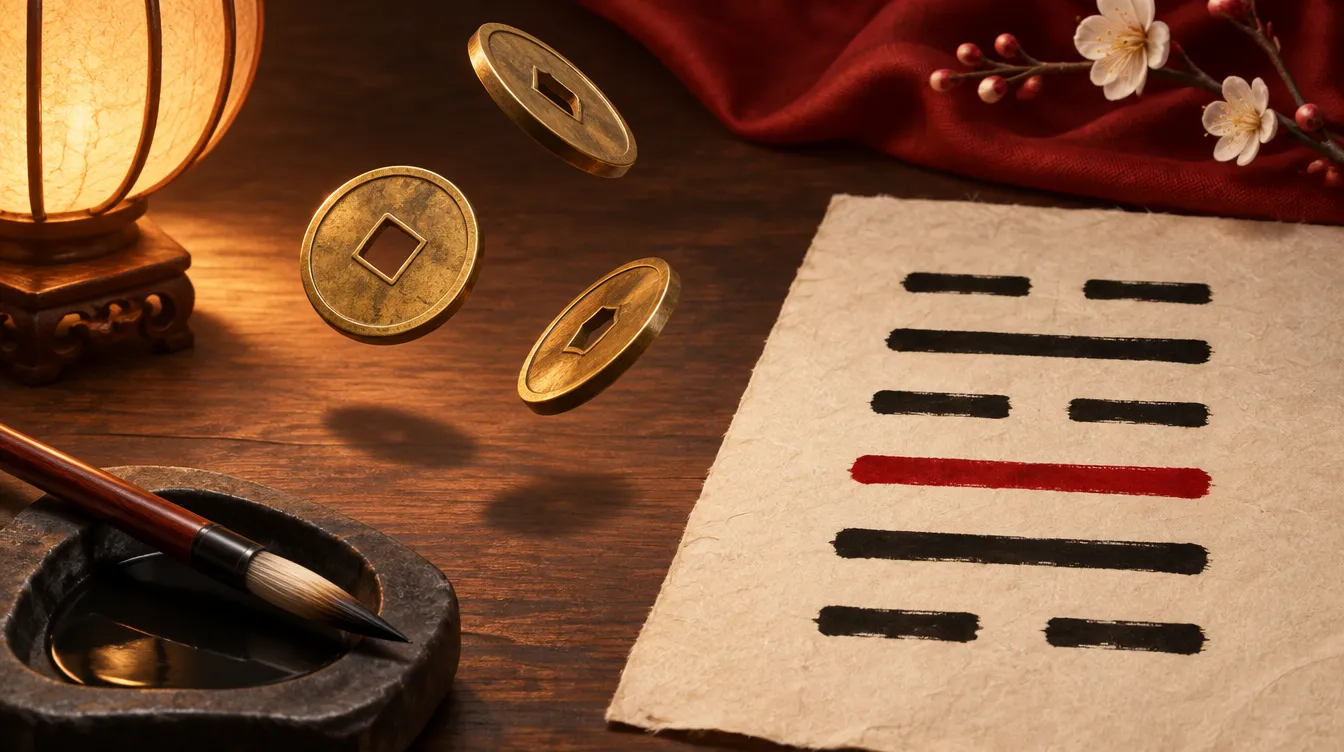
Hold your question in mind and toss three coins together, six times. Each toss gives one line. Count heads (the yang side) as 3 and tails (the yin side) as 2, and add up the three coins. The first toss is the bottom line, and the hexagram grows upwards to the sixth.
| Coins | Total | Line | Chance |
|---|---|---|---|
| Three tails | 6 | Old yin, broken and changing (becomes yang) | 1 in 8 |
| One head, two tails | 7 | Young yang, solid and stable | 3 in 8 |
| Two heads, one tail | 8 | Young yin, broken and stable | 3 in 8 |
| Three heads | 9 | Old yang, solid and changing (becomes yin) | 1 in 8 |
This is where the classical line names come from. A yang line is called 九 (nine) and a yin line 六 (six), and the positions run 初 (first), 二, 三, 四, 五 and 上 (top). So 初九 is a yang line at the bottom and 上六 a yin line at the top. In our tool, each coin is decided by a cryptographic random number generator on our server when you pick up the coins, and you reveal the lines one toss at a time. The tool shows the coins for every toss, and marks changing lines in red with 变.
Ask your question now
Toss three coins six times and read your hexagram’s judgment, image, changing lines and relating hexagram, in English and 中文.
Ask the I ChingHow to read the judgment, the image and the lines
Read in layers. The judgment (卦辞) is the hexagram’s short verdict on the situation as a whole. The image (象辞) pictures the two trigrams together and says what a wise person (君子) does about it. For hexagram 1, 乾, the judgment is 元亨,利贞, “great success; persistence brings benefit”, and the image is 天行健,君子以自强不息, “heaven moves with strength; the wise person keeps strengthening themselves without rest”.
Then turn to the changing lines. Each line has its own text, and only the changing ones apply to your cast. Traditionally the lower three lines describe the inner side of a matter and its beginnings, the upper three the outer side and how it plays out, with the second and fifth lines as the centres of each half. Our tool shows the judgment and image in classical Chinese with an English rendering, our plain-language meaning, a note on your topic if you chose a specific one, and one small next step.
How many changing lines?
- None: the situation is settled for now. The judgment and image are your answer, and there is no relating hexagram.
- One: that line is the heart of the answer. Read it closely against your question.
- Several: read each from the bottom up as stages of the same story. Schools differ on which line to weigh most, so let the relating hexagram guide the overall direction.
What is the relating hexagram (之卦)?
Changing lines are the moving parts of a situation. Flip each one, so an old yin 6 becomes yang and an old yang 9 becomes yin, and keep the other lines as they are. The result is the relating hexagram, also called the changed hexagram (变卦). The primary hexagram describes where you stand; the relating hexagram shows where things are heading if they keep moving the way they are.
Here is an example. Suppose you toss 9, 7, 7, 8, 8, 6 from the bottom. The lower three lines are all yang (乾, Heaven) and the upper three all yin (坤, Earth), which makes hexagram 11, 地天泰, Peace: heaven and earth in harmony. The first and sixth lines change. 初九 says 拔茅茹以其汇,征吉: pull up one reed and its roots bring others with it, so going forward together brings good fortune. 上六 says 城复于隍: the city wall slips back into its moat. Flip those two lines and you reach hexagram 18, 山风蛊, Repair. Read together: a good season, best used with others, that also asks you to look after what you have built before it wears down.
Our tool shows the relating hexagram only when your cast has changing lines. It draws it, gives its number and name, and labels it as where the situation is heading. With no changing lines, no relating hexagram appears, and the hexagram you cast is the whole answer.
Common mistakes when consulting the I Ching
- Casting again because you dislike the answer. The I Ching itself warns against this in hexagram 4, 蒙: 初筮告,再三渎,渎则不告, “the first divination is answered; asking two or three times is disrespectful, and then no answer is given”.
- Reading only the hexagram’s name. “Conflict” or “Standstill” sounds alarming on its own; the judgment and lines usually describe how to handle it calmly.
- Reading every line. Only the changing lines speak to your cast; the others describe stages that are not moving now.
- Changing the question after you see the answer. Read the hexagram against what you wrote down.
- Treating the answer as fate. A hexagram describes a tendency and gives advice; the choice stays with you.
Questions
Can I ask the I Ching a yes or no question?
You can, but you will get more from asking for advice, such as “What should I keep in mind if I accept this offer?”
Which line is the bottom one?
The first toss. Hexagrams are built from the bottom up, so line 1 is at the bottom and line 6 at the top.
Why do 6 and 9 change, but not 7 and 8?
6 and 9 are “old” yin and yang, at their extreme, so they turn into their opposite. 7 and 8 are “young” and stay as they are.
What if all six lines change?
Then the situation is turning over completely, and the relating hexagram, where you are heading, carries more weight than usual.
How often can I ask?
Ask once per question and give the answer time. Our free tool allows up to 5 casts a day per account, for different questions.
For reflection and entertainment.