Guide · New Year symbols
Mandarin oranges, pineapples and other New Year symbols explained
Updated 22 November 2026
In short
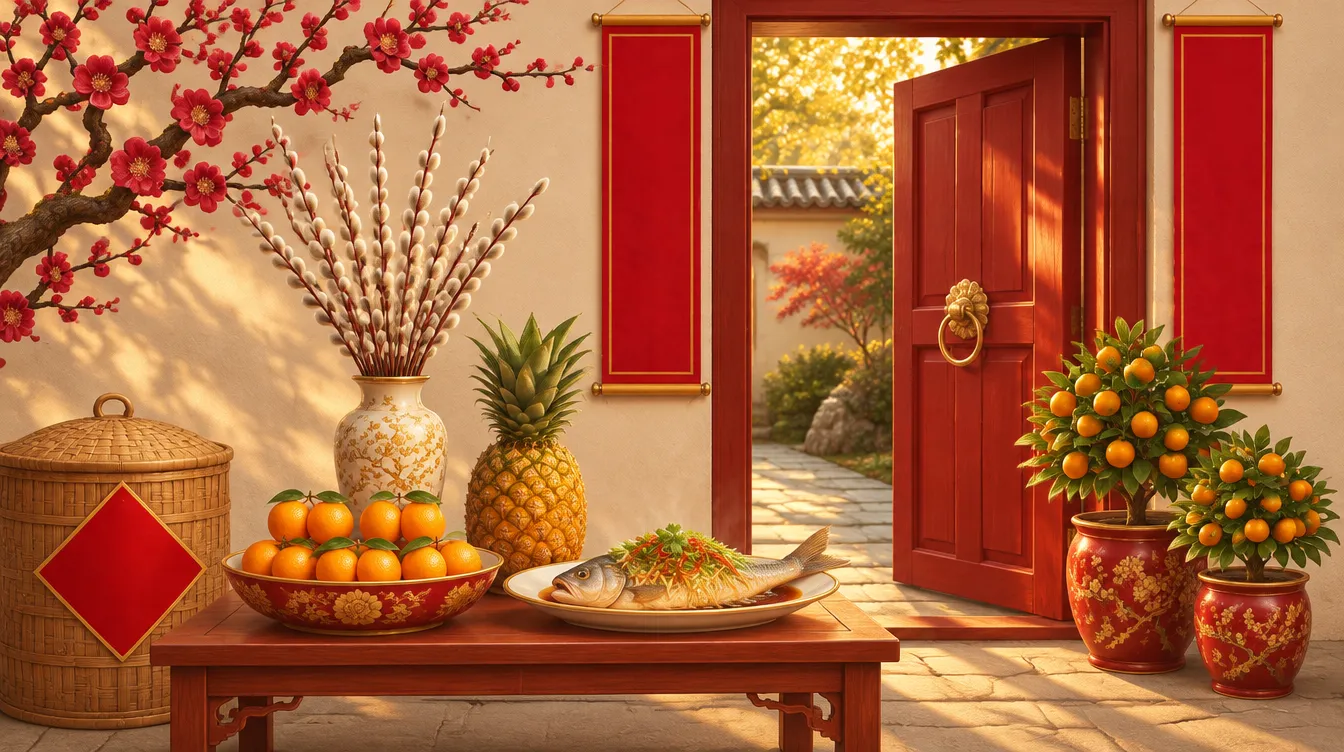
Most Chinese New Year symbols are puns. A mandarin orange is 柑 (gam), which in Cantonese sounds the same as 金, gold. A pineapple is ong lai in Hokkien, which sounds like “prosperity arrives”. An upside-down 福 reads as “luck has arrived”, and fish (鱼) sounds like surplus (余). Each pun works in a particular dialect, which is why Singapore and Malaysia homes, with their mix of Hokkien, Teochew, Cantonese and Hakka families, display such a rich set. Below is what each symbol means, where the wordplay comes from and how families use it.
Why are so many New Year symbols puns?
Chinese has a small number of syllables and a very large number of words, so many words share a sound. Families have used this for centuries: an object on the table or the door “says” a wish without anyone speaking it. The custom has a name, 讨口彩 (seeking lucky words), and it shapes what is bought, cooked and displayed in the last week of the old year.
The catch is that a pun only works in the dialect where the sounds match. The orange and gold pun is Cantonese. The pineapple pun is Hokkien and Teochew; in Mandarin the fruit is 菠萝 or 凤梨 and the joke disappears. So when a Cantonese grandmother insists on oranges and a Hokkien uncle hangs a pineapple, both are following their own family’s language.
The main New Year symbols and what they mean
| Symbol | The wordplay or meaning | Where you will see it |
|---|---|---|
| Mandarin oranges (柑) | Cantonese gam sounds like 金 (gold) | Carried in pairs when visiting; piled in bowls at home |
| Kumquat plants (金桔, 年桔) | 桔 (gat) sounds like 吉 (luck), and the fruit is golden | Potted pairs at shop and home entrances |
| Pineapple (黄梨, 王梨) | Hokkien and Teochew ong lai sounds like 旺来, prosperity arrives | Hanging decorations, pineapple tarts, a real fruit by the altar |
| Upside-down 福 | 倒 (upside down) sounds like 到 (arrived): luck has arrived | Doors, rice bins, cupboards |
| Fish (鱼) | 鱼 (yú) sounds like 余, surplus: 年年有余 | Reunion dinner; fish-shaped decorations |
| Pussy willow (银柳) | “Silver willow”: silvery buds like silver, and new shoots for growth | Tall vases in living rooms, often dyed or decorated |
| Plum blossom (梅花) | Flowers in the cold of late winter: endurance and the first sign of spring | Paintings, artificial branches, decorations |
| Spring couplets (春联) | Paired lines of good wishes on red paper, framing the door | Front doors, shopfronts, temple gates |
| Nian gao (年糕) | 糕 (gāo) sounds like 高, higher: rising year by year | Offerings and gifts; fried with egg or yam |
| Huat kueh (发粿, 发糕) | The cake “blooms” as it steams, like 发, to prosper | Altar offerings, especially in Hokkien homes |
Start the year with a stick
Draw a free Guanyin stick for the year ahead and read its classical verse, explained in plain words.
Draw a stickWhy are mandarin oranges given in pairs?
Visiting at New Year in Singapore and Malaysia usually means carrying a bag of mandarin oranges. You hand two to the host with a greeting, and the host gives two back as you leave, so both households end the visit with “gold”. Pairs matter because of a separate saying, 好事成双: good things come in pairs. Even numbers in general are preferred at New Year for the same reason.
Kumquat plants follow the same logic on a larger scale. Shops and homes place a matching pair either side of the entrance, the potted version of a couplet. After the season some families replant them. The fruit on these potted plants is usually sour, so it is more often preserved or squeezed into drinks than eaten fresh.
Pineapples and the upside-down 福
The pineapple is the most Southeast Asian of the symbols. Many Chinese families in Singapore and Malaysia have Hokkien or Teochew roots, and in both dialects the fruit’s name sounds like 旺来, prosperity arriving. That is why pineapple tarts (黄梨挞) are on almost every New Year table here, why shops hang plastic and paper pineapples, and why some families place a real pineapple near the altar.
The upside-down 福 works in Mandarin: 福倒了 (luck is upside down) sounds exactly like 福到了 (luck has arrived). A popular story credits a servant in a Qing dynasty prince’s household who pasted it the wrong way up and was saved by a quick-witted remark. Families still debate where it belongs. Many keep the 福 on the main door upright, as a respectful welcome to visitors, and turn it upside down on rice bins, water containers and inner doors. Either way is a family choice.
How spring couplets work
Spring couplets (春联) began as 桃符, peach-wood boards hung on doors. The earliest couplet on record is traditionally credited to Meng Chang (孟昶), ruler of the Later Shu kingdom in the tenth century: 新年纳余庆,嘉节号长春, “the new year receives lasting blessings; the fine festival is called eternal spring”. Paper replaced wood, and red became the colour of the season.
- A full set has three parts: an upper line (上联), a lower line (下联) and a short horizontal scroll (横批) above the door.
- The two lines match word for word in grammar and meaning. Traditionally the upper line ends on a falling or “oblique” tone and the lower line on a level tone.
- The traditional placement puts the upper line on the right as you face the door, because classical Chinese was read from right to left. Many modern sets follow the direction of the horizontal scroll instead.
- Cantonese families also put up 挥春 (fai chun): short four-character wishes, often on diamond-shaped squares, on walls and cupboards.
- Households in mourning traditionally skip red couplets for the year, out of respect.
Pussy willow, plum blossom and the fish you don’t finish
Pussy willow (银柳, “silver willow”) is a fixture of flower markets in both countries. The soft silvery buds are read as silver, and the shoots that follow as growth; in Cantonese the name also echoes 有银有楼, “silver and property”. Stalls often sell it dyed pink or gold, or hung with small ornaments. Kept in water, the branches often sprout leaves and even roots after the season, which many families take as a pleasant sign of the year ahead.
Plum blossom (梅花) carries a different message. It flowers in the cold at the very end of winter, so it stands for endurance and for spring arriving early. Plum trees struggle in the tropics, so in Singapore and Malaysia you mostly see it in paintings, prints and artificial branches. Its five petals are often linked with the five blessings (五福).
Fish brings the pun to the dinner table. Because 鱼 sounds like 余 (surplus), many families serve a whole fish at the reunion dinner and leave some of it uneaten, so the household “has surplus” as one year turns into the next. The dishes of the reunion dinner, and what each one means, have their own guide.
Questions
Why do people give two mandarin oranges at Chinese New Year?
In Cantonese the orange (柑) sounds like gold (金), and giving a pair follows the saying 好事成双, good things come in pairs. The host gives two back.
Should the 福 character be upside down on the front door?
Families differ. Many keep the main door’s 福 upright and turn it upside down on rice bins, cupboards and inner doors. Both are accepted customs.
What does the pineapple mean at Chinese New Year?
In Hokkien and Teochew the pineapple is ong lai, which sounds like 旺来, prosperity arrives. That is why pineapple tarts and decorations are everywhere in Singapore and Malaysia.
Why don’t families finish the fish at the reunion dinner?
Fish (鱼) sounds like surplus (余). Leaving some is a wish for 年年有余, having more than enough every year.
When do people put up and take down New Year decorations?
Couplets and 福 usually go up in the last days before the eve, after the big clean. Many homes leave couplets until they fade or are replaced the next year; other decorations often come down after Chap Goh Mei, the 15th day.
For reflection and entertainment.