Guide · Baby customs
Full month (满月) and first birthday (抓周) customs explained
Updated 22 November 2026
In short
A Chinese baby’s first month ends with 满月, the full-month celebration. It closes the mother’s confinement (坐月子), the traditional month of rest after the birth, and introduces the baby to family and friends. In Singapore and Malaysia the gift box changes with the family’s roots: red eggs almost everywhere, ang ku kueh and glutinous rice in Hokkien homes, pig trotters in ginger and black vinegar in Cantonese ones, and turmeric rice with curry chicken among the Peranakans. A year later many families hold 抓周, when the baby picks from a tray of objects. It is a game for photos and stories, and nothing about it decides a child’s future. This guide covers both, with a checklist for guests.
Why do Chinese families celebrate the first month?
The full month marks the end of confinement. Singapore’s national heritage site Roots describes the Chinese custom as a 30-day confinement in which the mother stays at home, keeps warm and eats “warming” foods such as ginger, vinegar, chicken, pig trotters, Chinese herbs and Chinese wine, while avoiding “cold” foods such as cucumber, cabbage and fruit juice. Traditionally the baby is not taken out during that month either. So the first big outing, and the first time most relatives meet the baby, is the full-month gathering.
Many families in Singapore and Malaysia hire a confinement nanny for the month, known in Cantonese as 陪月 (pui yuet), who cooks the confinement meals and helps with the baby. Some of the old rules, such as not washing the hair for a month, are hard to keep in a hot, humid climate, and Roots notes they are often not practical in Singapore. Your doctor’s advice on rest, bathing, diet and alcohol in cooking always comes first. For comparison, Malay and Indian mothers traditionally observe a longer confinement of 40 to 44 days, though many now keep 30.
What goes in a full-month gift box, family by family
Families send food to relatives and friends to announce the baby and share the joy. What goes in depends on where the family’s grandparents came from, and many households today mix traditions or order a ready-made set from a bakery.
| Family tradition | What is shared | What it stands for |
|---|---|---|
| Most Chinese families | Red-dyed hard-boiled eggs, often with pickled ginger | New life, roundness and togetherness; red for joy |
| Hokkien | Ang ku kueh (红龟粿, “red tortoise cake”) and glutinous rice | The tortoise for long life; rice for a life with enough to eat |
| Cantonese | Pig trotters and eggs stewed with ginger in sweet and black vinegar (猪脚姜醋) | A confinement food shared to say “we have a baby” |
| Peranakan (Baba-Nyonya) | Nasi kunyit (turmeric glutinous rice) with curry chicken, red eggs and ang ku kueh | Yellow and red for celebration; the set itself announces the full month |
The Cantonese custom has its own vocabulary. To 派姜醋, “hand out ginger vinegar”, means to announce a birth, so an aunt asking a newly married couple when they will 派姜醋 is really asking about a baby, and visiting a new mother is called 食姜醋, “eating ginger vinegar”. Roots also records a Malaysian variation: in Ipoh, Cantonese families give braised pig trotters to relatives after the twelfth day of confinement, a practice it notes is less common in Singapore.
Among Peranakan families, delivering the nasi kunyit set to close relatives is itself the announcement, so even families who skip a big party usually send it. Teochew, Hakka, Hainanese and Foochow families have their own variations, and the best source is always your own elders: ask what your grandmother sent.
See your baby’s four pillars
Enter the birth date, time and city. The free chart uses true solar time and shows the baby’s Day Master and favourable elements.
Make a free chartRed eggs, tortoise cakes and the first haircut
Each item in the box carries a wish. Eggs stand for new life, and their round shape for harmony and togetherness; dyeing them red adds the colour of celebration. Ang ku kueh are moulded with a tortoise-shell pattern because the tortoise is a symbol of long life and completeness. Glutinous rice sticks together and fills the stomach, a wish that the child will never go hungry.
Many families also trim or shave the baby’s first hair (剃胎毛) around the full month. Some keep a lock in a red packet or tied with red ribbon, and some have it made into a keepsake brush (胎毛笔). Close relatives often mark the day with small gold gifts, such as a bracelet, an anklet or a 长命锁, a little “longevity lock” pendant. Whether you follow any of this is entirely your family’s choice.
When is the full-month party held?
Families count the month in slightly different ways. Some hold it on the 30th day, some a full 30 days after the birth, and some older relatives prefer the same date in the next lunar month. In practice most families pick the nearest weekend so working guests can come. Here is a worked example we computed with our calendar library for a baby born on Wednesday 10 March 2027, which is the 3rd day of the 2nd lunar month:
- Counting the birth day as day 1, the 30th day is Thursday 8 April 2027.
- A full 30 days after the birth is Friday 9 April, which is also the 3rd day of the 3rd lunar month, so the solar and lunar counts happen to agree.
- The nearest weekend is Saturday 10 and Sunday 11 April, when most families would hold the meal.
Lunar months have 29 or 30 days, so in other months the two counts can differ by a day. If your family cares about the exact day, ask the eldest relative which way they count, and then choose the weekend around it.
What is 抓周, the first-birthday grab?
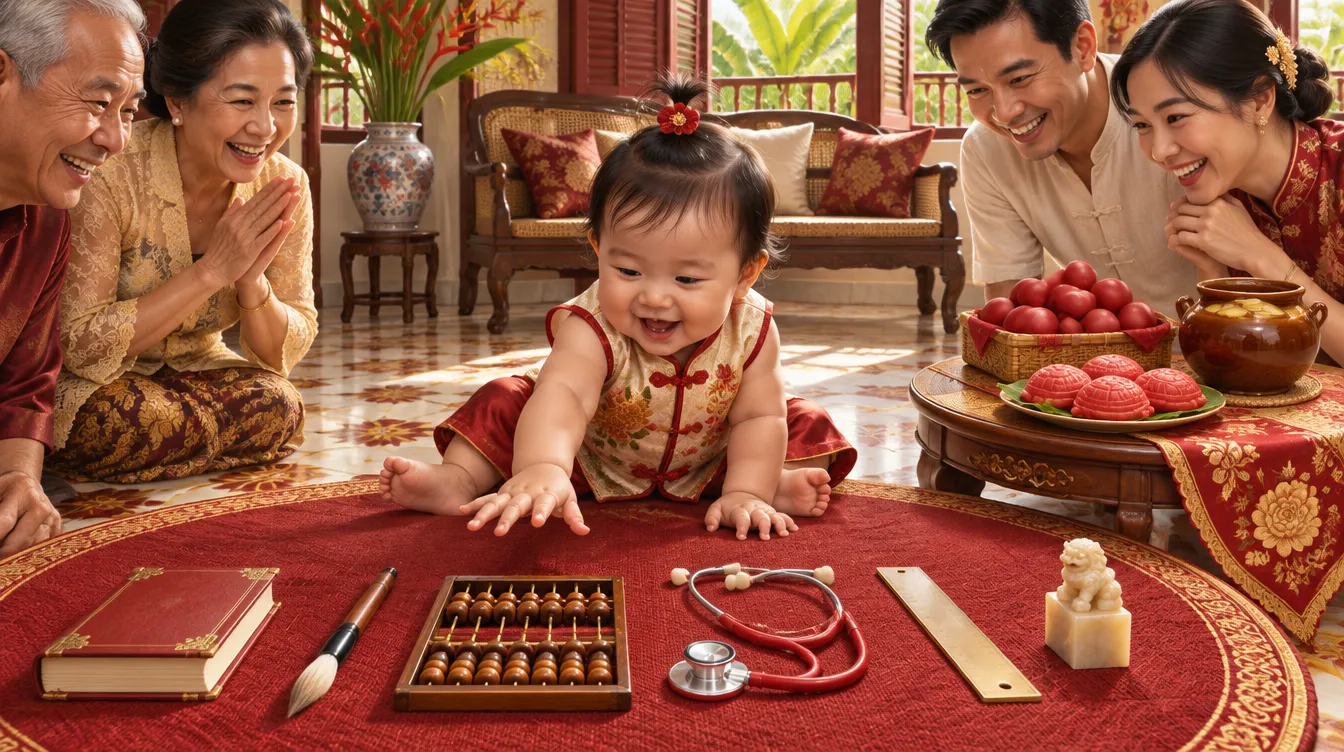
At the first birthday (周岁), many families lay out a tray or mat of objects and let the baby crawl over and pick one. The custom is old. In the sixth century Yan Zhitui described it in his Family Instructions (颜氏家训): in the south, when a child reached one year, it was bathed and dressed in new clothes, and a boy was given bows and arrows, paper and brushes, a girl knives and rulers, needles and thread, along with food, treasures and toys. The family watched what the child reached for, called it 试儿, “testing the child”, and then held a feast for relatives.
Even classic literature treats the result with a smile. In Dream of the Red Chamber (红楼梦), the baby Jia Baoyu ignores everything on offer and grabs rouge and hairpins, and his stern father decides he will grow up a pleasure-seeker. The novel then shows him as a boy of rare intelligence. The point is clear: the grab makes a good family story and tells you nothing about the future.
A modern tray often includes objects like these, each with a popular meaning:
- A book or a pen: study and learning.
- A calculator or an abacus: business and a head for numbers.
- A banknote in a red packet: a comfortable life.
- A toy stethoscope: caring for others, medicine.
- A ruler: fairness, design or building things.
- A seal or stamp: leadership.
- A toy microphone, a ball or a spatula: performing, sport or cooking.
Etiquette for guests: a quick checklist
- During confinement, ask before you visit, keep the visit short, wash your hands, and stay away if you are unwell. Many families prefer to receive visitors at the full-month gathering instead.
- Bring a red packet or a practical gift such as clothes in the next size up. Our red packet guide covers amounts and the numbers families avoid.
- Wrap gifts in red or bright colours rather than white or black.
- Ask before holding or photographing the baby, and before posting photos online.
- Accept the return gift of red eggs or kueh with thanks; it is the family’s way of sharing their good news.
- At a 抓周, cheer whatever the baby picks. Every object is a good one.
A baby’s BaZi chart is fixed at the moment of birth, so none of these customs changes it. If you want to look at that chart, for a name or out of curiosity, our naming guide and our guide for 2027 parents are good next steps.
Questions
What should I bring to a full-month party?
A red packet is the most common gift. Baby clothes, a practical item or, from close family, a small gold piece are also traditional.
Why are full-month eggs dyed red?
Eggs stand for new life and roundness, and red is the colour of joy and celebration, so a red egg shares good news.
Does what the baby grabs at 抓周 predict their career?
No. It is a family game that goes back at least to the sixth century. Enjoy the photos and the story.
Is 抓周 held on the solar or lunar birthday?
Either. Most families in Singapore and Malaysia now use the date on the birth certificate, while some elders prefer the lunar birthday.
Can we skip the big party?
Of course. Many families simply send gift boxes to relatives or hold a small family meal. The custom exists to celebrate, and no family is obliged to follow it.
For reflection and entertainment.