Guide · Flat feng shui
Feng shui for HDB flats and condos: practical tips that cost nothing
Updated 22 November 2026
In short
High-rise flats repeat the same few layouts, so the same feng shui worries come up again and again: a main door facing the neighbour’s door (门对门), a straight line from the door to a window or balcony (穿堂煞), a stove or toilet you can see from the entrance, and mirrors in the wrong place. Traditional schools describe each of these as qi that moves too fast, collides or leaks away. Almost every response costs nothing: move furniture you already own, close internal doors, adjust lighting, clear the entrance and keep the flat aired. If you do want to renovate, HDB rules on wall hacking, fire-rated main doors and noisy-work hours come first, and this guide lists them.
Which feng shui issues come up most in HDB flats?
Most HDB blocks and many condos place units along a shared corridor or around a lift lobby, with the living room, kitchen and bedrooms arranged in a compact rectangle. That efficiency creates a handful of layouts that traditional feng shui comments on. None of them makes a flat unlivable. They are simply the points older relatives tend to notice first at a viewing.
- 门对门, doors facing doors: your main door directly opposite a neighbour’s, common along corridors and in two-unit lift lobbies.
- 穿堂煞, the “piercing hall”: a clear straight line from the main door through the living room to a window or balcony door.
- 开门见灶, seeing the stove from the door: open-concept kitchens put the hob in view of the entrance.
- A toilet beside the entrance or near the middle of the flat, which some schools single out.
- Beams over the bed or sofa, a common side effect of structural design. Our bedroom guide covers beams in detail.
Is it bad if my main door faces a neighbour’s door?
Traditional texts call facing doors a source of 口舌, small disagreements, on the idea that the two households’ qi meets head on. In a corridor block it is also simply a matter of privacy: when both doors are open, each family looks straight into the other’s home. That is the practical problem worth solving, and it needs no special object.
- Keep your own door closed when you are not coming or going, and keep the gate and doormat area tidy.
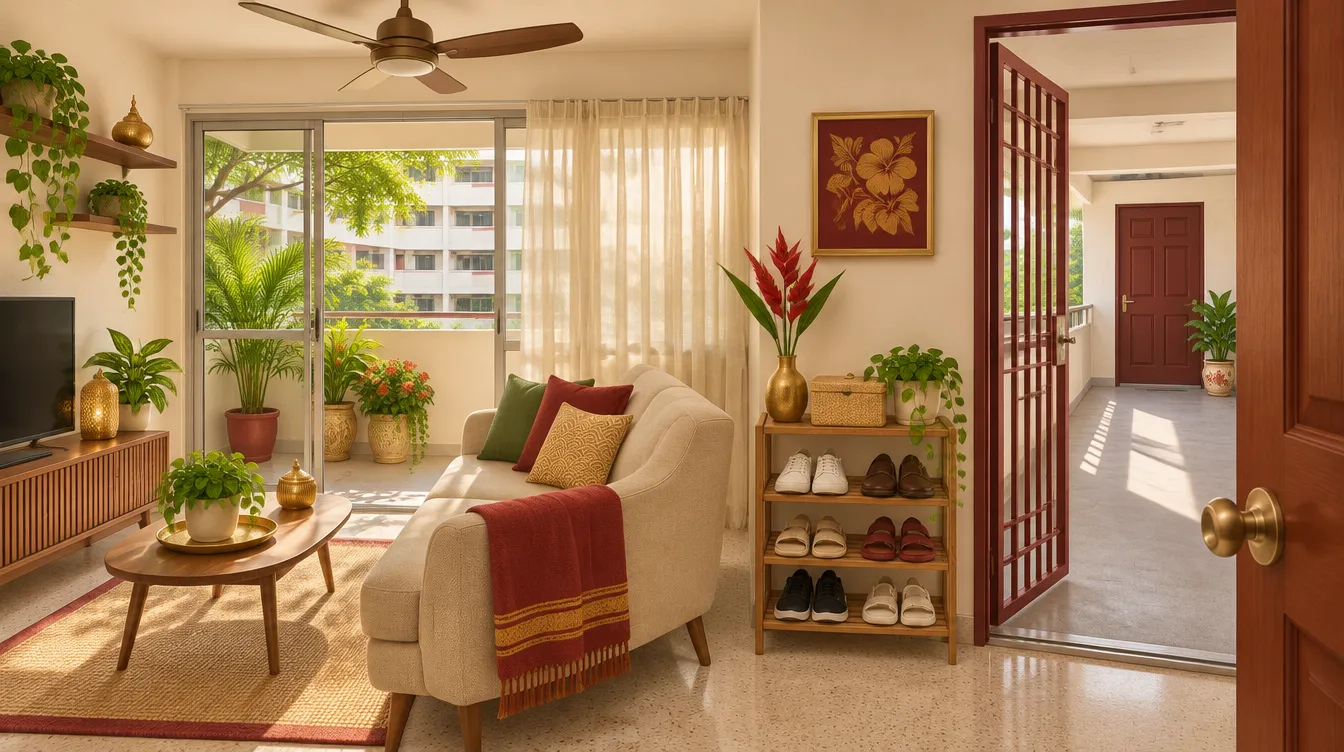
- If you already have a shoe cabinet or bookshelf, place it inside the door so the view into your living room is partly screened.
- Agree small things early with the neighbour: where shoes go, when the gate stays open. Good relations do more for 口舌 than anything hung on a wall.
Avoid pointing a mirror or a bagua plaque at the neighbour’s door. Many practitioners reserve those for outside features such as a sharp corner, and a neighbour who notices one aimed at them may take it as hostile, which creates exactly the friction you were trying to avoid. Remember that the corridor is a fire escape route too. SCDF guidelines call for a clear passage of at least 1.2 metres along the common corridor, and potted plants or shoe racks there are only allowed where the town council permits them.
Which part of your flat is good in 2027?
The free 2027 Flying Stars page shows the star in every sector of your home, and where Tai Sui, Sui Po and San Sha sit this year.
Open the 2027 Flying StarsWhat is 穿堂煞, and what can you do about it?
In feng shui, qi is said to settle where it can slow down and gather. When the main door lines up with a window or balcony door, the theory is that it enters and leaves in one rush, so the living room never holds it. Many HDB layouts are designed for cross-ventilation, which is valuable in a hot, humid climate, so the goal is to slow the path, not to block the breeze.
- Turn the sofa or a bookshelf you already own so it sits partly across the line, creating a gentle curve through the room.
- Draw sheer curtains halfway during the day: light and air still come through, but the view does not run straight out.
- Move existing potted plants to the window end of the line. Healthy plants are a traditional way to soften a fast path.
What about a kitchen or toilet near the main door?
The stove stands for the household’s nourishment and income in traditional feng shui, so seeing it straight from the door is read as wealth leaving easily. A toilet near the door, or near the centre of the flat, is the other common worry, because water draining away is linked with things leaking out. The everyday responses are the same for both, and they are really just good housekeeping:
- If the kitchen has a door or sliding panel, close it when you are not cooking. Many older HDB flats have one.
- Keep the hob clean and working, with every burner in use from time to time.
- Keep toilet doors shut and the lid down, run the exhaust fan or open the window, and dry the floor after use.
- Fix dripping taps and slow drains promptly; tradition and your water bill agree on this one.
Where should mirrors go, and where not?
Mirrors draw more disagreement between schools than almost anything else in a flat. Most practitioners advise against a mirror that directly faces the main door, on the idea that it sends incoming qi straight back out, though a few argue the opposite. Most also avoid a mirror facing the bed. A mirror that doubles the dining table is a popular wish for plenty, but it is a modern idea rather than a classical rule.
Where everyone agrees is light. A mirror on the side wall of a dark, narrow entrance passage, which many flats have, makes the space feel brighter and wider without facing the door. If you are unsure about a mirror you already own, move it to a side wall rather than buying anything new.
Before you change anything: HDB and condo rules
Feng shui advice sometimes ends in “move the door” or “knock down that wall”. In an HDB flat those are regulated works, and the rules below come from HDB’s published renovation guidelines. Check the current HDB renovation pages before you start, because details are updated from time to time.
| Work | What HDB says |
|---|---|
| Hacking or demolishing walls | Needs HDB’s prior written approval and a contractor from the Directory of Renovation Contractors. Structural walls, columns, beams and slabs cannot be hacked. |
| Replacing the main door | Where the door opens onto a fire escape route such as a staircase or lift lobby, the replacement must be half-hour fire-rated with a self-closing device, and needs a permit. |
| Noisy works (hacking, tile removal, heavy drilling) | 9am to 5pm, Monday to Friday only. Not on weekends, public holidays or the eves of major public holidays. |
| Other renovation works | 9am to 6pm on weekdays and Saturdays; none on Sundays or public holidays. |
| Bathroom finishes in a new flat | A three-year restriction applies to removing wall and floor finishes. |
Questions
Should I avoid buying a flat with its door facing a neighbour’s?
No. It is very common in corridor blocks. Keep doors closed, screen the view inside with furniture you have, and get on well with the neighbour.
Do I need a bagua mirror for my HDB flat?
No. Never aim one at a neighbour’s door. Layout, light, closed doors and good relations handle the usual worries.
Is an open-concept kitchen bad feng shui?
Some schools dislike seeing the stove from the door. Keep the hob clean and in use, and place a sofa or shelf you own to soften the view.
Can I hack a wall to fix 穿堂煞?
You rarely need to. Rearranging furniture and curtains works. Any wall hacking needs HDB approval and a DRC contractor, and structural walls cannot be touched.
Which floor is best for feng shui?
Classical feng shui has no single best floor. What matters inside the flat is light, air, a tidy entrance and how you use each sector.
For reflection and entertainment.