Guide · Plants
Plants in Chinese tradition: money plants, bamboo and what they symbolise
Updated 22 November 2026
In short
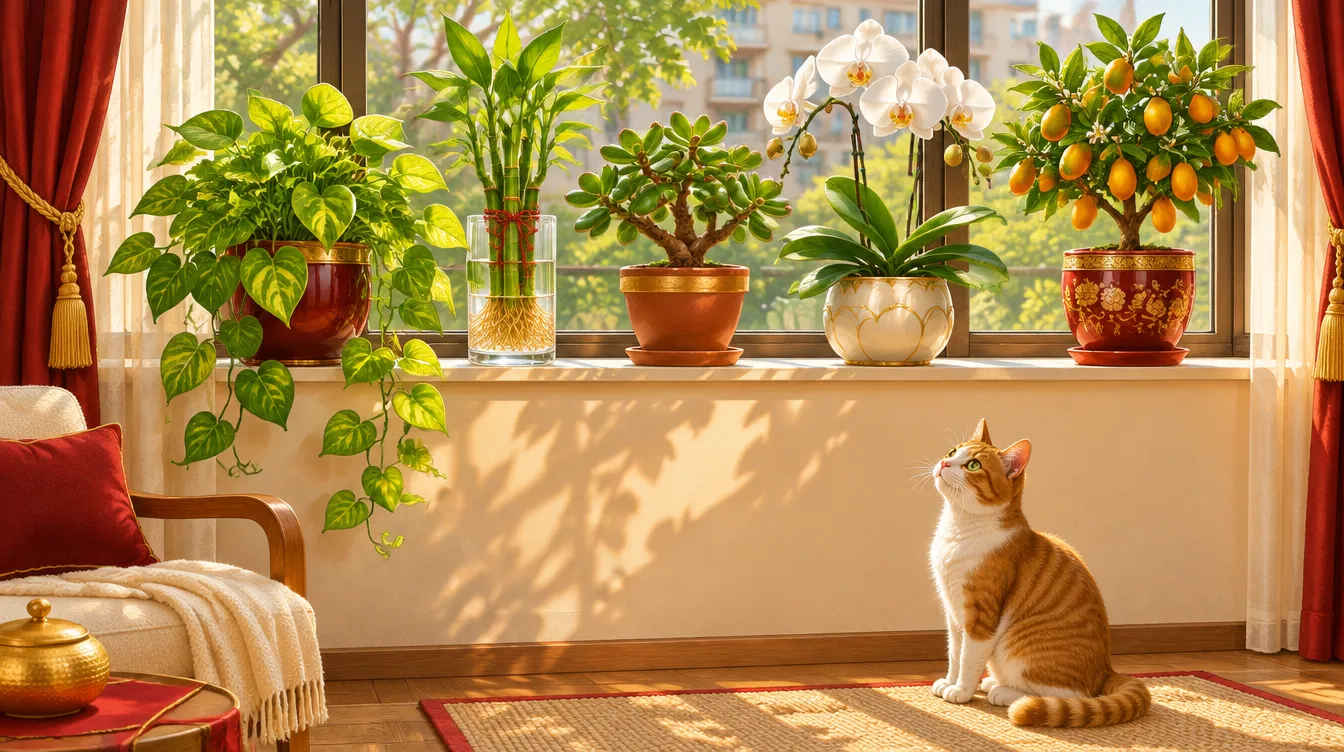
Chinese homes favour plants whose names or shapes carry a wish. The money plant (黄金葛, pothos) has “gold” in its name, lucky bamboo (富贵竹) means “wealth and honour”, and the jade plant’s round leaves look like coins. In feng shui, living plants bring the wood element and a sense of growth, which is why the advice is always to keep them healthy and remove dead ones. Two practical points matter as much as symbolism: several of these plants are toxic to cats and dogs according to the ASPCA, and any plant kept in water needs that water changed often in Singapore and Malaysia, where Aedes mosquitoes breed in still water.
Why do plants matter in a Chinese home?
In the five elements, plants are wood (木), the element of spring and growth, and feng shui reads a thriving plant as 生气, living qi. That is why the tradition is strict about condition rather than species: a healthy, ordinary plant is better than a wilting expensive one, and a dead plant is taken out promptly. Many families also give plants as gifts at housewarmings, openings and New Year, choosing them for their names, since Chinese wordplay turns a plant into a wish.
Some schools dislike spiky plants such as cacti indoors, especially near the door or bed, because sharp points are read as 煞, harsh energy. Others see no problem. If you love a cactus, a sunny windowsill away from where people walk is a reasonable middle way.
What does the money plant (黄金葛) symbolise?
In Singapore and Malaysia, “money plant” usually means pothos (Epipremnum aureum), called 黄金葛 in Chinese. The gold-streaked leaves and the word 黄金, gold, give it its meaning, and its habit of trailing and climbing quickly is read as money that keeps growing. It is one of the easiest plants for a flat: it tolerates low light, grows in soil or in a jar of water, and only needs watering when the top of the soil feels dry. Trim long vines and root the cuttings in water to share with friends, a small custom of passing on growth.
Where do plants suit your home in 2027?
The free 2027 Flying Stars page shows each sector’s star and what suits it, including where greenery helps this year.
Open the 2027 Flying StarsLucky bamboo, the jade plant and the money tree
Lucky bamboo (富贵竹)
Lucky bamboo is not a true bamboo but a dracaena (Dracaena sanderiana). Its name, 富贵, means wealth and honour, and its jointed stems echo 节节高升, “rising node by node”, a wish for steady progress. Sellers often attach meanings to the number of stalks, and many families avoid four because 四 sounds like 死. Grown in water, it needs bright, indirect light and clean water topped up often.
Jade plant (玉树) and money tree (发财树)
The jade plant (Crassula ovata) has thick, round leaves that look like jade coins, so it stands for wealth that holds steady. It is a succulent, and in a humid flat the usual way to lose one is overwatering: give it the sunniest spot you have and let the soil dry out between waterings. The money tree (发财树, Pachira aquatica), often sold with a braided trunk, carries 发财, “to prosper”, in its name. Be careful with English names: the ASPCA notes that the jade plant is also sold as “money tree” and “money plant”, so check the botanical name on the label.
Orchids, kumquats and pussy willow
The orchid (兰) is one of the Four Gentlemen of Chinese painting, with plum, bamboo and chrysanthemum, and it stands for refinement and quiet integrity. Moth orchids (蝴蝶兰) are a favourite New Year gift because a single spray lasts for weeks. Keep them in bright, indirect light and water sparingly; soggy roots are their weak point.
Kumquat plants (年桔) and pussy willow (银柳) arrive with the New Year flower markets, and our New Year symbols guide explains their wordplay. The care question comes after the festival. A kumquat needs several hours of direct sun a day to keep fruiting, so move it to the sunniest window or balcony you have. Pussy willow branches kept in water often sprout leaves and roots; change the water regularly and pot them up if you would like to keep them.
Which of these plants are safe for cats and dogs?
Several of the most popular lucky plants are toxic to pets. The table follows the ASPCA’s plant lists, checked in November 2026. “Toxic” usually means mouth irritation, drooling or vomiting rather than anything worse, but it is a reason to keep these plants where a curious cat or puppy cannot chew them. If a pet does eat one, call your vet.
| Plant | Meaning | Cats and dogs (ASPCA) |
|---|---|---|
| Money plant, pothos (黄金葛) | Gold, growing wealth | Toxic (calcium oxalate crystals) |
| Lucky bamboo (富贵竹) | Wealth and honour, steady progress | Toxic (listed under Dracaena, saponins) |
| Jade plant (玉树) | Wealth that holds steady | Toxic |
| Money tree (发财树, Pachira) | Prosperity | Non-toxic |
| Moth orchid (蝴蝶兰) | Refinement, integrity | Non-toxic |
| Kumquat (年桔) | Good fortune, gold | Treat as toxic: the ASPCA lists citrus such as orange as toxic |
| Pussy willow (银柳) | Silver, new growth | Not on the ASPCA list; keep stems out of reach |
Keeping water plants healthy, and mosquito-free
Plants in water, such as lucky bamboo, pothos cuttings and pussy willow, look clean and simple, but still water is exactly where Aedes mosquitoes lay their eggs. Singapore’s National Environment Agency advises changing the water in vases every other day, scrubbing the inside of the vase, washing the roots, and removing water from plant pot plates on the same schedule. The same habits suit Malaysian homes. They also keep the plant healthier, because stale water starves roots of oxygen.
- Every other day: change vase water, rinse roots, empty pot plates.
- Weekly: wipe dust off leaves so they can use the light, and turn pots so they grow evenly.
- When a plant dies or turns mostly yellow, compost it or bin it. Tradition and plant sense agree.
Where to put them is the last question. The east and south-east are the wood sectors of the home, and our 2027 checklist lists the sectors where plants suit this year. You do not need to buy a lucky plant at all: a healthy plant you already enjoy carries the same idea.
Questions
Is the money plant the same as the money tree?
No. The money plant is pothos (黄金葛), a vine. The money tree is Pachira (发财树). The jade plant is sometimes called both, so check the botanical name.
How many stalks of lucky bamboo should I have?
There is no classical rule. Sellers give each number a meaning, and many families avoid four because it sounds like 死.
Is lucky bamboo safe for cats?
No. The ASPCA lists dracaena, which includes lucky bamboo, as toxic to cats and dogs. Keep it out of reach.
Are artificial plants good feng shui?
Schools differ. Many prefer living plants for 生气. A clean artificial plant is better than a neglected real one.
What do I do with the kumquat plant after New Year?
Give it several hours of direct sun daily and water when the top soil dries. Some families replant it; others pass it on.
For reflection and entertainment.