Guide · Kitchen God Day 2027
Kitchen God Day 2027 (送灶): when it is and what families do
Updated 22 November 2026
In short
The Kitchen God (灶君, Zao Jun) is sent up to heaven a few days before Chinese New Year to report on the household to the Jade Emperor. Most Hokkien, Teochew and Cantonese families in Singapore and Malaysia do this on the 24th of the twelfth lunar month, which in 2027 is Sunday 31 January. Northern China keeps the 23rd, Saturday 30 January. Families offer sweet, sticky foods such as nian gao, then welcome the gods back on the fourth day of the new year, Tuesday 9 February 2027. The custom is optional, and many modern homes keep only a simple version.
When is Kitchen God Day in 2027?
The send-off falls in the last ten days of the twelfth lunar month, 腊月. Which day you use depends on where your family comes from. An old saying, 官三民四船家五, puts it neatly: officials sent the Kitchen God off on the 23rd, ordinary households on the 24th and boat-dwelling families on the 25th. Over time northern China settled on the 23rd, a change often linked to the Qing court, which held its own rites on that day. Southern China kept the 24th, and so did most Chinese communities in Southeast Asia.
| Lunar date | 2027 date | Who keeps it |
|---|---|---|
| 23rd of the 12th month | Saturday 30 January | Northern China; called 北方小年 |
| 24th of the 12th month | Sunday 31 January | Southern China and most families in Singapore and Malaysia |
| 25th of the 12th month | Monday 1 February | Traditionally boat-dwelling and fishing families |
| 4th of the 1st month | Tuesday 9 February | The gods are welcomed back (接神) in many Singapore and Malaysia homes |
We converted the lunar dates with a Chinese calendar library. The year that ends has a short twelfth month of 29 days, so the 24th falls exactly six days before New Year’s Day on Saturday 6 February. The almanac (通书) marks both the 23rd and the 24th as days suitable for 祭祀, making offerings, and the 24th also for 作灶, building or repairing a stove, which fits the occasion nicely. A weekend send-off in 2027 also means most families can be at home for it.
Who is the Kitchen God?
Zao Jun, also called 灶王爷 or 司命灶君, is the god of the hearth. In a traditional house the stove was the heart of family life, so the god who lived beside it saw everything: the meals, the quarrels, the kindness and the waste. Once a year he goes up to report to the Jade Emperor, known to Hokkien speakers as Thni Kong (天公), and the household’s fortune for the coming year is said to follow that report.
Stories about his origin vary. One of the best known tells of a man named Zhang who left his hard-working wife for another woman and fell into poverty. Years later, begging for food, he arrived at his former wife’s door. When he recognised her he was so ashamed that he hid in the stove and died there, and the Jade Emperor made him the god of the hearth. Many families simply know him as a fair-minded witness who keeps an eye on how the home is run.
Check the almanac for any day
Our free daily page shows what the almanac marks as suitable (宜) and best avoided (忌) each day, with a short reading for every sign.
See today’s almanacWhat do families offer the Kitchen God?
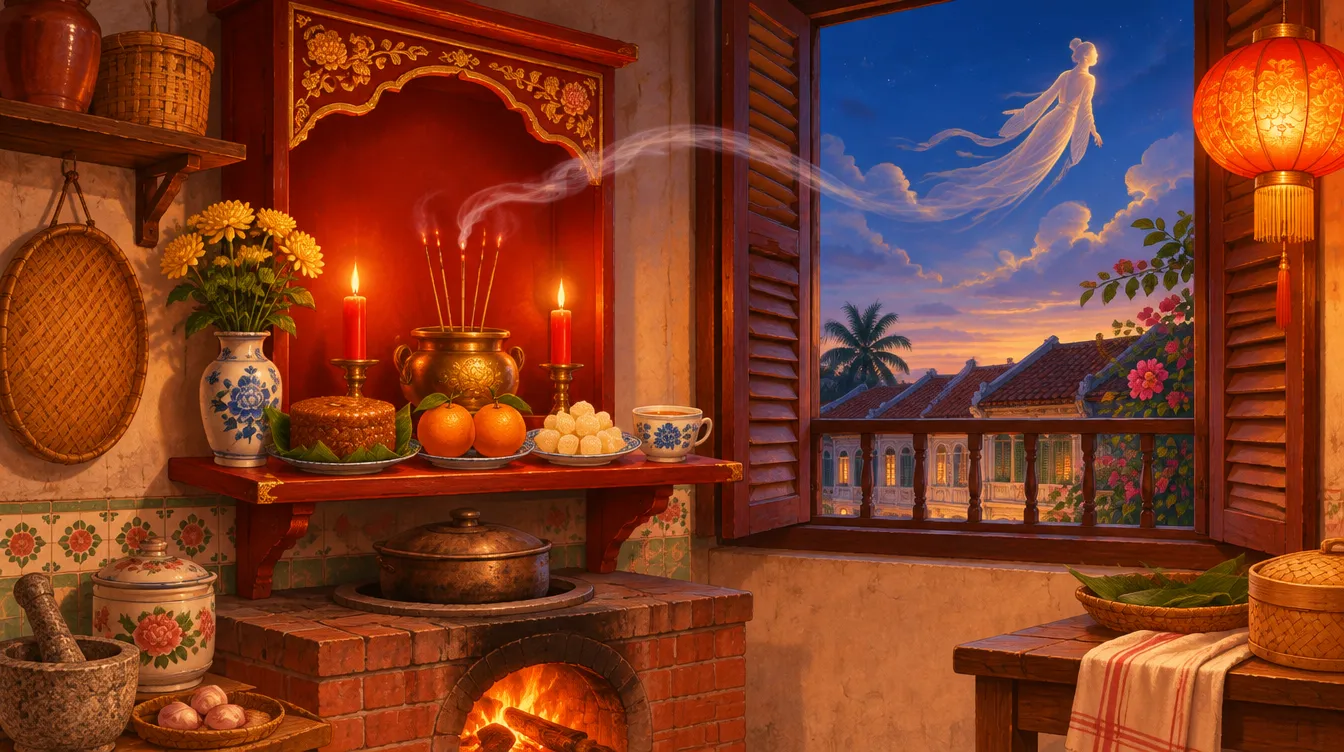
The offerings are sweet, and usually sticky. There are two popular explanations, and families happily hold both: sweet food makes the god speak sweetly of the household, and sticky food keeps his lips together so he cannot say anything unkind. In Penang and across Malaysia the classic choice is thnee kuih (甜粿), the sticky glutinous rice cake known in Malay as kuih bakul and in Mandarin as 年糕. Northern Chinese families offer malt sugar sweets called 糖瓜 or 灶糖.
- Nian gao or thnee kuih, the centre of the table.
- Mandarin oranges, usually in pairs.
- Candied winter melon, red dates, longan and other sweets.
- Chinese tea.
- Joss paper, and in some homes paper clothing, a hat and shoes for the journey.
A Penang family described by The Star in 2026 offers nian gao, mandarin oranges, candied melon and tea, with no meat or cooked dishes. That is typical of the vegetarian, sweet table many families set, though every household has its own version. In Hokkien the send-off is often called sang sin (送神), “sending off the deity”. The usual order is simple: clean the altar and the stove, set out the offerings, light incense, thank the god for watching over the home during the year, then burn the joss paper. If you live in an HDB flat or condominium, use the burners your town council or estate provides.
Why the send-off starts the New Year countdown
The day of the send-off is called 小年, “little New Year”. From here the year’s end gets busy. A folk belief says that once the gods have left to report, you can clean, move furniture and repair things without disturbing them, so the 24th is also known as the day for sweeping away dust (扫尘日). Many Singapore and Malaysia families do their big clean in the days that follow, buy their New Year goods, and finish everything before the reunion dinner on the eve, Friday 5 February 2027.
When does the Kitchen God come back?
In Singapore and Malaysia the gods who went up to heaven are traditionally welcomed back on the fourth day of the first month (接神), which in 2027 is Tuesday 9 February. Families who keep an altar set out fresh offerings, light incense and, where they use one, put up a new paper image of the Kitchen God. Many businesses reopen around the same day, so the welcome back often doubles as the start of the working year. In parts of China the Kitchen God is instead welcomed home on New Year’s Eve, so check what your own elders do.
Keeping the custom in a modern home
Plenty of families no longer have a kitchen altar, and that is fine. You can keep the spirit of the day without any ritual at all: give the stove and kitchen a proper clean, share a plate of nian gao with the family, and use the evening to settle small matters before New Year. If your parents or grandparents keep the full custom, joining them for the send-off is a simple way to learn it. Whether you follow it, and how much of it, is your own choice. Nothing needs to be bought, and no offering changes the year ahead; how your household lives does.
Questions
Is Kitchen God Day on the 23rd or the 24th?
Both are traditional. Northern China uses the 23rd (30 January 2027); southern China and most families in Singapore and Malaysia use the 24th (31 January 2027). Follow your family’s custom.
Why are the offerings sweet and sticky?
Tradition says sweet food makes the Kitchen God speak well of the family, and sticky food such as nian gao keeps his mouth closed so he cannot complain.
When are the gods welcomed back in 2027?
On the fourth day of the first lunar month, Tuesday 9 February 2027, in most Singapore and Malaysia homes that keep the custom.
Do I need an altar to mark the day?
No. Many families simply clean the kitchen, share some nian gao and start their New Year preparations. The custom is optional.
Can I start spring cleaning before the send-off?
Yes. Many families clean whenever they have time before the eve. By folk belief the days after the send-off are the traditional window, because the gods are away.
For reflection and entertainment.