Guide · Temple etiquette
Chinese temple etiquette: a guide for first-time visitors
Updated 22 November 2026
In short
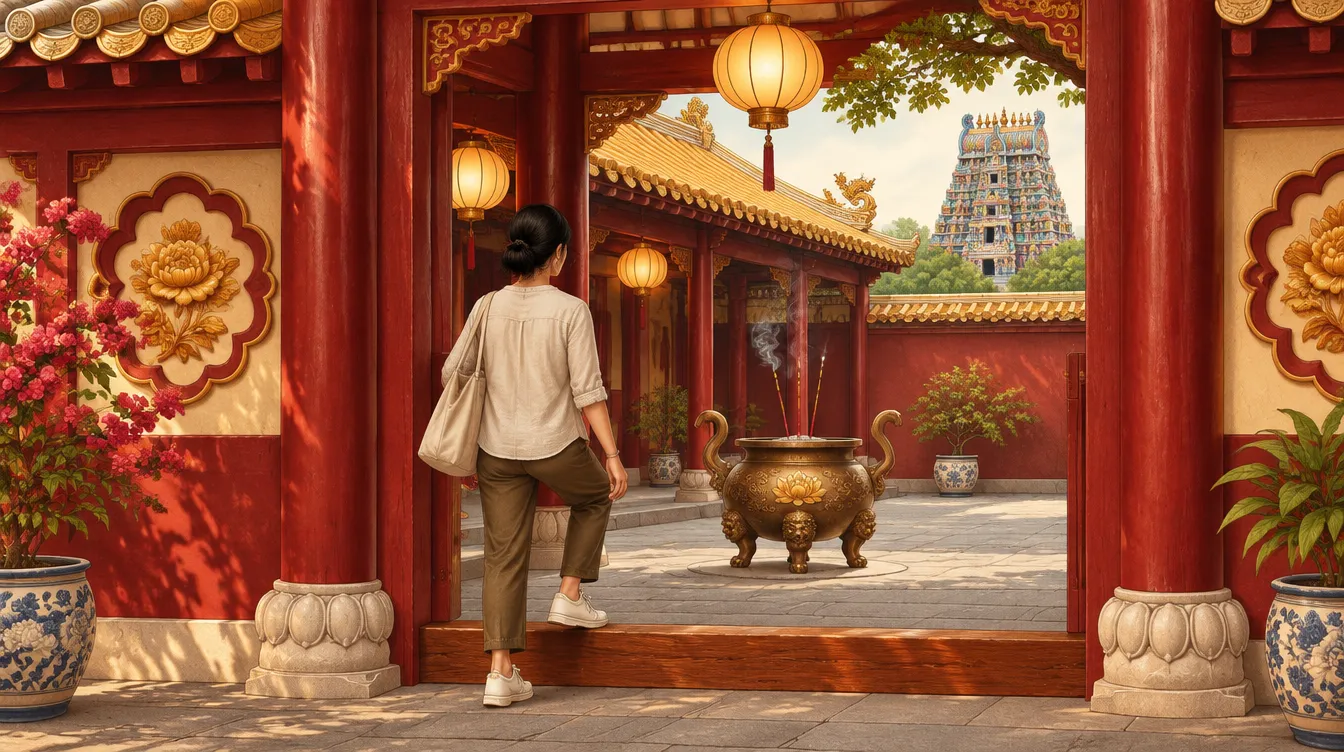
At most Chinese temples you leave the centre door for the deities, enter by the side door on your right as you face the temple (the “dragon side”) and leave by the left, stepping over the raised threshold rather than on it. Dress modestly, speak softly, offer incense in odd numbers (three is common, one where the temple asks), usually starting at the outer censer that faces the sky, and ask before taking photos. Donations are welcome and never compulsory. Customs vary from temple to temple, so the notices and the staff always have the last word.
What should you wear and bring to a Chinese temple?
There is no uniform, but a temple is a working place of worship, and the people praying beside you may be there for something serious. Choose clothes you would wear to visit an elderly relative: shoulders covered, nothing too short, and no slogans that might offend. Most Chinese temples let you keep your shoes on, though some Buddhist halls ask you to remove them, so look for a shoe rack at the door.
Bring a little cash for the donation box, a clear question if you plan to draw a fortune stick, and fruit or flowers if you would like to make an offering. Buddhist temples take vegetarian offerings only. Many temples now provide incense at a counter, and some prefer that you use theirs rather than bring your own.
Which door do you use, and why step over the threshold?
Many temples have three front doors. The centre one is traditionally kept for the deities and, in the old days, for emperors, so visitors use the sides. The common custom is 龙门进,虎门出: enter by the dragon door and leave by the tiger door. Seen from the deity on the altar, the dragon sits on the left and the tiger on the right, so for you, facing the temple from outside, the dragon door is on your right. Taiwanese guides explain it as going in by the dragon’s throat and out by the tiger’s mouth, taking the good in and the bad out.
Then step over the raised threshold, never on it. Its first job was to keep out water, but over time it came to mark the line between the street and a sacred space, and standing on it is seen as disrespectful. Buddhist monasteries teach the same courtesy, often with the advice to keep to the side of a doorway rather than walk through its centre.
Ask your question at our online temple
Can’t get to a temple today? Hold your question in mind and draw one of the 100 Guanyin sticks online, free, with the verse explained in English and 中文.
Draw a stickHow many incense sticks, and which altar first?
Incense is offered in odd numbers, which belong to yang. Three is the most common. Folk custom explains the three as honouring heaven, earth and people; Buddhist teachers link them to precepts, concentration and wisdom. Some temples ask for a single stick to cut smoke. In Singapore, a 2021 joint government advisory to temples, issued with the National Environment Agency, suggested one stick in place of three during busy festival periods, and you may see notices asking for this.
In many temples the round begins at the censer outside the main hall that faces the open sky, often called the 天公炉 or Heaven censer, and then moves inside to the main deity, then to the side altars, the dragon side before the tiger side. Larger temples sometimes number their censers or put up a map. Where there is no guidance, watch a regular and follow their route.
- Light the sticks from the temple’s lamp or lighter, and let any flame die down by waving the sticks gently.
- Hold them with both hands at about forehead height, bow, and say your name, address and wish silently if that is your custom.
- Place them gently in the censer. If one leans, leave it rather than pulling it out to replant; tradition reads pulling incense out as taking back your offering.
Can you take photos, and how much should you donate?
Many temples allow photos of the buildings and courtyards, and some forbid photographing the main altar. Look for signs first, switch off the flash, and never photograph someone praying or drawing a stick without asking. Keep calls outside, and avoid walking between a kneeling worshipper and the altar.
The donation box is usually marked 香油 or 添油香, “incense oil money”, a reminder of the days when gifts paid for the lamps. Give whatever feels right; a few dollars is perfectly normal and nobody keeps count. Temples may also offer lamp lighting or blessings for a fee. Whether you take them up is entirely your choice, and no visit requires them.
Kau cim and moon blocks: a few extra courtesies
If you would like to draw a fortune stick, our step-by-step kau cim guide covers the shaking, the moon blocks and reading the slip. At the temple itself, kneel or stand where others do, keep the cylinder low so sticks don’t scatter across the floor, and if a stick does fall, pick it up and return it before you continue. At a busy festival, draw once and step aside so the next person can have the cushion.
Temples side by side: multi-faith streets in Singapore and Penang
On Waterloo Street in Singapore, Kwan Im Thong Hood Cho Temple, a Guanyin temple from 1884, stands beside the Hindu Sri Krishnan Temple. Many devotees pray at both, a habit known as cross-worshipping, and the Hindu temple has set aside a place where Chinese worshippers can offer joss sticks. In George Town, Penang, the stretch of Jalan Masjid Kapitan Keling known as the Street of Harmony links St George’s Church, the Goddess of Mercy Temple (Kuan Yin Teng), the Sri Mahamariamman Temple and the Kapitan Keling Mosque within a short walk.
On a walk like this, each house has its own customs. Hindu temples and mosques ask you to remove your shoes, mosques ask for arms and legs to be covered, and prayer times may close some areas to visitors. Read the notice at each entrance and follow it, just as you would at a Chinese temple.
A quick checklist for your first visit
- Modest clothes, small cash, and a clear question if you will draw a stick.
- Use a side door: in on your right as you face the temple, out on your left.
- Step over the threshold, not on it.
- Odd numbers of incense, usually three, or one if the temple asks; start at the outer censer if there is one.
- Quiet voice, phone on silent, no flash, ask before photographing people.
- Give what you like to the donation box; nothing is compulsory.
- When in doubt, ask the staff at the counter. They are used to first-timers.
Questions
Can non-Chinese or non-religious visitors go into a Chinese temple?
Yes. Visitors are welcome at almost every temple. You do not have to offer incense or pray; simply walk quietly and follow the notices.
Which side do you enter a Chinese temple?
Usually the dragon side: the door on your right as you face the temple. You leave by the tiger side, on your left. The centre door is kept for the deities.
Why is it three incense sticks?
Odd numbers belong to yang. Folk custom reads three as heaven, earth and people; Buddhists read precepts, concentration and wisdom. One stick is also fine where a temple asks.
What if my incense goes out?
Relight it calmly. Temple keepers generally say there is nothing to worry about.
Do I have to pay for prayers or blessings?
No. Entry and prayer are free at almost every temple. Donations and paid services are optional.
For reflection and entertainment.