Guide · Guanyin feast days 2027
Guanyin’s three feast days in 2027 (观音诞): dates and customs
Updated 22 November 2026
In short
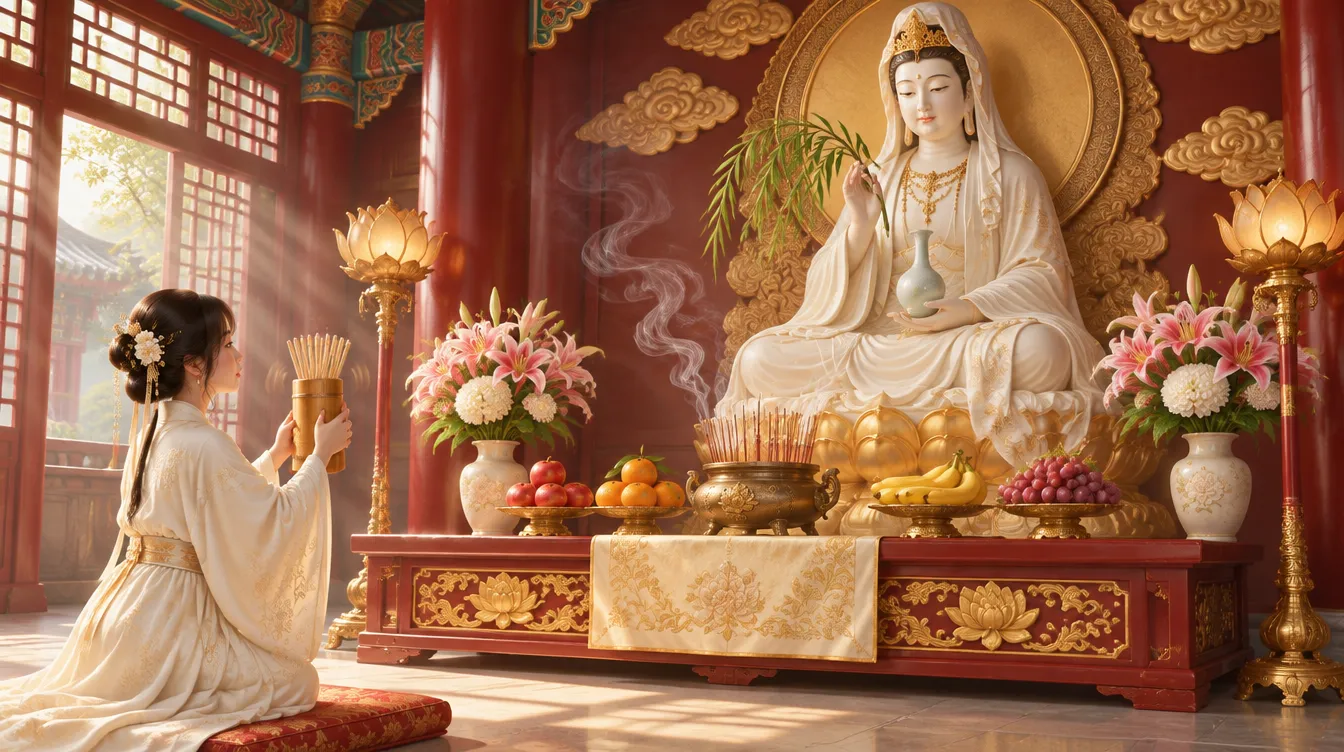
Guanyin (观音), the Bodhisattva of compassion, is honoured three times a year, on the 19th day of the 2nd, 6th and 9th lunar months. In 2027 those days are Friday 26 March, Thursday 22 July and Monday 18 October. Most traditions say the first is her birthday, but sources differ on what the other two mark. Many devotees eat vegetarian on these days, visit a Guanyin temple, and some draw a fortune stick. This guide explains the dates, the story behind them and how to make the most of a visit.
When are Guanyin’s feast days in 2027?
We converted each lunar date with the lunar-typescript calendar library. The dates match the ones in our Kau Cim Malaysia and Guanyin versus Wong Tai Sin guides. We have added 2028 so you can plan ahead: 2028 has a leap 5th lunar month (闰五月), which is why the summer feast day falls so late that year.
| Lunar date | 2027 | 2028 |
|---|---|---|
| 19th of the 2nd month | Friday 26 March | Tuesday 14 March |
| 19th of the 6th month | Thursday 22 July | Wednesday 9 August |
| 19th of the 9th month | Monday 18 October | Sunday 5 November |
Because the dates follow the moon, they land on different weekdays each year. In 2027 only the March date is close to a weekend, and the October one is a Monday, so plan around work if you want to visit. Each temple sets its own hours and programme, so check its notices before you go.
What does each feast day mark?
The most common account says the 19th of the 2nd month is Guanyin’s birthday (诞辰), the 19th of the 6th month is the day she attained enlightenment (成道), and the 19th of the 9th month is the day she left home to follow the religious life (出家). Some temples and writers swap the last two, putting her leaving home in the 6th month and her enlightenment in the 9th. Others give the 6th month a different meaning altogether. No early Buddhist scripture fixes these dates, so neither version is “correct”. Follow whatever your family or temple says.
The dates come from the Chinese legend of Princess Miaoshan (妙善), best known through the Precious Scroll of Fragrant Mountain (香山宝卷). Miaoshan, youngest daughter of King Miaozhuang, refused to marry and chose a life of devotion, which enraged her father. Years later the king fell gravely ill, and a monk said only a medicine made from the eyes and arms of a person without anger could cure him. Miaoshan, living as a hermit on Fragrant Mountain, gave them willingly. When the king came to thank his unknown healer, he recognised his daughter, who was then revealed as the thousand-armed Guanyin. Versions differ on whether her eyes and arms were restored.
Draw a Guanyin stick today
Ask one question and draw from the same 100 Guanyin sticks used in temples, with the verse and a plain-language meaning. Free, five draws a day.
Draw a stickDo you have to eat vegetarian on Guanyin’s days?
Nobody has to, and customs vary a great deal. Many devotees eat vegetarian on the feast day itself, as a simple way of practising the compassion Guanyin stands for. Some keep a vegetarian diet for several days before each date. Others follow a longer list of Guanyin fasting days (观音斋期) printed in some almanacs and temple calendars, though those lists differ from source to source. If you are new to it, one meat-free day on the 19th is a good start.
- Families often cook a simple vegetarian lunch at home, or visit a vegetarian stall near the temple.
- Common offerings are fruit, flowers and vegetarian food. Meat is never offered to Guanyin.
- Some people choose the day to do a kind act: visiting an older relative, donating, or simply being patient with someone.
What happens at temples in Singapore and Malaysia?
Guanyin temples are at their busiest on these three days and on the 1st and 15th of each lunar month. Expect long queues for incense, people kneeling with fruit and flowers, and, at Buddhist temples, group chanting. The Universal Gate chapter (普门品) of the Lotus Sutra, which is devoted to Guanyin, is often recited. Some Malaysian temples also stage opera or puppet shows for the feast days. Arrive early in the morning, or later in the afternoon, for a calmer visit, and take public transport where you can.
One more Guanyin day is well known in Singapore: the 26th day of the 1st lunar month, called the opening of Guanyin’s treasury (观音开库). At the Kwan Im Thong Hood Cho Temple on Waterloo Street, devotees have queued on that day to “borrow” a red packet as a token of good fortune for the year. In 2027 that day falls on Wednesday 3 March. Arrangements have changed in some years, so check the temple’s announcements, and whether you take part is entirely your choice.
Where do Guanyin fortune sticks fit in?
Many Guanyin temples keep a cylinder of 100 numbered sticks, the Guanyin sticks (观音灵签). You pray, ask one question, shake out a stick, confirm it with moon blocks, and read the matching verse. Feast days are a popular time to draw because people feel closest to Guanyin then, but the sticks give the same answers on any day. On a crowded feast day the queue for the cylinder can be long, so have your question ready before you reach it.
If you cannot get to a temple, you can draw one of the same 100 Guanyin sticks online here for free, and every stick has its own page with the rank, the classical verse, its story and a plain-language meaning. Read a stick as a prompt to think your question through, and keep the final decision your own.
Questions
When is Guanyin’s birthday in 2027?
The birthday, the 19th of the 2nd lunar month, is Friday 26 March 2027. The other feast days are 22 July and 18 October.
Which feast day is the most important?
All three are celebrated, and temples are busy on each. The birthday in the 2nd month is the one most people know, but many devotees treat the three equally.
Is it a good day to draw a fortune stick?
Many people like to, but a stick means the same on any day. What matters most is a clear, single question.
Can non-Buddhists visit a Guanyin temple on a feast day?
Yes. Dress modestly, speak quietly, follow the queue and ask before taking photos of people praying.
For reflection and entertainment.