Guide · Fortune sticks
Guanyin sticks and Wong Tai Sin sticks: what’s the difference?
Updated 22 November 2026
In short
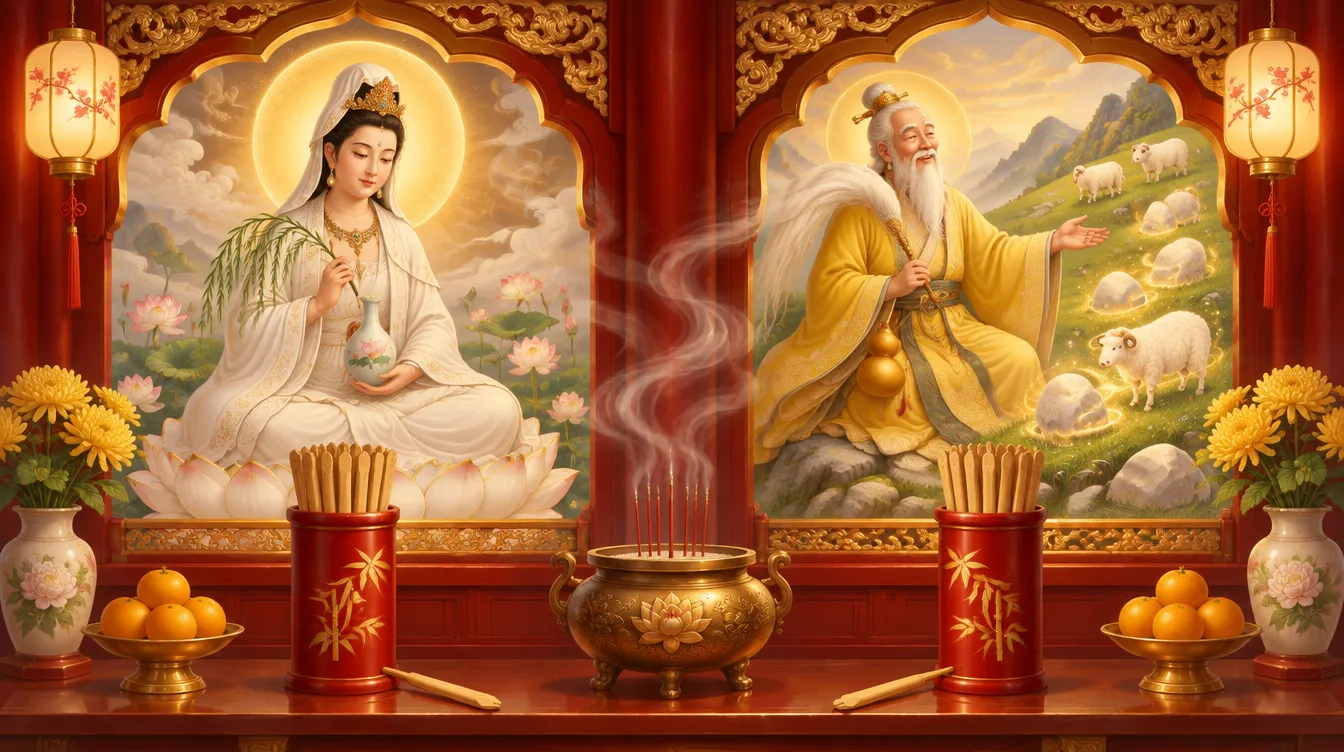
Guanyin (观音) is the Buddhist Bodhisattva of compassion. Wong Tai Sin (黄大仙) is a Taoist immortal, the deified Huang Chuping of Jinhua in Zhejiang, best known through the Sik Sik Yuen Wong Tai Sin Temple in Kowloon, Hong Kong. Both are consulted with a cylinder of 100 numbered sticks, and in both sets each number leads to a four-line verse of seven characters with a story behind it. The verses themselves are different, and so are the ranks, so a number from one set cannot be read with the other. Qian Temple uses the 100-stick Guanyin set, ranked 上, 中 or 下.
Who are Guanyin and Wong Tai Sin?
Guanyin (观音)
Guanyin, short for 观世音, “the one who hears the cries of the world”, is the Bodhisattva of compassion, known in Sanskrit as Avalokiteśvara. Hokkien speakers in Singapore and Malaysia call her Kwan Im, and Cantonese speakers Kwun Yam. Her three feast days fall on the 19th day of the 2nd, 6th and 9th lunar months, which in 2027 are 26 March, 22 July and 18 October.
Wong Tai Sin (黄大仙)
Wong Tai Sin, “the Great Immortal Wong”, is the Taoist name of Huang Chuping (黄初平). The earliest account of him is in Ge Hong’s Biographies of Immortals (神仙传), written in the Eastern Jin period. It tells of a boy of fifteen sent out to herd sheep, who was led by a Taoist to a stone chamber on Jinhua Mountain in Zhejiang. More than forty years later his elder brother found him and asked where the sheep were. Chuping called out, and the white stones on the hillside rose up as sheep, the story known as 叱石成羊. He later took the name Chisongzi, Master Red Pine (赤松子). His birthday is traditionally celebrated on the 23rd day of the 8th lunar month, which is 23 September in 2027.
What is the Wong Tai Sin Temple in Hong Kong?
Wong Tai Sin worship spread from Zhejiang into southern China during the Ming and Qing dynasties and was widespread in Guangdong by the late Qing. In 1915 Liang Ren’an (梁仁庵) and his son, Taoist practitioners from an altar on Xiqiao Mountain in Guangdong, brought it to Hong Kong. In 1921 Liang founded a private temple in Chuk Yuen Village, Kowloon, and set up Sik Sik Yuen (啬色园) to run it. The temple opened to the public in 1956, and in 1969 the surrounding district was named Wong Tai Sin after it. Sik Sik Yuen teaches that Taoism, Buddhism and Confucianism share the same roots, so the temple also honours Confucius and the Buddha.
The temple is famous for kau cim, and its motto 有求必应, “every request is answered”, is closely tied to the sticks. Visitors light incense, kneel before the main altar with their question, and shake a bamboo cylinder until one stick falls out. They exchange its number for a printed slip, and many take it to one of the interpreters in the temple’s fortune-telling arcade. On Lunar New Year’s Eve, crowds wait to place the first incense of the year (头炷香). Wong Tai Sin belief and customs were added to China’s fourth national list of intangible cultural heritage in 2014.
Draw a Guanyin stick
Light incense, shake the cylinder and confirm your stick with the moon blocks, then read the verse, its story and a plain meaning in English and 中文.
Draw a stickHow do the two stick sets compare?
| Feature | Guanyin sticks (观音灵签) | Wong Tai Sin sticks (黄大仙灵签) |
|---|---|---|
| Tradition | Buddhist, also kept in many Taoist and folk temples | Taoist, at a temple that honours three teachings |
| Number of sticks | 100 | 100 |
| Verse | Four lines of seven characters, with a story title | Four lines of seven characters, with a story title |
| Extra text on the slip | Varies by edition and temple | 解曰, a short explanation, and 仙机, short notes on topics such as family, marriage and plans |
| Ranks | 上, 中 or 下 in the set we use | Widely printed in five grades: 上上, 上吉, 中吉, 中平, 下下 |
| Best-known home | Guanyin temples across Asia | Sik Sik Yuen Wong Tai Sin Temple, Kowloon |
On paper the two sets look alike: a hundred numbered sticks, a quatrain for each and a story from history or legend behind it. The verses, though, are different poems. Guanyin stick 1, for example, carries the story 钟离成道, Zhongli Quan attaining the Way, and opens with heaven and earth taking shape. Wong Tai Sin stick 25 tells of 朱洪武登基, the first Ming emperor taking the throne. The same number in the other set is a different verse with a different story.
The ranks differ too. In the edition of the Guanyin set we use, the hundred sticks split into 23 上, 59 中 and 18 下, and none is labelled 上上 or 下下. Wong Tai Sin slips are commonly printed with five grades, with 上上 the rarest. So a 中 Guanyin stick and a 中平 Wong Tai Sin stick are not the same thing. In both sets a rank is only a summary. The verse, its story and your own question carry the real meaning.
How do you read a slip from each set?
A Guanyin verse speaks in images: boats, flowers, the moon, a traveller on a mountain road. The story title points to a well-known tale from history or opera, and the lesson of that tale is usually the key. Read the verse once for its mood, then ask what the story’s hero did right or wrong, and how that fits your question.
A Wong Tai Sin slip usually does more of the work for you. Below the verse, the 解曰 section explains it in plain words, and the 仙机 lines give a short answer for each common kind of question. Read the line that matches what you asked, then go back to the verse for the fuller picture. With either set, an interpreter will first ask what your question was, because the same verse can read differently for a job and for a relationship.
Where can you draw each set in Singapore and Malaysia?
Guanyin sticks are the ones you are most likely to meet at home. In Singapore, the best-known place is Kwan Im Thong Hood Cho Temple (观音堂佛祖庙) on Waterloo Street in Bugis. In Penang, the Goddess of Mercy Temple (观音亭, Kuan Yin Teng) in George Town has its own oracle sticks, and in Kuala Lumpur, Thean Hou Temple has a Guanyin altar beside Mazu’s and fortune-stick oracles in its main hall.
Even Guanyin temples do not all share one set. One local history source counts 60 sticks at Kuan Yin Teng, with verses closer to those used in Mazu temples. Always read a slip with the set it came from; if in doubt, ask at the counter.
Wong Tai Sin worship is centred on Hong Kong, and the Kowloon temple is where his sticks are best known. We have not been able to confirm a specific Wong Tai Sin temple in Singapore or Malaysia, so we do not name one here. If a temple near you keeps a Wong Tai Sin set, its slips will say so.
Which set does Qian Temple use?
Our virtual temple uses the 100-stick Guanyin set (观音灵签). You light incense, shake the cylinder, confirm your stick with the moon blocks, then read the verse, its story and a plain-English meaning for career, love, wealth, health, family and travel. Every verse, rank and story title comes from published editions of the set, checked line by line against a second edition, and we keep the 上, 中 and 下 ranks as they are written.
If you drew a stick at a temple that uses the same 100 Guanyin verses, you can look up its number on our stick pages. If your slip came from Wong Tai Sin or from another set, the same number points to a different verse, so read it with that temple’s own slip or interpreter.
Questions
Are Guanyin sticks and Wong Tai Sin sticks the same?
No. Both sets have 100 sticks with seven-character quatrains, but the verses, stories and ranks are different, so a number only works with its own set.
How many sticks are in a Wong Tai Sin set?
One hundred, the same as the Guanyin set used on this site.
Is Wong Tai Sin Buddhist or Taoist?
Wong Tai Sin is a Taoist immortal. The Hong Kong temple run by Sik Sik Yuen also honours Confucius and the Buddha, because it teaches that the three traditions share the same roots.
Can I look up a Wong Tai Sin stick number on your site?
No. Our stick pages are the 100-stick Guanyin set. A Wong Tai Sin number would show you a different verse, so use the temple’s own slip.
Is a 上上 stick better than a 上 stick?
Only within a set that uses both grades. The Guanyin set we use has only 上, 中 and 下, so its 上 is already its top rank.
For reflection and entertainment.