Guide · Luo Shu
The Luo Shu square: how a Flying Stars chart is built
Updated 22 November 2026
In short
Every Flying Stars chart starts from the Luo Shu (洛书), a three-by-three square of the numbers 1 to 9 in which each row, column and diagonal adds up to 15. Each number belongs to a compass sector, with 5 in the centre. To build a chart, you put one number in the centre and let the others follow the same route every time: centre, north-west, west, north-east, south, north, south-west, east, south-east. In 2027 the centre number is 9, so star 1 goes to the north-west, 2 to the west, and so on round the square. The same method, with different centre numbers, gives the monthly charts and each home’s own chart.
What is the Luo Shu square?
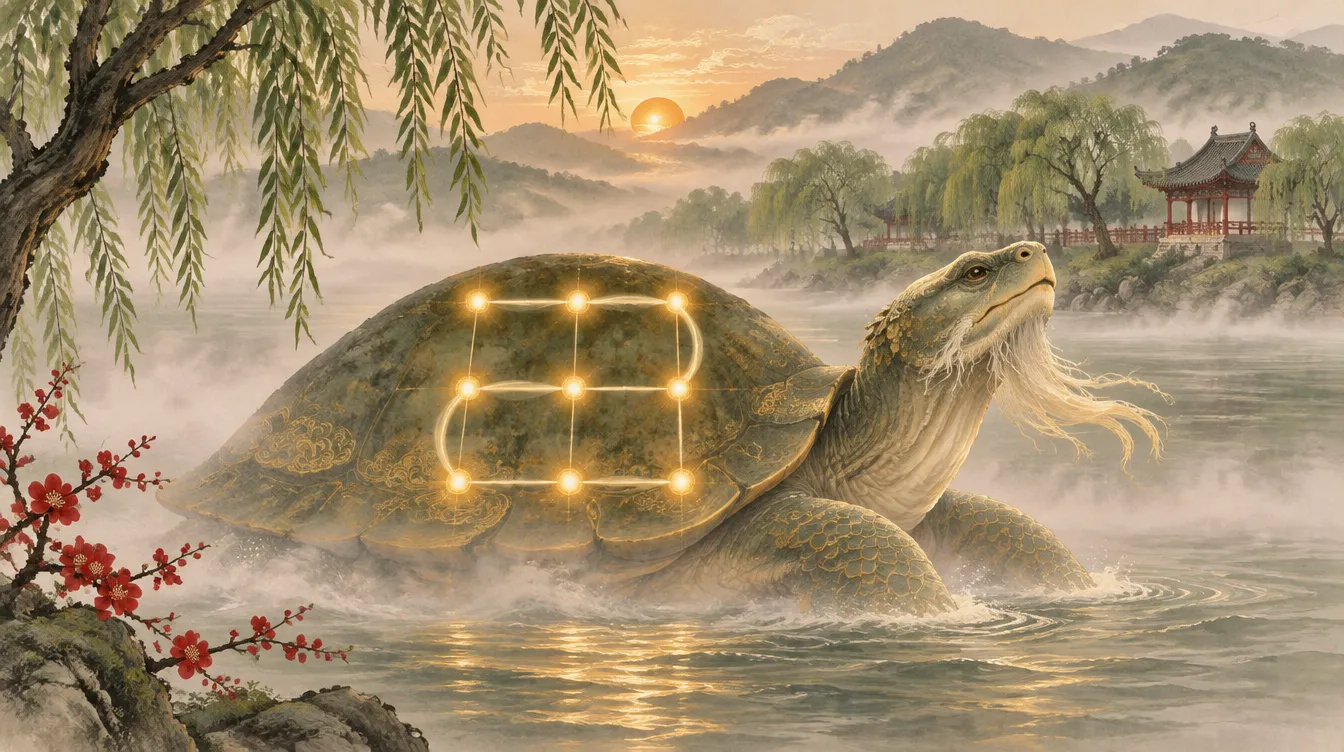
Tradition says the Luo Shu appeared on the shell of a turtle that rose from the Luo River in the time of Yu the Great, the legendary tamer of floods. The pattern of dots on its back became the nine numbers arranged in a square. A traditional rhyme fixes the layout: 戴九履一,左三右七,二四为肩,六八为足,五居中央, “wear nine on the head, tread on one, three on the left, seven on the right, two and four are the shoulders, six and eight the feet, five sits in the centre.”
Chinese maps traditionally put south at the top, so the “head” of the square is south. Laid out that way, the square reads like this, and every line adds up to 15:
| South-east | South | South-west |
|---|---|---|
| 4 | 9 | 2 |
| 3 (east) | 5 (centre) | 7 (west) |
| 8 (north-east) | 1 (north) | 6 (north-west) |
Two features are worth noticing. The odd numbers sit in the four cardinal directions and the even numbers in the corners. And numbers opposite each other always add up to 10: 1 and 9, 2 and 8, 3 and 7, 4 and 6. Feng shui calls that pairing 合十, “joining to ten”, and it comes up again when practitioners read house charts. Each outer number also belongs to one of the eight trigrams of the later-heaven arrangement (后天八卦): 1 is 坎 (water), 2 坤, 3 震, 4 巽, 6 乾, 7 兑, 8 艮 and 9 离 (fire). The number 5 has no trigram, which is also why nobody has a Kua number of 5.
What is the flight path of the Flying Stars?
The route the stars take is hidden in the square itself. Follow the numbers in order, 5 → 6 → 7 → 8 → 9 → 1 → 2 → 3 → 4, and you trace a fixed path through the palaces: centre, north-west, west, north-east, south, north, south-west, east, south-east. This path is called the 洛书轨迹, the Luo Shu track. Whatever number goes into the centre, the next number goes to the north-west, the next to the west, and so on along the same track.
Counting up as you go is called flying forward (顺飞). Annual and monthly stars always fly forward. In a home’s own chart, some star sets fly backward (逆飞), counting down along the same track, depending on the facing. When 5 is in the centre and flies forward, you simply get the original Luo Shu back.
See the 2027 chart on your home
The free 2027 Flying Stars page shows what each star means in its 2027 sector, plus where Tai Sui, Sui Po and San Sha sit.
Open the 2027 Flying StarsHow is the 2027 annual chart built?
Step 1: find the centre star
The annual centre star steps down by one each year, counted from 立春, the start of spring, and wraps from 1 back to 9. 2024 had 3 in the centre, 2025 had 2 and 2026 has 1, so 2027 has 9. A quick check for years from 2000: add the four digits of the year, reduce to one digit, and subtract from 11. For 2027, 2 + 0 + 2 + 7 = 11, which reduces to 2, and 11 − 2 = 9. If the answer is 10, the centre star is 1.
Step 2: fly the rest along the track
With 9 in the centre, 1 goes to the north-west, 2 to the west, 3 to the north-east, 4 to the south, 5 to the north, 6 to the south-west, 7 to the east and 8 to the south-east. A shortcut gives the same result: add 4 to each number of the original square and subtract 9 if the total passes 9. This matches the 2027 chart in our feng shui data, which we checked against eight published sources.
| South-east | South | South-west |
|---|---|---|
| 8 | 4 | 6 |
| 7 (east) | 9 (centre) | 2 (west) |
| 3 (north-east) | 5 (north) | 1 (north-west) |
What are the nine stars’ traditional names?
Each number has a colour and a star name. Seven of the names are the stars of the Northern Dipper (北斗), and the last two are its attendant stars, 左辅 and 右弼. The home palace is where the number sits in the original Luo Shu.
| Star | Star name | Home palace |
|---|---|---|
| 1 White (一白) | 贪狼 Tan Lang, Greedy Wolf | 坎, north |
| 2 Black (二黑) | 巨门 Ju Men, Giant Gate | 坤, south-west |
| 3 Jade (三碧) | 禄存 Lu Cun | 震, east |
| 4 Green (四绿) | 文曲 Wen Qu, the scholar star | 巽, south-east |
| 5 Yellow (五黄) | 廉贞 Lian Zhen | Centre |
| 6 White (六白) | 武曲 Wu Qu | 乾, north-west |
| 7 Red (七赤) | 破军 Po Jun, Army Breaker | 兑, west |
| 8 White (八白) | 左辅 Zuo Fu | 艮, north-east |
| 9 Purple (九紫) | 右弼 You Bi | 离, south |
Year, month and house: how the charts fit together
The same square and the same track produce three kinds of chart, each with its own centre number.
- The monthly chart changes at each solar-term month boundary. A traditional rhyme gives the first month’s centre: 8 in 子, 午, 卯 and 酉 years, 5 in 辰, 戌, 丑 and 未 years, and 2 in 寅, 申, 巳 and 亥 years. So 2027, a 未 year, starts with 5 in the centre from 4 February, then 4 from 6 March, and keeps stepping down. Our desk guide tracks where the study star goes each month.
- The house chart starts with the period number in the centre. For any home whose period is 9, the base chart has exactly the same layout as the 2027 annual chart above. Two more sets of stars, the mountain and water stars, are then flown from the sitting and facing palaces, sometimes backward. Our Period 9 guide explains what that era means for homes.
- The year’s chart is laid over the house chart, sector by sector. That overlay is what a full Flying Stars reading looks at.
To use any of these charts at home, draw a three-by-three grid over your floor plan and find the sectors with a compass; our 2027 home checklist walks through how. The method is the same whether you are reading a year, a month or a house.
Questions
Why does every line of the Luo Shu add up to 15?
The numbers 1 to 9 total 45, and the three rows share that equally, 15 each. The arrangement is the only three-by-three square, apart from rotations and reflections, where every line works.
Which star is in the centre in 2027?
9 Purple (九紫), from 立春 on 4 February 2027 until 立春 2028. 2028 has 8 in the centre.
Do the stars ever fly backward?
Annual and monthly stars never do. In a home’s own chart, the mountain or water stars can fly backward, depending on the facing.
Is the Luo Shu the same as the He Tu?
No. Tradition pairs them: the He Tu (河图) came from the Yellow River, the Luo Shu from the Luo River. Flying Stars uses the Luo Shu.
Why is south at the top of the chart?
Chinese maps and compasses traditionally put south at the top. The numbers stay with their directions whichever way you draw it.
For reflection and entertainment.