Guide · Winter Solstice 2027
Winter Solstice 2027 (冬至): tangyuan and why it is called the little new year
Updated 22 November 2026
In short
The 2027 winter solstice, 冬至, arrives at 10:42 on Wednesday 22 December 2027, Beijing time. Singapore and Malaysia keep the same clock, so it is 10:42 there too. Families mark the evening with tangyuan (汤圆), sweet glutinous rice balls, and many offer the first bowl to their ancestors. The solstice was once the start of the year in ancient China, which is why people still call it the little new year and say that eating tangyuan makes you a year older. In BaZi it sits in the middle of the 子 (Rat) month, when Water is at its height and the first trace of yang returns.
When is Dong Zhi 2027, in Singapore and Malaysia time?
A solar term begins at an exact instant, so the almanac gives a time as well as a date. For 2027 that instant is 10:42 on 22 December, Beijing time, worked out with the lunar-typescript calendar library. Singapore and Malaysia both use UTC+8, the same as Beijing, so your phone will show 10:42 as well. On the lunar calendar the day is the 25th of the 11th month (冬月廿五). The solstice always falls in the 11th lunar month, because that is how the calendar decides which month is the 11th.
By the sun the moment comes earlier. Singapore’s clocks run about an hour ahead of local solar time, so the solstice reaches Singapore at about 9:39 true solar time, Kuala Lumpur at about 9:30 and Penang at about 9:25. We worked these out with the same longitude and equation-of-time correction our BaZi charts use. It makes no difference to the festival, but it matters for anyone born that morning.
| Year | Winter solstice (Beijing, Singapore and Malaysia time) |
|---|---|
| 2026 | Tuesday 22 December, 04:50 |
| 2027 | Wednesday 22 December, 10:42 |
| 2028 | Thursday 21 December, 16:19 |
| 2029 | Friday 21 December, 22:14 |
| 2030 | Sunday 22 December, 04:09 |
What does the winter solstice mean as a solar term?
冬至 means “winter arrives” or, more exactly, “winter reaches its extreme”. North of the equator it is the shortest day and the longest night of the year. Near the equator the change is tiny: in Singapore, at just over one degree north, the shortest day is less than ten minutes shorter than the longest, which is one reason the festival here is about family rather than weather.
Chinese thought reads the solstice as a turning point. Yin reaches its fullest, and at that very moment yang begins to grow again, an idea summed up as 冬至一阳生, “at the winter solstice one yang is born”. In the I Ching calendar of twelve sovereign hexagrams (十二消息卦), the 子 month belongs to hexagram 24, 复 (Return): five broken yin lines with a single solid yang line at the bottom, like the first light coming back.
Born in the 子 month?
Your free BaZi chart finds your month pillar from the exact solar term, using true solar time for your birth city.
See my free chartWhy is Dong Zhi called the little new year?
For part of ancient Chinese history, the solstice month really did open the year. The Zhou dynasty counted its first month from the month containing the solstice, the 子 month (周正建子). Later calendars moved New Year to the 寅 month, around early spring, where it stays today, but the solstice kept its feeling of a fresh start. That is the root of the saying 冬至大过年, “the winter solstice is bigger than New Year”, still repeated by grandparents in Singapore and Malaysia.
A related folk saying is 吃了汤圆大一岁, “eat your tangyuan and you are a year older”. It links to the traditional way of counting age, in which everyone gains a year together rather than on their birthday. Children often take it literally and ask for an extra ball. It is a family joke more than a rule, and families differ on whether the extra year counts from the solstice or from Lunar New Year.
How do families in Singapore and Malaysia eat tangyuan?
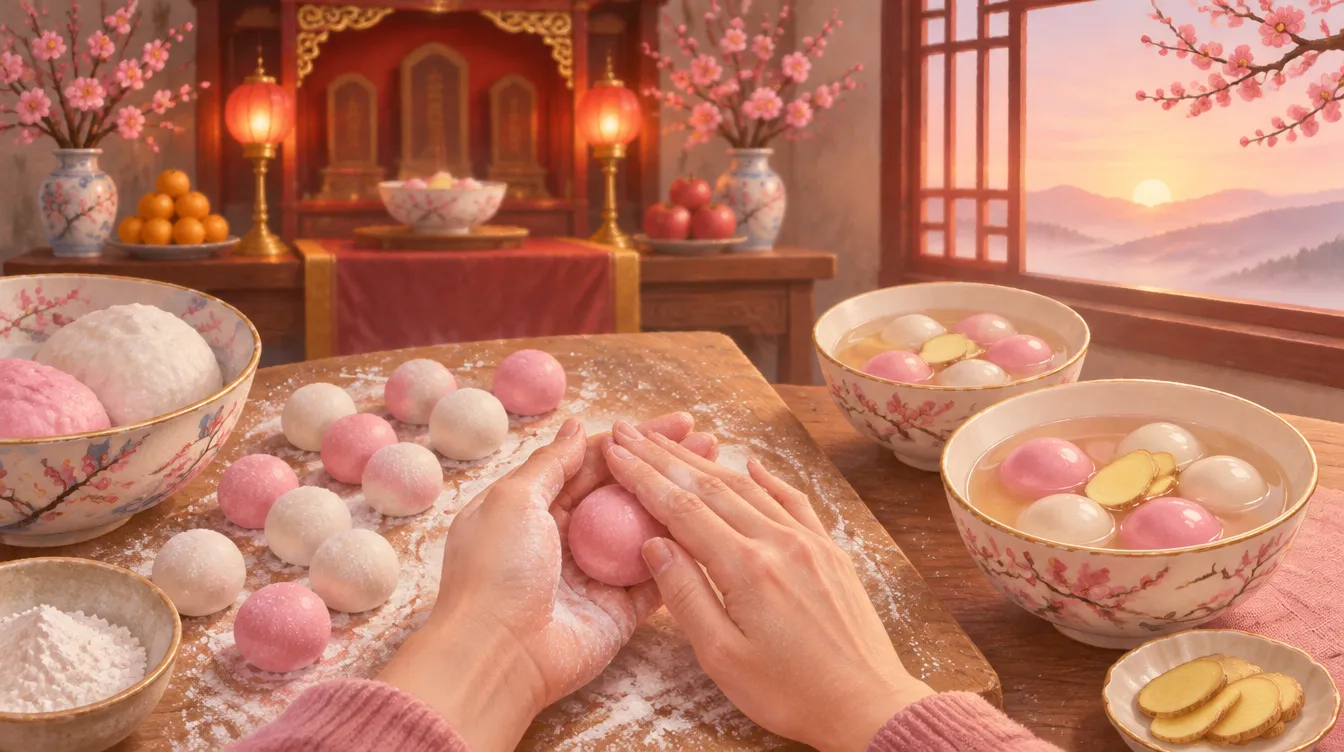
Most local Chinese families trace their roots to Fujian and Guangdong, where the solstice food is tangyuan rather than the dumplings eaten in northern China. The traditional local colours are pink and white. Some balls are small and plain; others are filled with black sesame, peanut or red bean paste. They are served in a sweet syrup, either plain or flavoured with ginger. Their roundness stands for 团圆, the family gathered together.
In many homes the eldest family member serves the first bowls on the ancestral altar as thanks for the year, and the family eats afterwards. In Penang some families take tangyuan to the columbarium to remember relatives. Busy households often buy frozen or ready-made tangyuan, while others keep the habit of rolling them together. An old folk custom, now rare, was to stick a few balls on doors or windows for good fortune.
A simple tangyuan evening at home
- Mix glutinous rice flour with warm water until it feels like soft play dough. Tint half with a drop of pink colouring.
- Let everyone roll their own balls. Small ones need no filling; larger ones can hold a spoon of sesame or peanut paste.
- Boil until they float, then a minute more, and serve in a light sugar syrup, with a few slices of ginger if you like.
- If you keep an altar, set the first bowls there before the family eats. If not, a phone call to a relative abroad carries the same meaning.
What does the 子 month mean in BaZi?
BaZi months begin at the 节 solar terms, so the solstice itself does not change your month pillar. The 子 month of 2027 starts at 大雪, Major Snow, at 16:37 on 7 December 2027, and runs until 小寒, Minor Cold, at 03:54 on 6 January 2028, Beijing time. Its pillar is 壬子: Yang Water over the Rat, the most watery month of the year, with the solstice falling right in its middle. Anyone born in that window has 子 as their month branch.
Nor does the solstice change the year. A minority view holds that the BaZi year should turn at 冬至, echoing the old Zhou calendar, but most schools, and our chart engine, change the year at 立春, the start of spring. The 2028 year therefore begins at 15:31 on 4 February 2028, not on 22 December. The same idea of yang being reborn sits behind the 子 hour, which is why some schools start the new day at 23:00.
Questions
What date is Dong Zhi 2027?
Wednesday 22 December 2027. The solar term begins at 10:42 Beijing time, which is also 10:42 in Singapore and Malaysia.
When is Dong Zhi this year, 2026?
Tuesday 22 December 2026, at 04:50 Beijing, Singapore and Malaysia time.
Why do people eat tangyuan at the winter solstice?
Their round shape stands for reunion (团圆), and southern Chinese families, including most in Singapore and Malaysia, have long eaten them as the solstice dish.
Does the winter solstice start a new BaZi year?
Not in most schools. The year changes at 立春 around 4 February. The solstice falls in the middle of the 子 month and does not change your month pillar either.
Is Dong Zhi a public holiday in Singapore or Malaysia?
No. It is observed at home in the evening, usually with a family meal and tangyuan.
For reflection and entertainment.