Guide · 24 solar terms
The 24 solar terms (二十四节气): the sun’s calendar behind BaZi
Updated 22 November 2026
In short
The 24 solar terms mark the sun’s journey through the year in steps of 15°. Each term is a single moment, not a whole day, and because the terms follow the sun they land on almost the same Gregorian dates every year. Twelve of them, the 节, open the twelve BaZi months; the other twelve, the 中气, sit in the middle of each month and anchor the lunar calendar. Below is every term for 2027 to the minute, with what each name means and how it shapes a chart.
What are the 24 solar terms?
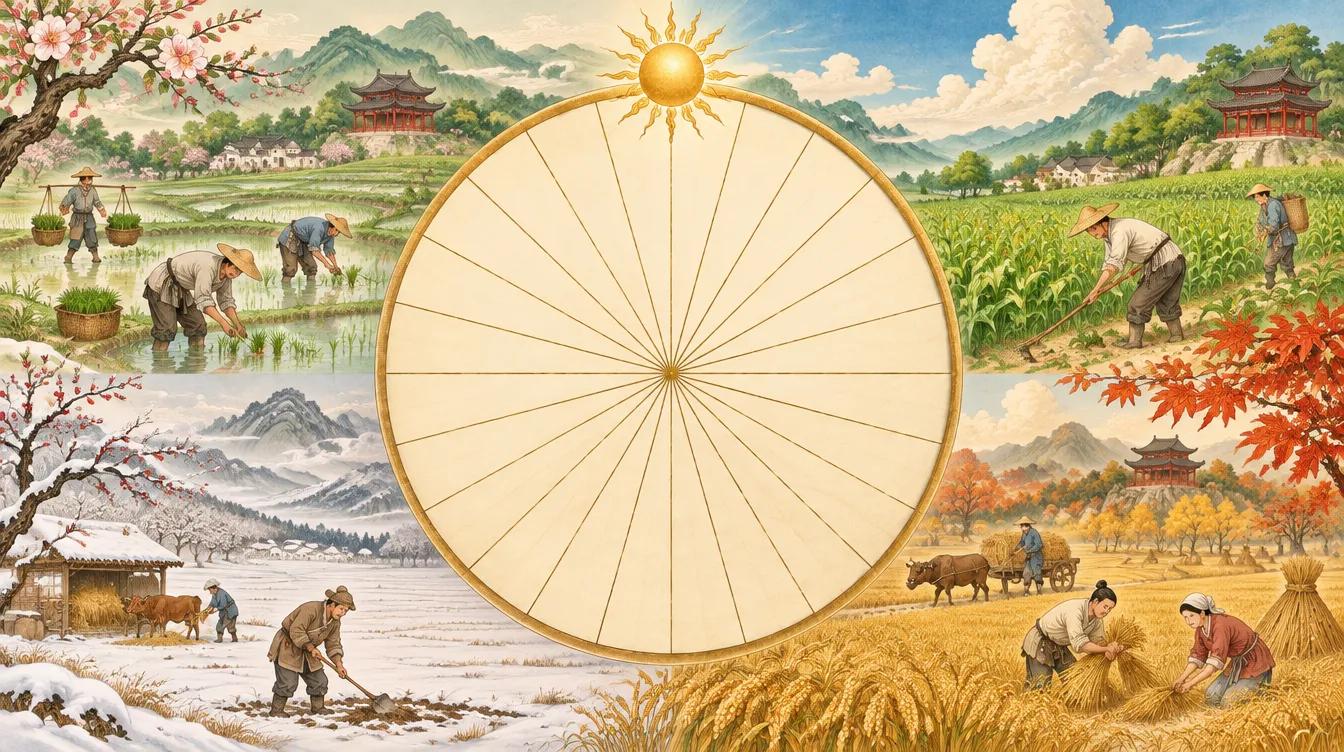
Picture the sun’s apparent path across the sky over a year as a circle of 360°. Astronomers start the count at the spring equinox, 春分, where the sun sits at 0°. Every further 15° brings a new solar term, so the circle holds 24 of them, roughly 15 days apart. The winter solstice, 冬至, is at 270°, and 立春, the start of spring, is at 315°.
A term begins at the instant the sun crosses its line, so it has an exact time as well as a date. That is why almanacs print 立夏 2027 as 01:25 on 6 May rather than simply “6 May”. The Gregorian calendar also follows the sun, so the terms barely drift against it: 清明 has fallen on 4 or 5 April in every year from 1950 to 2050, and 冬至 on 21, 22 or 23 December.
Each term was later split into three pentads (候) of about five days, giving 72 small seasons with names such as “the east wind melts the ice”. Almanacs still print some of them, though few people follow them today.
All 24 solar terms in 2027, with exact times
These times were worked out with the astronomical calendar library our chart engine uses, in Beijing time (UTC+8), which is also the clock time in Singapore and Malaysia. Minutes are rounded down, as most almanacs do. The “kind” column shows whether a term is a 节, which opens a BaZi month, or a 中气.
| Term | Meaning | Sun at | 2027 (Beijing time) | Kind |
|---|---|---|---|---|
| 小寒 xiǎohán | Minor Cold | 285° | 5 Jan 22:09 | 节: opens the 丑 month |
| 大寒 dàhán | Major Cold | 300° | 20 Jan 15:29 | 中气 |
| 立春 lìchūn | Start of Spring | 315° | 4 Feb 09:46 | 节: opens the 寅 month and the year |
| 雨水 yǔshuǐ | Rain Water | 330° | 19 Feb 05:33 | 中气 |
| 惊蛰 jīngzhé | Awakening of Insects | 345° | 6 Mar 03:39 | 节: opens the 卯 month |
| 春分 chūnfēn | Spring Equinox | 0° | 21 Mar 04:24 | 中气 |
| 清明 qīngmíng | Clear and Bright | 15° | 5 Apr 08:17 | 节: opens the 辰 month |
| 谷雨 gǔyǔ | Grain Rain | 30° | 20 Apr 15:17 | 中气 |
| 立夏 lìxià | Start of Summer | 45° | 6 May 01:25 | 节: opens the 巳 month |
| 小满 xiǎomǎn | Grain Buds | 60° | 21 May 14:18 | 中气 |
| 芒种 mángzhòng | Grain in Ear | 75° | 6 Jun 05:25 | 节: opens the 午 month |
| 夏至 xiàzhì | Summer Solstice | 90° | 21 Jun 22:10 | 中气 |
| 小暑 xiǎoshǔ | Minor Heat | 105° | 7 Jul 15:37 | 节: opens the 未 month |
| 大暑 dàshǔ | Major Heat | 120° | 23 Jul 09:04 | 中气 |
| 立秋 lìqiū | Start of Autumn | 135° | 8 Aug 01:26 | 节: opens the 申 month |
| 处暑 chǔshǔ | End of Heat | 150° | 23 Aug 16:14 | 中气 |
| 白露 báilù | White Dew | 165° | 8 Sep 04:28 | 节: opens the 酉 month |
| 秋分 qiūfēn | Autumn Equinox | 180° | 23 Sep 14:01 | 中气 |
| 寒露 hánlù | Cold Dew | 195° | 8 Oct 20:17 | 节: opens the 戌 month |
| 霜降 shuāngjiàng | Frost Descends | 210° | 23 Oct 23:32 | 中气 |
| 立冬 lìdōng | Start of Winter | 225° | 7 Nov 23:38 | 节: opens the 亥 month |
| 小雪 xiǎoxuě | Minor Snow | 240° | 22 Nov 21:16 | 中气 |
| 大雪 dàxuě | Major Snow | 255° | 7 Dec 16:37 | 节: opens the 子 month |
| 冬至 dōngzhì | Winter Solstice | 270° | 22 Dec 10:42 | 中气 |
Which solar month were you born in?
The free BaZi chart compares your birth moment with the 节 to the minute and shows the month pillar it gives you.
See my free chartWhat is the difference between a 节 and a 中气?
The terms alternate. Odd-numbered ones counting from 立春 are 节 (jié, “joints” or “nodes”) and mark where one month hands over to the next. Even-numbered ones are 中气 (zhōngqì, “middle breaths”) and fall near the centre of each month. Both kinds are 15° of the sun apart, so a 节 is followed by its 中气 about 15 days later.
They do different jobs in different calendars. BaZi’s solar months run from 节 to 节, and the 中气 play no part in setting the month pillar. The lunar calendar works the other way round: its months follow the moon, and the 中气 decide how those months are numbered. The 冬至 solstice must fall in the 11th lunar month, and a lunar month that contains no 中气 at all becomes a leap month. Our guide to the lunar calendar and leap months walks through that rule with recent examples.
How the 节 set your BaZi month
Your month pillar is fixed by which pair of 节 your birth falls between, compared to the minute. In 2027, 清明 arrives at 08:17 on 5 April. A baby born at 07:30 that morning still has a 癸卯 Rabbit month; one born at 09:00 has a 甲辰 Dragon month. The day pillar is the same for both, but the month, which BaZi reads for career, parents and the season of your birth, has changed.
A 中气 never moves the month pillar. Someone born just after 春分 on 21 March 2027 is still in the 卯 month that began at 惊蛰. Some schools do look at how many days have passed since the last 节 to judge which hidden stem in the month branch is strongest, so the distance from the 节 can matter in a detailed reading.
January is the month people most often get wrong. 小寒 on 5 January 2027 at 22:09 opens the 辛丑 month, the last month of the 丙午 Horse year, which runs until 立春 on 4 February. Our Li Chun 2027 guide lists the month pillar that each 节 opens through the year.
What the names mean, and why they still work near the equator
The names describe the weather and farm work of the Yellow River plain in northern China, where the system grew up. They fall into a few families:
- The four starts of the seasons: 立春, 立夏, 立秋 and 立冬. In BaZi these open the Tiger, Snake, Monkey and Pig months.
- The two solstices and two equinoxes: 夏至, 冬至, 春分 and 秋分. All four are 中气.
- Heat and cold: 小暑, 大暑 and 处暑 in summer; 小寒 and 大寒 in winter.
- Moisture: 雨水, 谷雨, 白露, 寒露, 霜降, 小雪 and 大雪 trace rain, dew, frost and snow.
- Nature and farming: 惊蛰 (insects wake), 清明 (clear skies), 小满 (grain filling out) and 芒种 (bearded grain ripens and new crops go in).
In Singapore or Kuala Lumpur there is no snow at 大雪 and no frost at 霜降, so the names can feel like a foreign weather report. What the terms really measure is the sun’s position, which is the same for everyone on Earth at that instant. That is why BaZi uses them unchanged in the tropics. A small number of practitioners swap the seasons for births in the southern hemisphere; most schools, and our engine, use the same terms everywhere.
Festivals on solar terms, and the UNESCO listing
Most Chinese festivals follow the lunar calendar, but two of the big ones follow the sun. 清明 is both a solar term and the day for tidying and visiting family graves; in 2027 the term begins on 5 April, and many families in Singapore and Malaysia visit in the days before and after. 冬至, the winter solstice, is the evening for 汤圆 (glutinous rice balls) and a family meal; in 2027 it falls on 22 December. 立春 has customs of its own, covered in our Li Chun guide.
China placed the solar terms on its national list of intangible cultural heritage in 2006. In November 2016, at its 11th session in Addis Ababa, UNESCO’s intergovernmental committee inscribed them on the Representative List of the Intangible Cultural Heritage of Humanity, as knowledge of time developed in China through watching the sun’s yearly motion.
Questions
How many solar terms are there in a month?
Two: one 节 that opens the month and one 中气 about 15 days later.
Are the solar terms part of the lunar calendar?
They follow the sun, not the moon, so they stay on nearly fixed Gregorian dates. The lunar calendar uses the 中气 to number its months and place leap months.
When is the winter solstice in 2027?
Wednesday 22 December 2027 at 10:42 Beijing time, which is the same clock time in Singapore and Malaysia.
Do the solar terms change my zodiac sign?
Only 立春 does. In BaZi the year and your sign change at 立春; the other 节 change the month pillar, and the 中气 change nothing in the chart.
Why are the times given in Beijing time?
It is the reference time for Chinese almanacs, and it matches Singapore and Malaysia clocks. A solar term is one instant worldwide, so in London 立春 2027 is at 01:46.
For reflection and entertainment.