Guide · Qingming 2027
Qingming Festival 2027 (清明): the date, and how families honour their ancestors
Updated 22 November 2026
In short
Qingming Festival 2027 is on Monday 5 April. The 清明 solar term, “clear and bright”, begins at 08:17 that morning (Singapore and Malaysia share Beijing’s clock time), and the day before, Sunday 4 April, is 寒食, the old cold-food day. Families visit graves and columbaria to clean, make offerings and remember their ancestors, usually across the weeks around the date rather than on the day itself. Qingming is not a public holiday in Singapore or Malaysia, so weekends and Good Friday (26 March in 2027) are when crowds peak.
When is Qingming 2027?
Unlike most Chinese festivals, Qingming does not follow the moon. It is one of the 24 solar terms, which track the sun’s position, so it always falls on 4 or 5 April. In 2027 the term begins at 08:17 Beijing time on Monday 5 April, which on the lunar calendar is the 29th day of the second month. The 清明 period then lasts fifteen days, until the next term, 谷雨 (Grain Rain), on 20 April. We worked out the times below with the same calendar library that powers our charts.
| Day | 2027 date | Note |
|---|---|---|
| 春分 Spring equinox | Sun 21 Mar, 04:24 | Some families start visits from here |
| Good Friday | Fri 26 Mar | Public holiday in Singapore; expect crowds |
| 寒食 Cold-food day | Sun 4 Apr | The day before Qingming |
| 清明 Qingming | Mon 5 Apr, 08:17 | Lunar 2nd month, 29th day |
| 谷雨 Grain Rain | Tue 20 Apr, 15:17 | The 清明 period ends |
What does Qingming mean?
清明 means “clear and bright”, a name for the fresh, rain-washed weather of mid-spring in the Yellow River plains where the calendar grew up. The 24 solar terms were added to UNESCO’s list of the Intangible Cultural Heritage of Humanity in 2016, and Qingming is the only one that is also a major festival. Its two sides fit together: a spring outing in the fresh air (踏青, “treading the green”) and a visit to the family graves.
At heart it is a festival of filial respect (孝). Visiting the grave shows that the family has not forgotten, and the shared work of cleaning, setting out food and bowing together is often the one day a year that scattered cousins meet. In northern China people also fly kites and wear or hang willow sprigs; in Singapore and Malaysia the grave visit is the centre of the day.
Check a day before you go
The free daily page shows the almanac’s suitable and avoid activities for any day, and how the day meets each of the twelve signs.
See today’s almanacWhere does 寒食, the cold-food day, come from?
寒食 (hánshí, “cold food”) was once a festival of its own, when households put out their fires and ate food cooked in advance. The best-known story links it to Jie Zitui (介子推), a loyal follower of Duke Wen of Jin (晋文公) in the seventh century BCE. Jie refused any reward after the duke came to power and retreated into the mountains with his mother; the duke set fire to the forest to drive him out, and Jie died rather than come down. In remorse, the duke ordered that no fires be lit on that day.
Historians note that the early records do not tell the story in this full form, and that fire-ban customs may be older still. What is clear is the later history. By the Tang dynasty, visiting graves at 寒食 had become an official rite, and because the two days sat side by side, the customs slowly merged into Qingming. Modern almanacs list 寒食 as the day before Qingming, which in 2027 is Sunday 4 April.
How families in Singapore and Malaysia observe Qingming
In Singapore most families now visit a columbarium niche rather than a grave, because land is scarce and most of the old cemeteries were cleared over the decades. The government-managed sites are Choa Chu Kang Cemetery and the Choa Chu Kang, Mandai and Yishun columbaria, alongside many temple and private columbaria. In Malaysia, family graves on hillside cemeteries are still common, and at Kwong Tong Cemetery in Kuala Lumpur, one of the oldest, families were seen arriving three weeks early in 2025 to beat the crowds. Its manager told reporters that there is no taboo in going earlier or later.
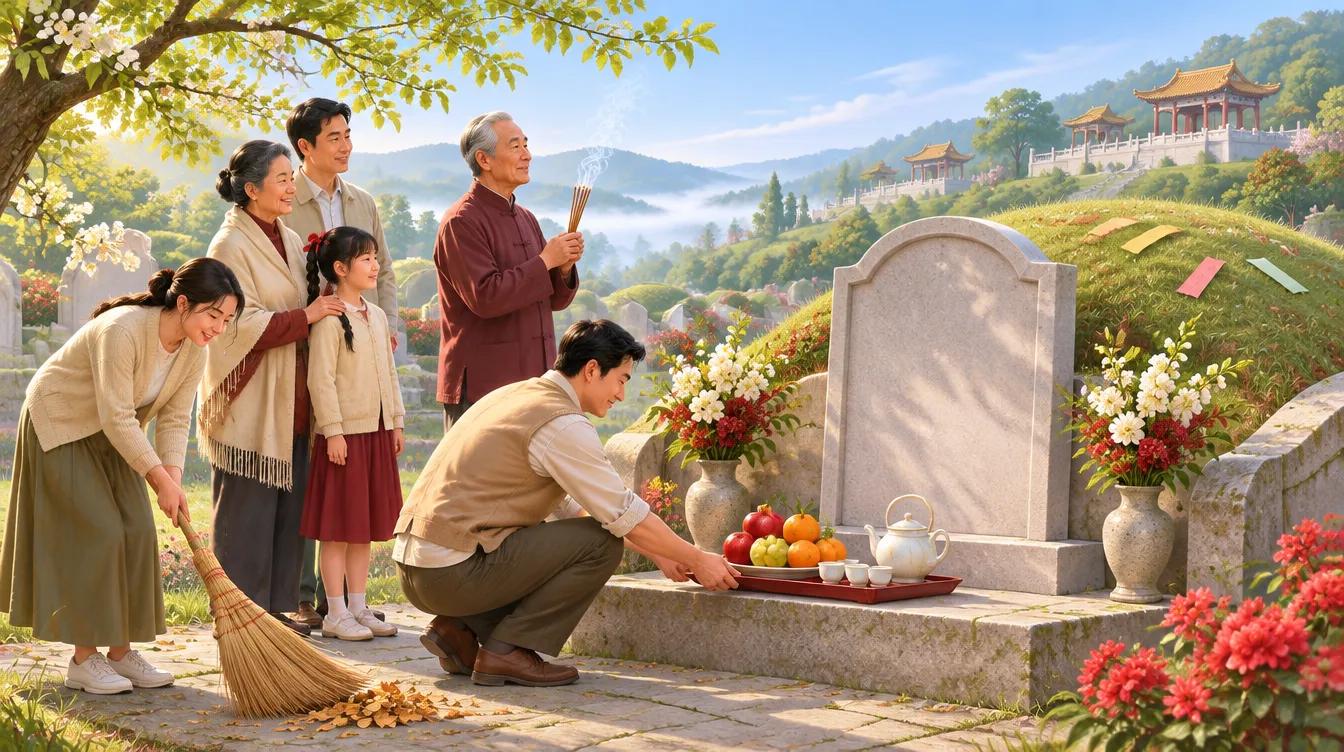
A visit usually follows the same shape, whatever the dialect group. Families tidy the site, clear weeds from a grave and sometimes repaint the inscription. They set out offerings, commonly fruit, cooked dishes, kueh, tea or wine, light incense and candles, and bow in order of seniority. Many then burn joss paper in the burners provided. Hokkien and Teochew families often leave strips of coloured paper (压纸) weighed down on the grave, a sign to others that the descendants have been. Afterwards the food is usually taken home and shared, so the visit ends as a family meal. Clan associations also hold spring rites of their own; Singapore’s Hokkien Huay Kuan, for example, holds prayers at Mandai and Choa Chu Kang, where older Hokkien burial grounds were relocated.
Planning a visit in 2027
Each year Singapore’s National Environment Agency (NEA) publishes an advisory for the government-managed sites. In 2026 it named a peak period of about four weeks around Qingming, from 21 March to 19 April, with eleven peak days: the weekends and Good Friday. Look for the 2027 advisory on nea.gov.sg, usually issued in March. The pattern so far suggests these steps:
- Go on a weekday if you can. In 2026 NEA encouraged visits outside the peak days, and the columbaria opened 24 hours during the period.
- Driving? In 2026 cars needed an e-appointment, booked with Singpass, to park at Choa Chu Kang and Mandai columbaria at set times. Check whether 2027 repeats this.
- Free shuttle buses ran on peak days from Yew Tee MRT to Choa Chu Kang and from Khatib MRT to Mandai in 2026.
- Burn joss paper only in the burners and pits provided, in small amounts, and never leave candles or incense unattended.
- Take food offerings home or clear them before you leave; unattended offerings are removed.
- Go early in the day. Many families prefer the morning, and it is cooler and calmer for older relatives.
Which 2027 weekend days suit a visit, by the almanac?
Some families like to choose a visiting day that the almanac marks 宜祭祀, suitable for offerings to ancestors. The table lists the weekends and Good Friday around Qingming 2027 and what the almanac in our calendar library says about each, plus the sign each day clashes with, which some families also check. Almanacs from different publishers can differ slightly. One detail surprises people: Qingming itself, 5 April 2027, lists 祭祀 among the day’s 忌 (things to avoid). Families visit on Qingming anyway, because the festival is the reason for the visit, so treat this as extra information rather than a rule.
| Date | Lunar date | Almanac on 祭祀 | Day clashes with |
|---|---|---|---|
| Fri 26 Mar (Good Friday) | 2nd month, 19th | Suitable (宜) | Dog |
| Sat 27 Mar | 2nd month, 20th | Not listed | Pig |
| Sun 28 Mar | 2nd month, 21st | Not listed | Rat |
| Sat 3 Apr | 2nd month, 27th | Not listed | Horse |
| Sun 4 Apr (寒食) | 2nd month, 28th | Not listed | Goat |
| Mon 5 Apr (清明) | 2nd month, 29th | Listed under avoid (忌) | Monkey |
| Sat 10 Apr | 3rd month, 4th | Suitable (宜) | Ox |
| Sun 11 Apr | 3rd month, 5th | Suitable (宜) | Tiger |
| Sat 17 Apr | 3rd month, 11th | Listed under avoid (忌) | Monkey |
| Sun 18 Apr | 3rd month, 12th | Suitable (宜) | Rooster |
Questions
What date is Qingming in 2027?
Monday 5 April 2027. The solar term begins at 08:17 Beijing time, which is the same clock time in Singapore and Malaysia.
Is Qingming a public holiday in Singapore or Malaysia?
No. That is why weekends and other public holidays around it, such as Good Friday in Singapore, are the busiest days at cemeteries and columbaria.
Can I visit before or after Qingming?
Yes. Many families visit in the weeks before or after, and cemetery managers and temples generally say there is no taboo in going early or late.
What is 寒食 and when is it in 2027?
An old cold-food day when fires were not lit, linked by legend to the loyal Jie Zitui. It is the day before Qingming: Sunday 4 April 2027.
What offerings do families bring?
Commonly fruit, cooked dishes or kueh, tea or wine, incense, candles and joss paper. Many bring a favourite food of the person being remembered. Customs vary by family.
For reflection and entertainment.