Guide · Dragon Boat 2027
Dragon Boat Festival 2027 (端午): the date, zongzi and old customs
Updated 22 November 2026
In short
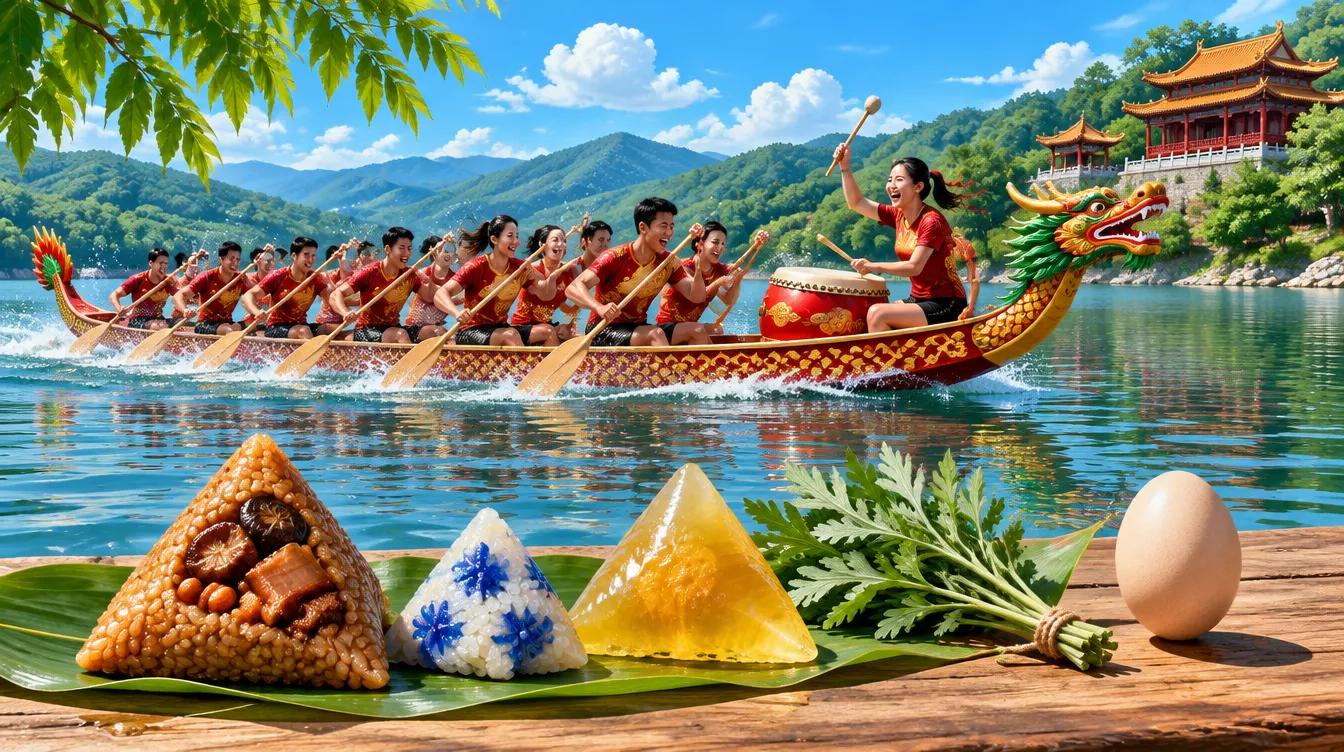
The Dragon Boat Festival (端午节) in 2027 is on Wednesday 9 June, the fifth day of the fifth lunar month. It remembers the poet Qu Yuan, who drowned himself in the Miluo River, and the people who raced out in boats to find him. Families eat zongzi, called bak chang (肉粽) in Hokkien, and in Singapore and Malaysia there are three well-loved styles: brown, savoury Hokkien; fragrant, slightly sweet Nyonya; and Cantonese with mung beans and salted egg yolk. The festival is not a public holiday in either country, so races and family gatherings often move to the nearest weekend.
When is the Dragon Boat Festival in 2027?
The festival falls on the fifth day of the fifth lunar month, so its Gregorian date moves each year, landing between late May and late June. In 2027 that is Wednesday 9 June; in 2026 it was Friday 19 June. We converted the date with the same calendar library that calculates our charts. The name 端午 hints at the date: 端 means “beginning”, and 午 is traditionally explained as standing in for 五, “five”, so the name means roughly “the first fifth”, which is why the day is also called 端五 or 重五, “double fifth”.
The fifth month was traditionally seen as the hottest, most humid part of the year in central China, when insects multiplied and illness spread. Many of the festival’s oldest customs, such as hanging herbs and wearing fragrant sachets, grew from this practical concern for summer health long before they were tied to Qu Yuan.
Who was Qu Yuan, and why do people race dragon boats?
Qu Yuan (屈原) was a poet and minister of the state of Chu during the Warring States period, in the third century BCE. He warned his king against trusting the rival state of Qin, was slandered by courtiers and sent into exile, where he wrote some of the most celebrated poems in Chinese, including 离骚 (Li Sao, “Encountering Sorrow”). When Qin’s armies took the Chu capital, he walked into the Miluo River (汨罗江), traditionally on the fifth day of the fifth month.
The story says local people rowed out to search for him, beating drums and splashing to keep fish and river creatures away, and threw rice into the water so the fish would eat that instead of his body. The boat search became dragon boat racing, and the rice became zongzi. Other regions honour different figures on the same day, such as Wu Zixu (伍子胥) around Suzhou. In 2009 the Dragon Boat Festival was inscribed on UNESCO’s list of the Intangible Cultural Heritage of Humanity.
What is 9 June good for?
See the almanac’s suitable and avoid activities for the festival, or any day, and how it meets each of the twelve signs.
See the daily almanacHokkien, Nyonya or Cantonese: which zongzi is which?
Zongzi are glutinous rice parcels wrapped in leaves, tied with string and boiled or steamed for hours. Every dialect group brought its own recipe south, and Singapore and Malaysia added a Peranakan one. Here is how to tell the common styles apart at a hawker stall or a relative’s kitchen:
| Style | What is inside | How to recognise it |
|---|---|---|
| Hokkien bak chang (福建肉粽) | Braised pork belly, dried mushroom, chestnut, dried shrimp, five-spice | Brown rice throughout, from frying with shallots and dark soy before wrapping |
| Nyonya chang (娘惹粽) | Minced pork with candied winter melon, ground coriander, pepper, garlic and shallots | Smaller; often blue patches from butterfly pea flower; pandan leaves for fragrance |
| Cantonese (广东咸肉粽) | Pork, mung beans, salted egg yolk, sometimes Chinese sausage | Pale rice, often larger, in rectangular or pillow shapes |
| Kee chang (碱水粽) | Plain rice treated with alkaline water; sometimes red bean paste | Yellow and translucent; eaten cold, dipped in sugar or kaya |
Hakka families have another festival food: 艾粄 (ai ban), a kueh of glutinous rice and mugwort, the same herb that is hung on doors. And an old saying, still quoted in southern Chinese families, captures the old link between the festival and the seasons: 未食五月粽,寒衣不敢送, “until you have eaten the fifth-month zongzi, don’t pack away your winter clothes”. In the tropics the saying is pure nostalgia, but it shows that the festival once marked the true arrival of summer.
Old customs: mugwort, sachets and an egg at noon
- Mugwort and calamus on the door. Bundles of mugwort (艾草) and calamus (菖蒲), whose leaves look like swords, were hung by the door to keep away insects and bad influences. In Singapore this is now rarely seen, though some older households keep it up.
- Fragrant sachets (香囊). Small embroidered pouches filled with dried herbs, worn by children or hung in the home. They are a pleasant craft activity for families today.
- Five-colour threads (五彩绳). Some families tie threads of five colours, for the five elements, around children’s wrists on the festival morning.
- Balancing an egg at noon (立蛋). Folk belief holds that the sun’s energy peaks at noon on 端午, so an egg will stand on its end. With patience an egg can be balanced on other days too, which makes it a fun family challenge rather than a test.
- Realgar wine (雄黄酒). Traditionally drunk, or painted as the character 王 on children’s foreheads. Realgar is an arsenic mineral, and studies have found that both drinking the wine and painting it on skin raise arsenic levels in the body, so most families now leave this custom in the history books.
Where are the dragon boat races in Singapore and Malaysia?
According to the Singapore Chinese Cultural Centre, Singapore’s annual dragon boat races date from 1978. Bedok Reservoir is the main venue, and races have also been held at Marina Bay, the Singapore River and East Coast Park. Crews come in two sizes: twelve people (ten paddlers, a steerer and a coach) or twenty-two (twenty paddlers, a steerer and a drummer). The races are usually on a weekend near the festival, so check the year’s programme before you go.
Penang has one of the region’s longest traditions. Its first race was held in 1956 to mark George Town’s centenary, and the Penang International Dragon Boat Festival began in 1979, first off Gurney Drive, then at Teluk Bahang Dam from the early 2000s. In 2024 the international regatta moved to the sea off Straits Quay and is now held in November, when overseas teams can attend. A mid-year race for 端午 was revived in 2025 by the Penang Chinese Swimming Club, so Penang now has races in both seasons.
Before a race, many teams hold an eye-dotting ceremony (点睛), painting the pupils of the dragon’s eyes to “wake” the boat. It is a short, colourful moment worth arriving early for.
Where 端午 2027 sits in the Chinese calendar
In the solar-term calendar that BaZi uses, the Horse month (午月) begins at 芒种, Grain in Ear, which in 2027 falls at 05:25 Beijing time on 6 June. So the festival sits in the 丙午 month, at the height of the year’s Fire, on a 己未 day in the 丁未 year. Horse (午) and Goat (未) form a harmony (六合), one of the friendliest pairings among the twelve branches. It is a nice fit for a day about community and teamwork, though, as always, what a day means for you depends on your own chart.
Questions
When is the Dragon Boat Festival in 2027?
Wednesday 9 June 2027, the fifth day of the fifth lunar month.
Is the Dragon Boat Festival a public holiday in Singapore or Malaysia?
No. Races and family gatherings are usually held on a nearby weekend.
What is the difference between bak chang and kee chang?
Bak chang is savoury, filled with pork and other ingredients. Kee chang is plain glutinous rice treated with alkaline water, yellow and springy, and eaten cold with sugar or kaya.
Why is Nyonya chang blue?
Part of the rice is coloured with butterfly pea flowers, a Peranakan touch. The filling of pork and candied winter melon gives it its sweet-savoury taste.
Can you only balance an egg at noon on 端午?
No. With a steady hand an egg can stand on other days too. Trying it at noon on the festival is a tradition and a bit of fun.
For reflection and entertainment.