Guide · Nine Emperor Gods 2027
Nine Emperor Gods Festival 2027 (九皇爷): dates and customs in Malaysia and Singapore
Updated 22 November 2026
In short
The Nine Emperor Gods Festival (九皇爷诞), Kew Ong Yah in Hokkien, fills the first nine days of the 9th lunar month. In 2027 that is Thursday 30 September to Friday 8 October, and many temples receive the gods on the evening of Wednesday 29 September. Devotees keep a strict vegetarian diet, dress in white or yellow, and follow processions to the sea or a river to welcome the gods and send them off. Visitors are welcome at most temples if they dress plainly, bring no meat, and give the rituals room.
When is the Nine Emperor Gods Festival in 2027?
The festival follows the lunar calendar, so we converted each day with the lunar-typescript calendar library. In 2027 the 8th lunar month has 29 days, which makes Wednesday 29 September its last day: the evening when many temples go to the water to receive the gods. Each temple sets its own receiving time, so check its notices.
| Date (2027) | Lunar date | What usually happens |
|---|---|---|
| Wed 29 September | 29th of the 8th month | Receiving the gods at the sea or river, often at night |
| Thu 30 September | 1st of the 9th month | Festival opens; the nine lamps burn on their poles |
| Fri 1 to Thu 7 October | 2nd to 8th | Daily prayers, visits between temples at some, vegetarian food stalls nearby |
| Fri 8 October | 9th of the 9th month | Sending off the gods; also Double Ninth (重阳) |
| Sat 9 October | 10th of the 9th month | Many temples close the festival by late morning and lower the lamps |
Nine is the highest single yang number in Chinese thought, and the 9th day of the 9th month doubles it, which is why the Double Ninth falls on the same day as the send-off. A small calendar detail: the solar term 寒露, Cold Dew, begins at 20:17 on 8 October 2027, so in BaZi the month changes from 己酉 to 庚戌 on the very evening the gods depart.
Who are the Nine Emperor Gods?
In Taoist teaching the Nine Emperors are the stars of the Northern Dipper (北斗), seen as the nine sons of Dou Mu (斗母), the Mother of the Dipper. Seven stars are visible and two are said to be hidden, a pattern described as 七现二隐. Sources disagree on the names of the two hidden stars: some call them 左辅 and 右弼, others 洞明 and 隐元. The Dipper has long been linked with longevity and with protection, which is why the festival is about purification and blessing.
Local stories add other layers. Some temples tell of nine brothers who robbed the rich to feed the poor; others connect the gods with Ming loyalists who resisted the Qing. Singapore’s National Heritage Board records these versions side by side, and they are best taken as part of the festival’s living history rather than as one fixed account. The seven visible stars carry names you may recognise from Zi Wei Dou Shu, such as 贪狼, 武曲 and 破军, because that system also grew out of Dipper star lore.
See the Dipper stars in your own chart
Zi Wei Dou Shu places stars such as 贪狼, 武曲 and 破军 in twelve palaces from your birth details. Your chart is free.
Make my Zi Wei chartWhere is the festival held in Singapore and Malaysia?
Singapore has more than a dozen Nine Emperor Gods temples. Hougang Tou Mu Kung (后港斗母宫), founded in 1921 and now at 779A Upper Serangoon Road, is among the oldest. Receiving and sending-off ceremonies in Singapore are held mainly by the sea, at places such as East Coast Park, Changi Beach and Punggol, where devotees once used rivers and canals.
In Malaysia, the two oldest temples are usually named as the Hong Kong Street Dou Mu Gong (香港巷斗母宫) in Penang and Nan Tian Gong (南天宫) in Ampang, and several Singapore temples trace their incense lineage to them. In Ampang, devotees gather on the eve to usher the gods in from the nearby river. Across the channel in Butterworth, the Tow Boo Kong temple on Jalan Raja Uda ends the festival with a large procession to Pantai Bersih beach, where a ceremonial boat is towed out to sea to send the gods home.
What do devotees eat and wear during the nine days?
The vegetarian diet is stricter than everyday vegetarian food. Devotees and helpers avoid meat, eggs and milk, and also garlic and onions, for at least ten days; those carrying palanquins or leading rituals often start a month or more ahead. Temples raise a 斋戒 sign to mark the period, spring-clean in advance, and limit the inner chamber to people keeping the full regime. Vegetarian food fairs spring up near the larger temples.
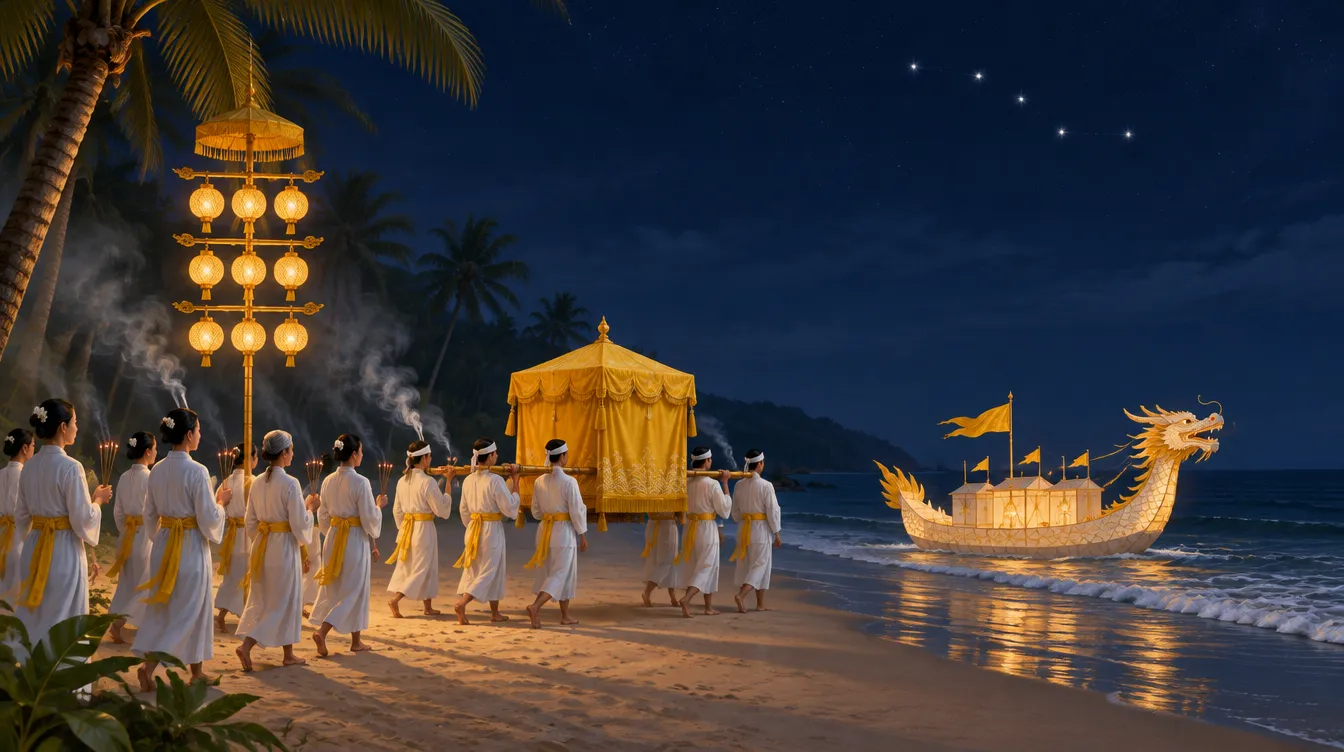
Participants wear white or yellow shirts and trousers, some with a white cloth over the head and yellow strips at the waist and wrists. Both colours mean purity. Yellow (黄) also sounds like 皇, “emperor”, so it replaces the usual temple red on banners, lanterns and palanquins. The festival opens when nine oil lamps, the 九天灯, are raised on a tall pole to tell heaven the festival has begun; they are lowered, cleaned and refilled before dawn and at dusk. Some temples also set up a 平安桥, a Bridge of Blessing, for devotees to cross.
The palanquins carrying the gods are fully covered, and sacred objects are carried out of view. In Singapore, the send-off ends with a paper dragon boat, loaded with salt, oil and rice, being burnt at the water’s edge, and some devotees write their names on it beforehand.
How can visitors attend respectfully?
- Wear plain white or light clothes and covered shoulders. It shows respect and helps you blend in.
- Bring no meat, eggs or snacks containing them into the temple grounds, and eat a vegetarian meal before you go if you can.
- Keep clear of the palanquins and of the path in front of them, and follow the marshals at processions.
- Ask before photographing devotees, mediums or the altar, and never use a flash inside.
- Expect crowds, smoke and loud drums on the eve and on the 9th day. Seashore ceremonies run late, so plan your transport home.
- Arrangements change from year to year and differ between temples. Check each temple’s own notices for 2027 times.
Questions
What are the dates of the Nine Emperor Gods Festival 2027?
Thursday 30 September to Friday 8 October 2027 (the 1st to 9th of the 9th lunar month). Many temples receive the gods on the evening of 29 September.
Do I have to be vegetarian to visit?
Visitors are not usually asked, but you are encouraged to eat vegetarian on the day and you should never bring meat or eggs into the temple.
Why do devotees wear white?
White, like yellow, stands for purity during the festival. Yellow also sounds like the word for emperor (皇).
What does Kew Ong Yah mean?
It is the Hokkien pronunciation of 九皇爷, “the Nine Emperor Lords”. In Cantonese it is Kau Wong Yeh.
When is the festival in 2028?
The 1st of the 9th lunar month falls on 18 October 2028, so the nine days run from 18 to 26 October 2028.
For reflection and entertainment.